




Folk dances, another way to get together?
Le Regard Libre N° 41 - Vincent Schicker
For several years now, it has been possible in Switzerland to dance to the sounds of a variety of groups on different dance floors. The evening is filled with waltzes, gavottes and polkas. But despite the importance of some of these events, the world of folk remains little-known.
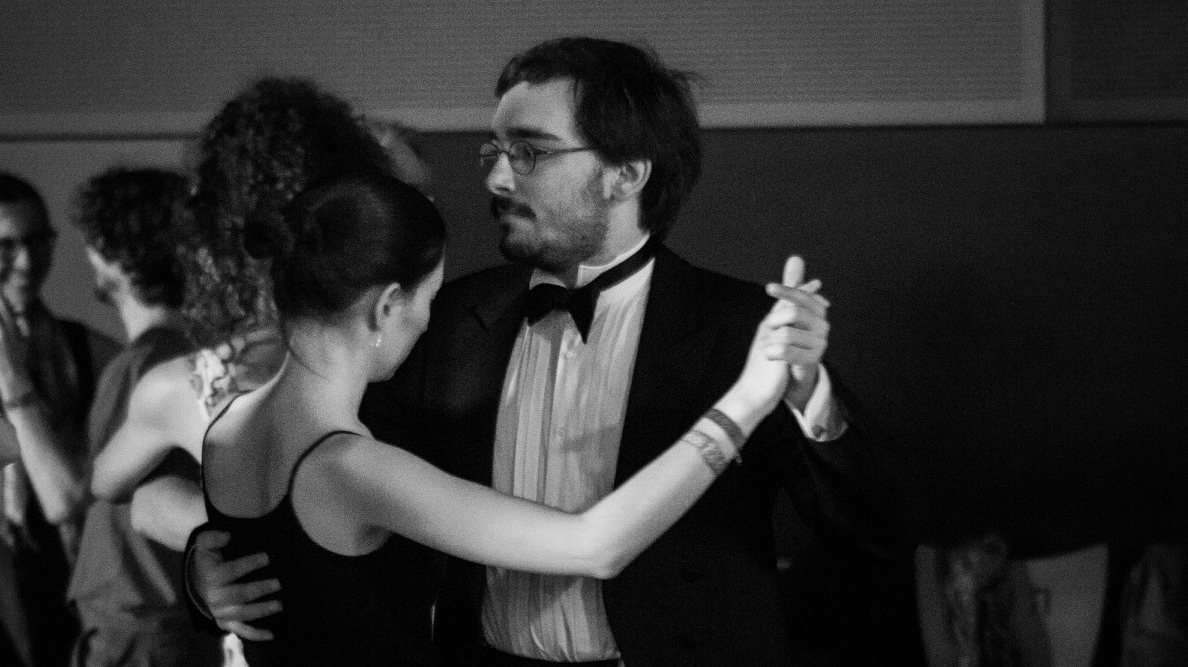
Quite often, the first image that springs to mind when one thinks of a «folk ball» is that of a group of people in traditional costume, dancing various choreographies well studied in advance during numerous rehearsals. The second image has more to do with the imaginary of a ball, evoking the grandeur and splendor of an evening animated by a string orchestra, to the sound of which ladies in long dresses are led by men in tuxedos, twirling to the rhythm of a waltz.
While there is a certain amount of truth in both images, neither conveys reality. It's true that the dances we find are of traditional or folk inspiration - whether Breton, Basque, Piedmontese or Auvergne - but they are not danced in the manner of folk dance groups. Rather, they are danced in a setting close to the one in which they were originally danced: by everyone, during festivities, to get together and share a moment of togetherness. As for the imaginary ball, it can be found to a certain extent depending on the place where it takes place or the different people there: a ball in a large hall with a beautiful parquet floor will more easily give off this impression than a ball in a church hall, or even outdoors.
A varied audience
Of all the people you'll meet at a Folks Ball, no two are alike. Whether in terms of age, social class or place of origin, balls are a veritable melting pot of European cultures. Quite often, you'll find yourself dancing a polka with a student from Basel or a florist from Geneva, who has previously shared a waltz with an engineer from Provence, and so on.
Once again, the cliché of a ball where you have to be dressed to the nines doesn't hold true, as evidenced by the variety of personalities present. While some like to mark the occasion by donning their finest finery, others attach no importance to it at all, and we find ourselves faced with a veritable mosaic of styles: here, a musician in a sarouel; here, a thirty-something in jeans with a simple T-shirt; still further still, a young man dancing barefoot. The watchword is to wear clothes - and especially shoes - that you feel comfortable dancing in. Everyone has their own approach to comfort.
This variety makes folk dances an important place for socializing. Dancing is of course an important part of it, but encounters are just as likely to take place in the refreshment bar or on the sides of the dance floor. Of course, you could say that the same kind of encounters can be had in nightclubs, and in absolute terms, that's true. But the atmosphere is radically different, more jovial, and flirtations - although they do exist - are not present in the slightest interaction.
What about dancing?
The main fear of all beginners: the fear of not knowing how to dance, or of not being able to dance. It's true that a tiny minority of people fail to grasp a rhythm, but this is highly unlikely. Dance music is - as the name suggests - made for dancing, with a strong rhythm and clear musical phrases. What's more, there are plenty of options if you don't know any dances: the overwhelming majority of ball organizers offer a pre-ball initiation for beginners. And if you come later, you'll always find a partner who's happy to teach you the basic steps, even quickly. Many dancers began by learning a few basic dances on the job, before mastering them a little better and eventually moving on to more varied dances, less often danced but just as interesting.
Another fear of new dancers is not finding a partner. It's true that dances are almost always attended by women, but this is by no means a problem. The «folk community» is generally very welcoming and, if you ask with a smile, any dancer will be ready to take you out on the floor.
There's a huge variety of dances, but within this vast repertoire there's a set of dances that can be found at every ball, unless the ball is specifically focused on Swedish or Basque dances, for example. The majority of these common dances are danced as a couple, but there are also various group dances - in line or in a circle - and even couple dances in which the dancers change partners. There's something for everyone: languorous mazurkas, lively polkas, whirling waltzes, bouncy scottisches or the more contemplative gavottes de l'Aven.
Dance is one thing, but music is another
As already mentioned, there's a wide variety of dances, but the music is even more impressively varied. Traditional instruments include the accordion, the fiddle, various relatives of the bagpipe and the hurdy-gurdy, but guitars, trombones, xylophones, drums, banjo and double bass can also be heard on stage. From this variety of instruments emerges a variety of musical possibilities. The same piece performed by a guitar-clarinet duo will not have the same energy as a hurdy-gurdy-cabrette-accordion trio!
These musical possibilities are further enhanced by a highly diverse repertoire. There's a vast number of songs, known to many musicians, that can be performed in traditional or more modern ways, but many groups choose to compose their own music. And, as in all musical genres, each group has its own internal synergy, different instruments and therefore its own unique style.
Folk dances are very different from the clichés they've been given, and vary enormously: from one group to the next, from one venue to the next, from one dancer to the next, the experience will rarely be the same. The friendly atmosphere here means that new dancers can get to grips with the activity without fear, and make new acquaintances with ease. If readers would like to find out more about the various dances taking place in Switzerland, they can do so at danseinfo.ch.
Write to the guest author: [email protected]
Photo credit: © Samuel Lagneau / Facebook: Marshmallow Photo

You'll also like
 French
  German
  English
Leave a comment