



At the Pulloff, «Madame Sosostris» mixes magic and poetry
Unpublished article - Ivan Garcia
Nigerian writer Ben Okri's new play has its world premiere these days at Pulloff Théâtres in Lausanne. Directed by Sophie Kandaouroff and compagnie théâtre K, this dark comedy explores our relationship with others, love and the social masks we hide behind. A poetic romp through the land of broken hearts.
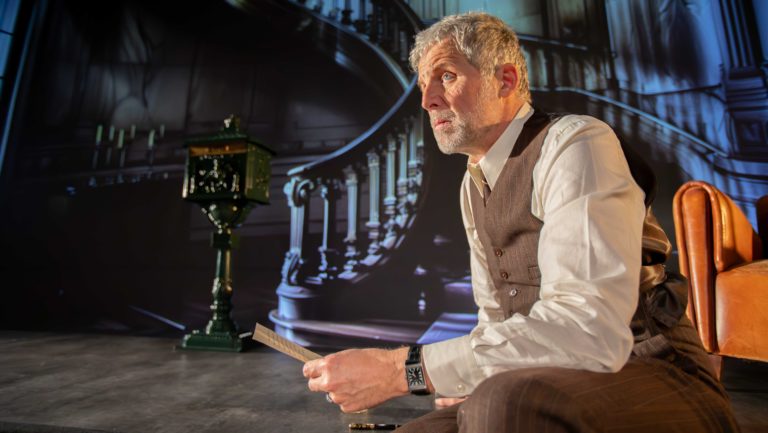
In a dark room, far left, a luminous elevator arrow glows. A intervals, people in their underwear emerge from the strange black box. There are four of them. Each has a pile of clothes, which he slips on in silence. The spectator sees a man dressed as a clown, a woman as a knight another man as a dandy, and a final actress as a princess. We quickly. And here they are. These eternal archetypes that haunt our thoughts and our representations. This prologue is reminiscent of the famous play Six characters in search of an author from Luigi Pirandello. The actor becomes a character. Even more, it's the famous «Once upon a time...». Once dressed, the elevator closes before the first scene begins. At the end of the play, the elevator opens and closes, one last time. The play comes full circle. Curtain on the tale.
Mix of levels
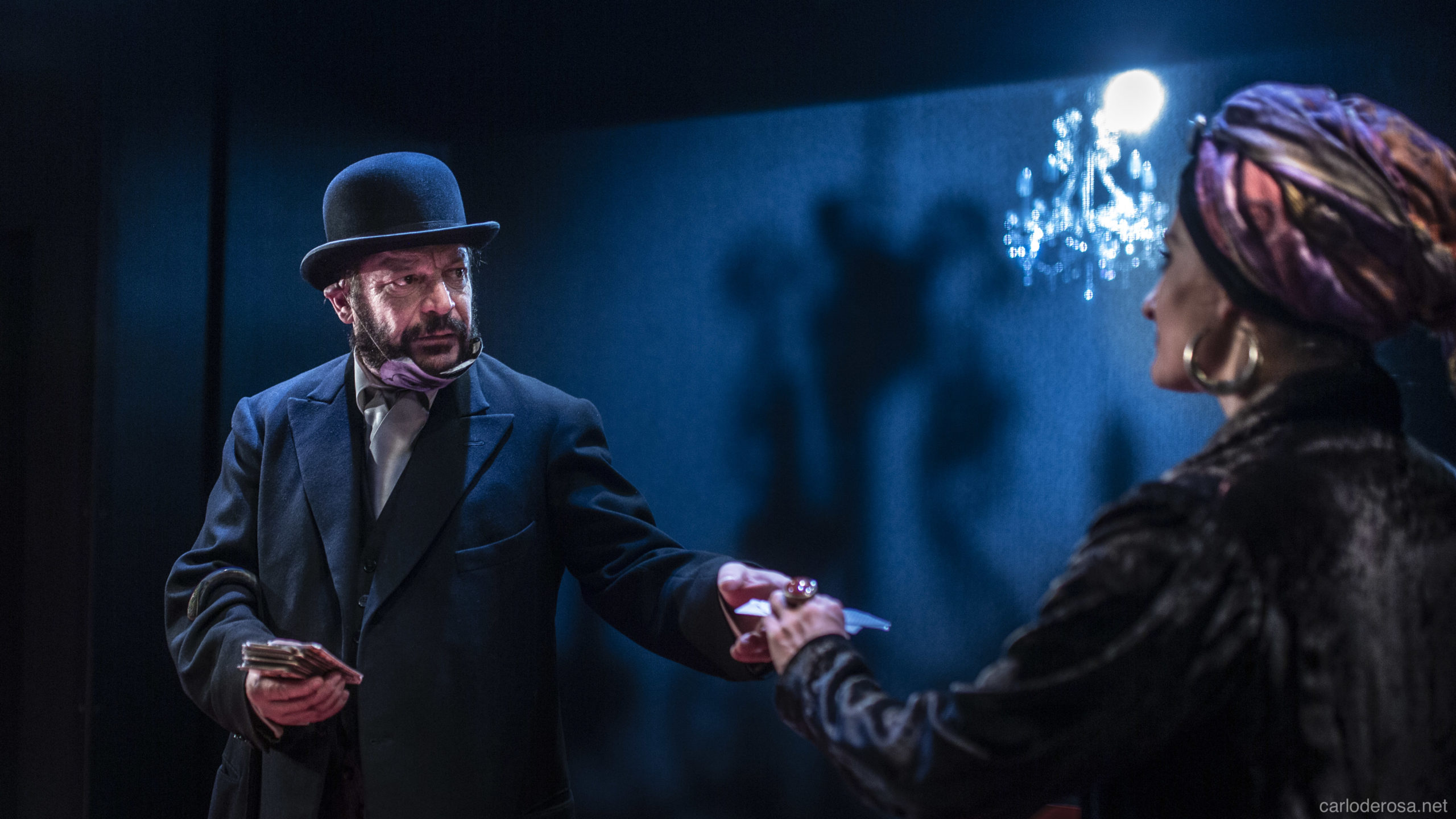
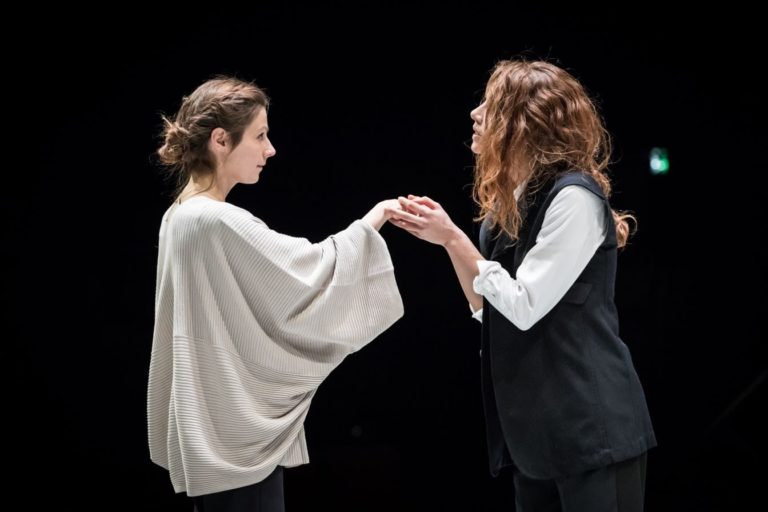
Just a minute. Before talking about the ending, let's talk about the tale. The staged one. Josephine, the daughter dressed as a princess, is chatting with Alan, her husband dressed as a jester. She's organizing a gigantic costume ball, the main attraction of which was supposed to be Madame Sosostris, the wisest woman in Europe and a legendary clairvoyant. But when Madame Sosostris comes down with a cold, she fails to show up. Panicking, she convinces her friend Jeanne, disguised as Joan of Arc, to pose as the seer. It's a role she takes on with great difficulty, and one that leads her to discover the depths of the human heart. Especially when it comes to... failed love affairs.
Read also: Reading The End of Love by Pascal Rambert.
Ben Okri, winner of the Booker Prize at 1991, is an author who likes to mix different levels of reality, both theatrical and spiritual. theatrical and spiritual. animist worldview, which leads the living to encounter spirits. encounter spirits. For example, in his novel The road to hunger, the protagonist Azaro is a child abiku, a spirit-child residing between two worlds. With Mrs Sosostris, we're in the same league. Jeanne, transformed for an evening into a clairvoyant mysteriously endowed with a gift that allows her to converse with ghosts who have been killed by love. She must then counsel them to find peace. peace.
Sophie Kandaouroff's direction accentuates these crossovers between styles and genres, especially between reality and fiction. The contrasts between the characters' statements, notably on the role of the social mask they all wear - Jung would have said the persona -Their own attire is both ironic and symbolic. Take Toulouse-Lautrec, the man disguised as a dandy, who is Jeanne's husband. Despite his rationalism, he fails to recognize his wife, even from two steps away. All four characters are unhappy couples. Each would like to convince himself of something else. To escape reality and build a new character. «Is there anything I could have done to change my past? leitmotiv of the room.
Poetic moments
The irony is clearly highlighted by the staging. There's dancing, laughter, music and pirouettes. Yet the masked ball turns out to be quite dark; the characters are aware that they are in disguise and therefore playing a role. Sometimes to the point of believing that their disguise is their true selves. And this is where the play stands out. With this unveiling of the inner workings, these archetypes and their statements, the spectator appreciates the play and reflects. Aren't we all made that way? Wanting to play a character?
«Josephine: I wonder if I won't be playing this character for the rest of my life. It's so much better than being myself.»
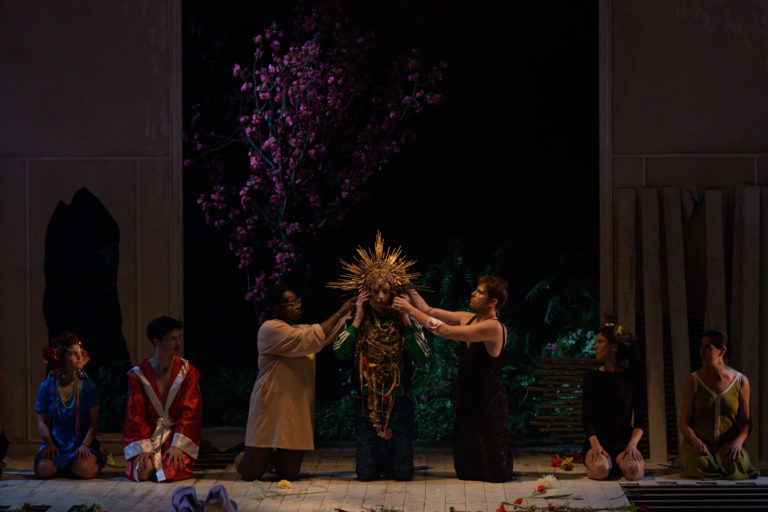
A right of the stage, the scenography reveals a sort of glittery entrance, reminiscent of a magician's hat. reminiscent of a magician's hat. Characters enter and exit through this entrance. The The contrast between comedy and tragedy is accentuated by the use of lights, which often enhance the darkness of the situations. Between the passages, a kind of masked ghost in a red cape plays the piano a few works by Debussy on the piano. The staging emphasizes these poetic moments, detaching them from the rest of the the rest of the work. As if to mark a moment of pause and reflection in the midst of it all. of it all.
Tarot deck
«Jeanne: If we don't let rotten relationships fall apart, new ones won't form. Most relationships are built on the ruins of previous ones after all. Our humanity is founded on rejection and abandonment. As the sacred book says, the history of mankind begins with a break in a garden...»
A masked ball in a forest, spirits, playing characters, love... Seeing all this, one inevitably thinks of the famous A Midsummer Night's Dream by Shakespeare. It's cheerful and friendly. It's almost like a remake. But Madame Sosostris, explains Ben Okri, is a character who appears in the poem The Waste Land by T. S. Eliot. The «famous fortune-teller... the wisest woman in Europe, with a mean deck of cards.» It's often forgotten, but theater also owes a great deal to mysticism. Especially tarot. After all, aren't the twenty-two major arcana of the Tarot de Marseille our beloved archetypes?
After the show, Sophie Kandaouroff explained to me that the four characters represented, in her eyes, the first four arcana of the Tarot de Marseille. A rich source of inspiration. In her game, Jeanne-Sosostris sometimes uses false arcanas, such as «L'œuf brisé» (The Broken Egg), which symbolize the situations of the various characters. Madame Sosostris sees through all this and repairs these hearts broken by their loves and their masks. Mrs Sosostris, a little piece that mixes magic and poetry.
«Madame Sosotris, the wisest woman in Europe».», Pulloff Théâtres, Lausanne, until 1er March. Text by Ben Okfri, translation by Roxanne Fuschetto. Directed by Sophie Kandaouroff. With Frank Michaux, Marc Mayoraz, Ariane Moret, Madeleine Raykov. 021 311 44 22, http://www.pulloff.ch
Write to the author: [email protected]
Photo credit: © Carlo De Rosa

You'll also like

 French
  German
  English
Leave a comment