




The dangerous illusion of fully measurable health
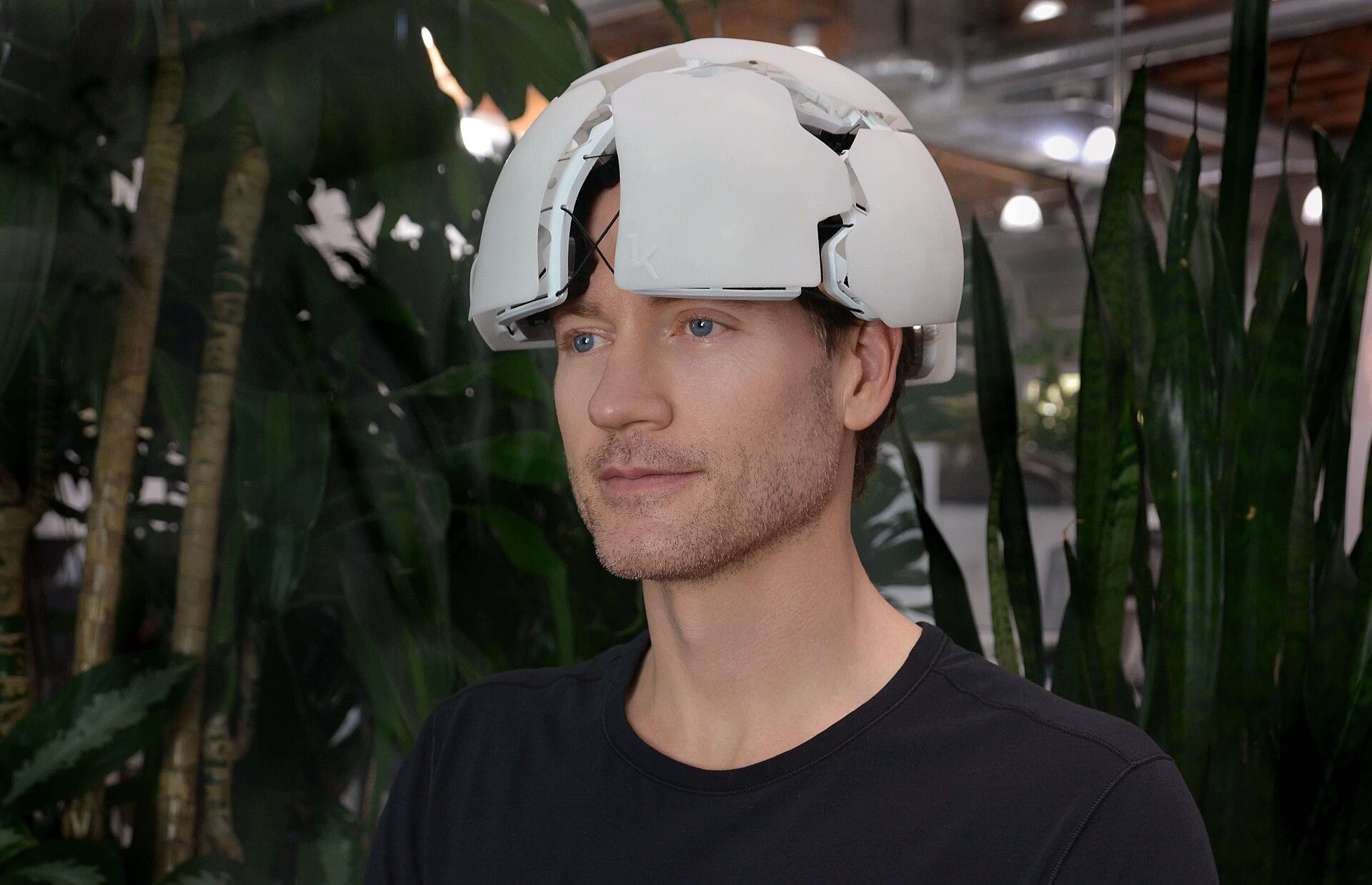
Californian entrepreneur Bryan Johnson wearing a brain imaging headset produced by his company Kernel, in 2021. Photo: Katriece Ray for Kernel (via Wikimedia, under CC 3.0)
Bryan Johnson embodies an age governed by technology, where only that which can be quantified counts. A certain conception of health, compatible with this ethic of numbers, has become the central value. Even to the exclusion of other components of well-being.
Every day at five o'clock in the morning, Bryan Johnson gets up and swallows around sixty pills. Not out of medical necessity: he's in excellent health. But precisely because it's not enough. With a career in the technology sector that has amassed him a fortune of several hundred million dollars, this forty-something devotes most of his resources to «Blueprint», a project whose aim is to slow down, or even reverse, the aging of his body.
Every night is analyzed and every meal weighed down to the gram. Light, air, posture, microbiome... even his nocturnal erections: everything is recorded, measured, archived and optimized. His experiments included a plasma transfusion from his teenage son, with the aim of obtaining, at almost 50, the organs of an 18-year-old man. His results are disturbing: on several biological markers, this modern-day Benjamin Button seems to come very close indeed.
The reign of quantification
It's tempting to deride Johnson's approach, but that would be to miss the point. If the Californian fascinates, it's because he pushes a contemporary logic to its extreme, revealing the excesses that its more modest forms conceal. In this sense, this entrepreneur embodies not so much an anomaly as a fundamental trend: a world where technology is no longer content to accompany its users, but ends up subjecting them to its own language. The language of quantification.
It's no coincidence that connected objects - Apple Watch, Whoop and other smartphone extensions - were first deployed in the health sector. Since the latter is easily translated into indicators such as blood pressure, glycemia levels or body mass index, it appears to be the ideal breeding ground for an era that thinks only in terms of technology.
The constant projection of health status on screens imperceptibly transforms the relationship with the body. Feel from the inside, it is now lu from the outside - to the point where we consult our sleep score before even asking ourselves if we feel rested.
The limits of measurability
The technological approach alone leads to a radical selection of what we consider valuable. Indeed, in the interests of compatibility with its methods, technology necessarily excludes that which is not quantifiable – or that which is difficult to quantify. Yet there is good reason to believe that health goes beyond this. The World Health Organization has defined it in its constitution as «a state of complete physical, mental and social well-being and not merely the absence of disease or infirmity». A definition that already seems to include unquantifiable elements.
These are potentially of two kinds. On the one hand, we can imagine factors of well-being that are not yet quantifiable, notably because scientific research has not identified them or because the tools needed to measure them have not yet been commercialized. Relying solely on existing indicators is tantamount to subordinating one's behavior to the technologies of the moment.
Read also | Health is not our most precious asset
On the other hand, there seem to be components of health which, by their very nature, cannot be reduced to numbers. In other words: components that fall within the realm of qualitative. Take social interactions, widely held to be essential to good health. While technology can measure the frequency of human relationships, or even the heart rate of the individuals involved, it can't capture the quality or depth of these relationships. The «effect it has» is the object of an approach like phenomenology, which transcends any technology.
The same applies to pleasure. Technology can count the number of sexual encounters or glasses of wine consumed, or even the secretion of hormones that these acts produce; it cannot capture all the facets of the subjective experience of enjoyment, which also contributes to the feeling of well-being.
Health beyond quantitative indicators
The above examples converge on the same issue: psychic well-being. The philosophical debate is open as to whether the mind is reducible to physical elements or not, precisely because there seems to be something like an irreducibility to consciousness.
In this sense, it's not surprising that an age obsessed with technology can be faced with a refinement of behaviors related to physical health – lower alcohol consumption, increased attention to diet, sleep and fitness - and, at the same time, a rise in mental malaise, particularly among the youngest.
The point here is not to argue against technological progress or to neglect the importance of good health, but to consider it in a broader conception than its mere quantitative indicators suggest. As the Russian writer Evgeny Zamiatin foresaw in The rest of us (1924), the precursor of the dystopian genre, which depicts a society entirely governed by calculation, a life governed by measurement that ultimately loses what makes it livable.
Economics graduate and president of the Association Café-philo, Yann Costa is an editor at Regard Libre.
You have just read an analysis from our dossier «Pleasure and health», published in our paper edition (Le Regard Libre N°126).
You'll also like






 French
  German
  English
Leave a comment