




«Emma's century», a story of men and women
Tuesday's books - Amélie Wauthier
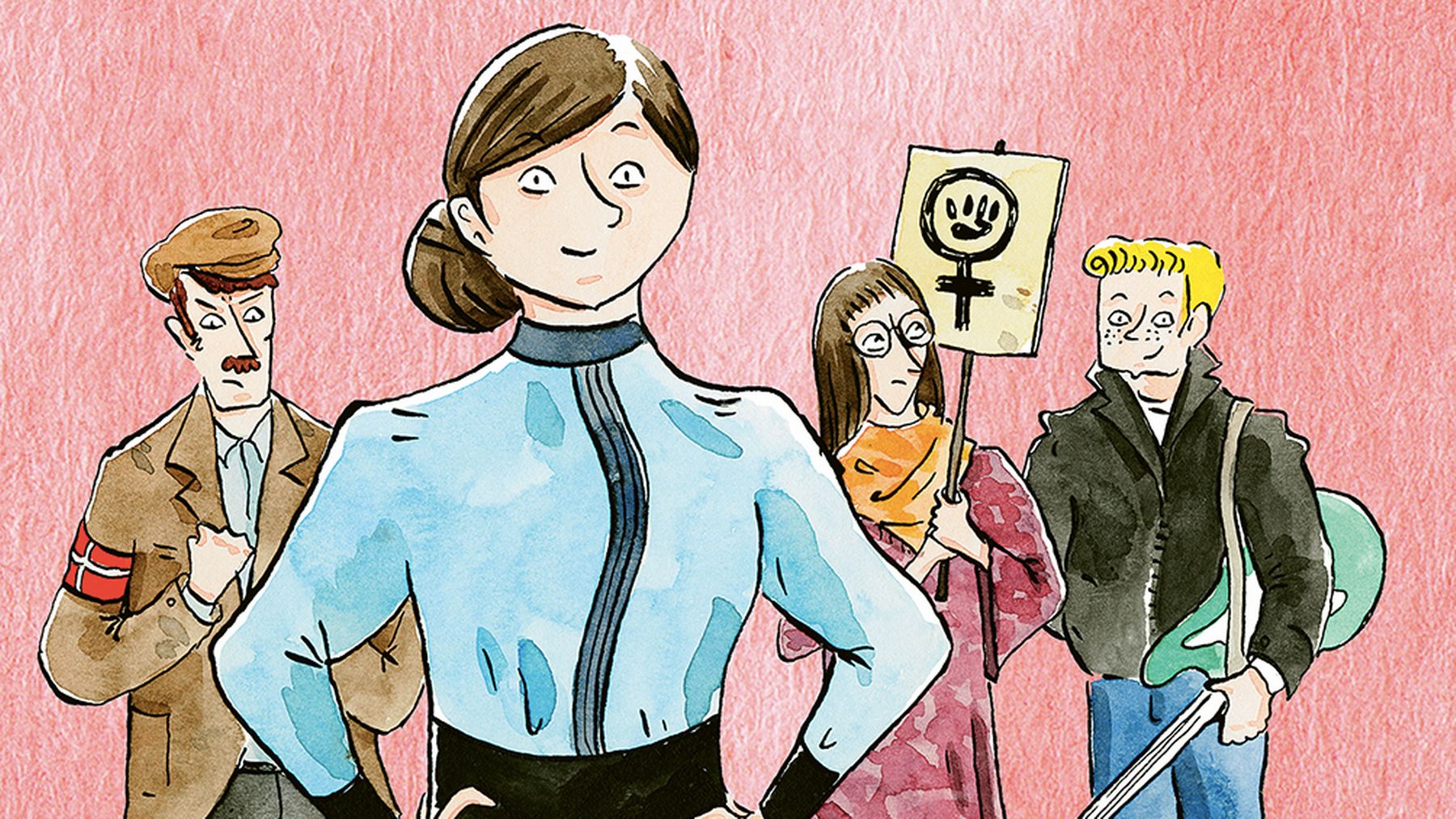
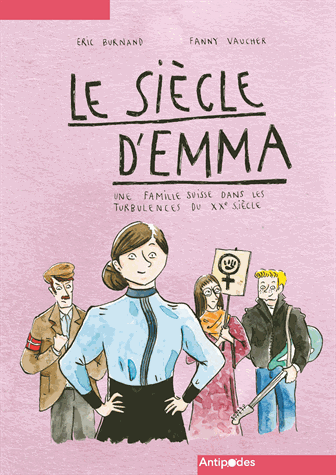
On the pink cover, four figures face us. In the foreground, a woman poses proudly, hands on hips. Behind her, a stern-looking Swiss soldier seems to be pulling a face. To her left, a young hippie brandishes a sign for women's rights alongside a black jacket with a perfect banana. Coincidentally, I find myself writing my review of the graphic novel Emma's century March 8, 2020.
On page 3, you can read why Eric Burnand and Fanny Vaucher decided to collaborate on this project. «Haha! But nothing's ever happened in Switzerland!» you'd think you could hear me. Clearly, there are quite a few of us who think that our beloved nation is not the most rock'n'roll place on Earth. And yet, just because we've never all met up at the Bastille to topple a few crowned heads doesn't mean that nothing's ever happened in Switzerland!
The story begins in Granges, in the canton of Jura. Emma was born at the beginning of theth Marius, her fiancé, works in the watchmaking industry. The Spanish flu is wreaking havoc, the First World War is over, times are hard and many households are destitute. Then tragedy struck. With Switzerland divided and the climate tense, Marius was shot dead by a soldier during the general strike of November 14, 1918. That day, three of them fell, never to rise again. Emma was disgusted. She could stand neither the army nor the passivity of the Swiss. So she went to Zurich to find her brother Franz, a banker who dreamed of revolution and shared her rage.
From Emma's story, we switch to Franz's, twenty years later. We discover his journey, becoming spectators of the wheels that lead him to betray his country in favor of Nazi Germany. One event follows another, as do the trials and tribulations, and then the stories. We follow several generations of Swiss through the struggles of members of the same family, all witnesses to our country's history. We touch on women's suffrage, the living conditions of Italian seasonal workers, rock music, sexual liberation and community life in the seventies.
Simple and efficient
So many themes and events addressed simply and effectively. Eric Burnand's words are relevant and well enhanced by Fanny Vaucher's line. I'm not usually very fan of this kind of layout. But the illustrator manages to capture the soul of our beloved country. What's more, her layout is very dynamic and warm. If the young woman has succeeded in the rather ambitious challenge of seducing me with her drawings, it's above all because they're done the old-fashioned way: with paper and ink! I can't thank enough the artists who still have recourse to these tools, which one might think are outdated... Because even with a 10-year degree in Photoshop, nothing captures the warmth and grain of paper and pencil quite like paper and pencil.
The lives of these fictional characters are punctuated by informative, archival maps and historical events. Biographical cards allowed the ignoramus in me to discover who strike leader Ernst Nobs, nationalist trade unionist Willi Ritschard and feminist pioneer Jacqueline Wavre were. I have to admit that history is by no means my passion. But I'd certainly be more interested in it if it were explained in such a daring way every time - and with an extra dose of humour, maybe I'd even remember a few significant events.
It's a pleasant book to read, and helps to break down certain clichés about Switzerland, a neutral country par excellence where life is so good... and perhaps these heroes/antiheroes of the past could, who knows, give a few ideas to their children of the present.
Photo credit: © Amélie Wauthier
Write to the author: [email protected]
Fanny Vaucher and Eric Burnand
Emma's Century
Antipodes
2019
207 pages

You'll also like




 French
  German
  English
Leave a comment