



Neither left nor right: thinking politics through «Le Je et le Nous»
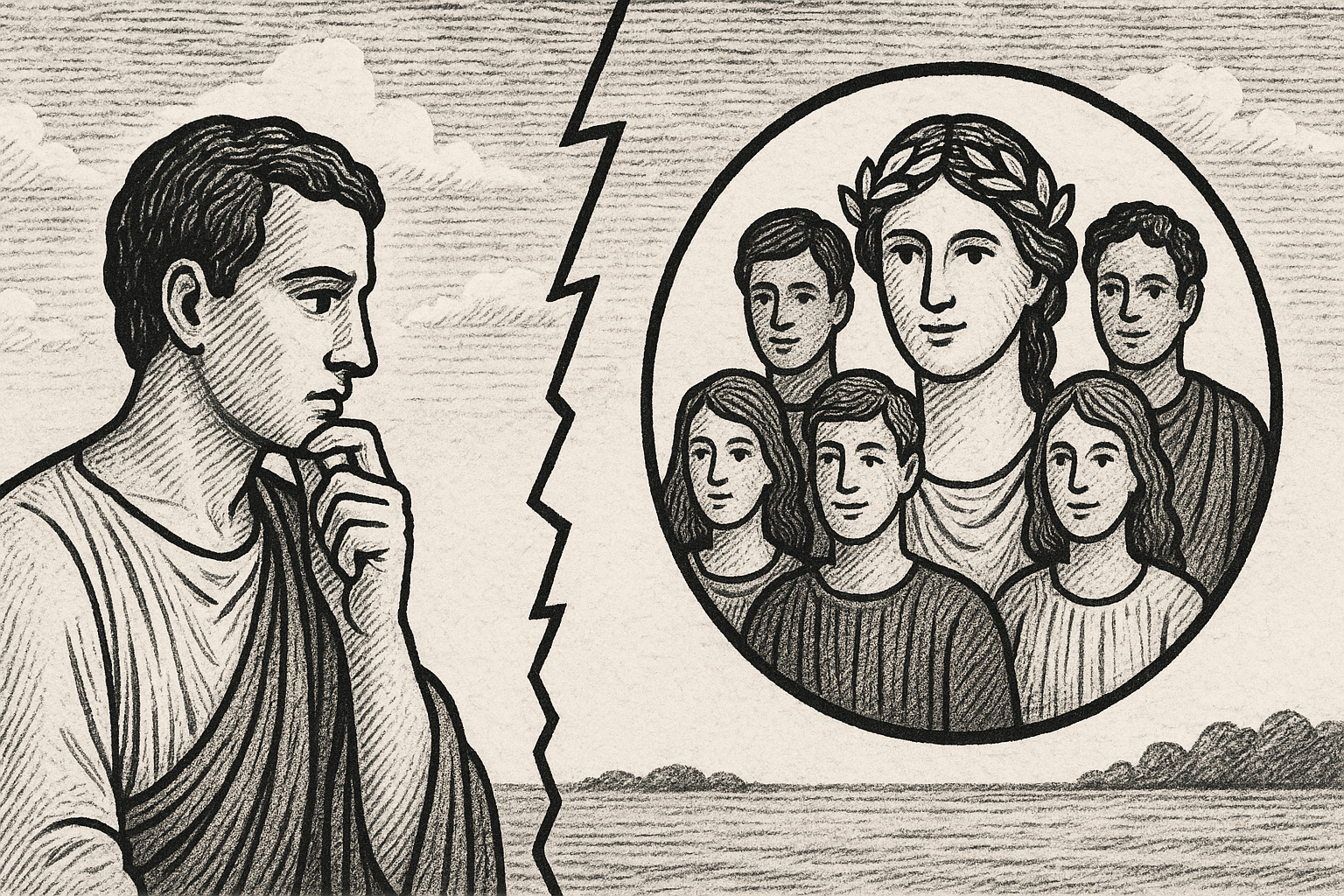
Image generated with the help of artificial intelligence (ChatGPT)
By comparing the «I» and the «We», François Huguenin offers a challenging survey of the history of Western political thought. An ambitious synthesis that invites us to look beyond contemporary divisions without giving in to ideological shortcuts.
To synthesize the history of Western political thought by putting into perspective the ideas governing the relationship between the individual and the community: this is the aim of François Huguenin in Le Je et le Nous(«The I and the We»). To reconcile these entities, which have been in tension since the dawn of time, and perhaps particularly under the regime of the individual king and the cognitive endogamy of social networks, the French essayist sets out to reformulate the foundations of our political conceptions.
To achieve this, François Huguenin draws on a principle of synthesis through the primal entities of the «I» and the «We». The chapter on Antiquity, for example, focuses on Aristotle, whose conception «is irrigated by the idea that the We does not pre-exist the I, nor does it replace it. The We is the union of the I's, and the purpose of the city is to foster the good life of the individuals who make it up».
The methodical presentation of the various currents of thought addressed in the book, and of their representatives, is systematically based on this principle of aphoristic reduction, whose effort and effect are appreciable - at the cost of sometimes convoluted syntactical compositions.
The author takes a healthy epistemological precaution: as the terrain is undermined by everyone's idea of the contemporary outcomes of history, François Huguenin regularly calls on the reader to avoid shortcuts and the summoning up of hasty or anachronistic filiations.
Le Je et le Nous also has the merit of promulgating a different approach to the spatial metaphorization of the political spectrum, where the qualifiers left, center and right often evoke nothing more than feelings of identity belonging and vague moral principles divorced from the mastery of their philosophical origins. In this respect, and in the interest of the reader, it is regrettable that the notions, both vast and elementary, used throughout the book (goodness, virtue or freedom, for example) are not placed more in their context of meaning, according to the eras concerned.
François Huguenin reminds us that, long before the intervention of St. Augustine, Thomas Aquinas or even Locke and his modern heirs, the desire to separate civil and religious power was not originally a political one. It was the early Christians, faced with Roman omnipotence, who expressed their desire to divest themselves of earthly affairs: «Caesar's things to Caesar, and God's things to God», as we read in Matthew's Gospel. «My kingdom is not of this world», says Jesus in John's Gospel.
Let's hope that this essay will be of interest to as many I's as possible for the sake of We, and that a new edition will correct the unusual number of truncations - probably generated by the layout - which somewhat disrupt the otherwise pleasant reading.
You've just read an open-access review. Debates, analyses, cultural news: subscribe to support us and access all our content.

François Huguenin
Le Je et le Nous. Une histoire de la pensée politique des origines à nos jours («The I and the We. A history of political thought from the origins to the present day»)
Les Editions du Cerf
August 2025
448 pages
You'll also like





 French
  German
  English
Leave a comment