



Rilke and Rodin, two geniuses
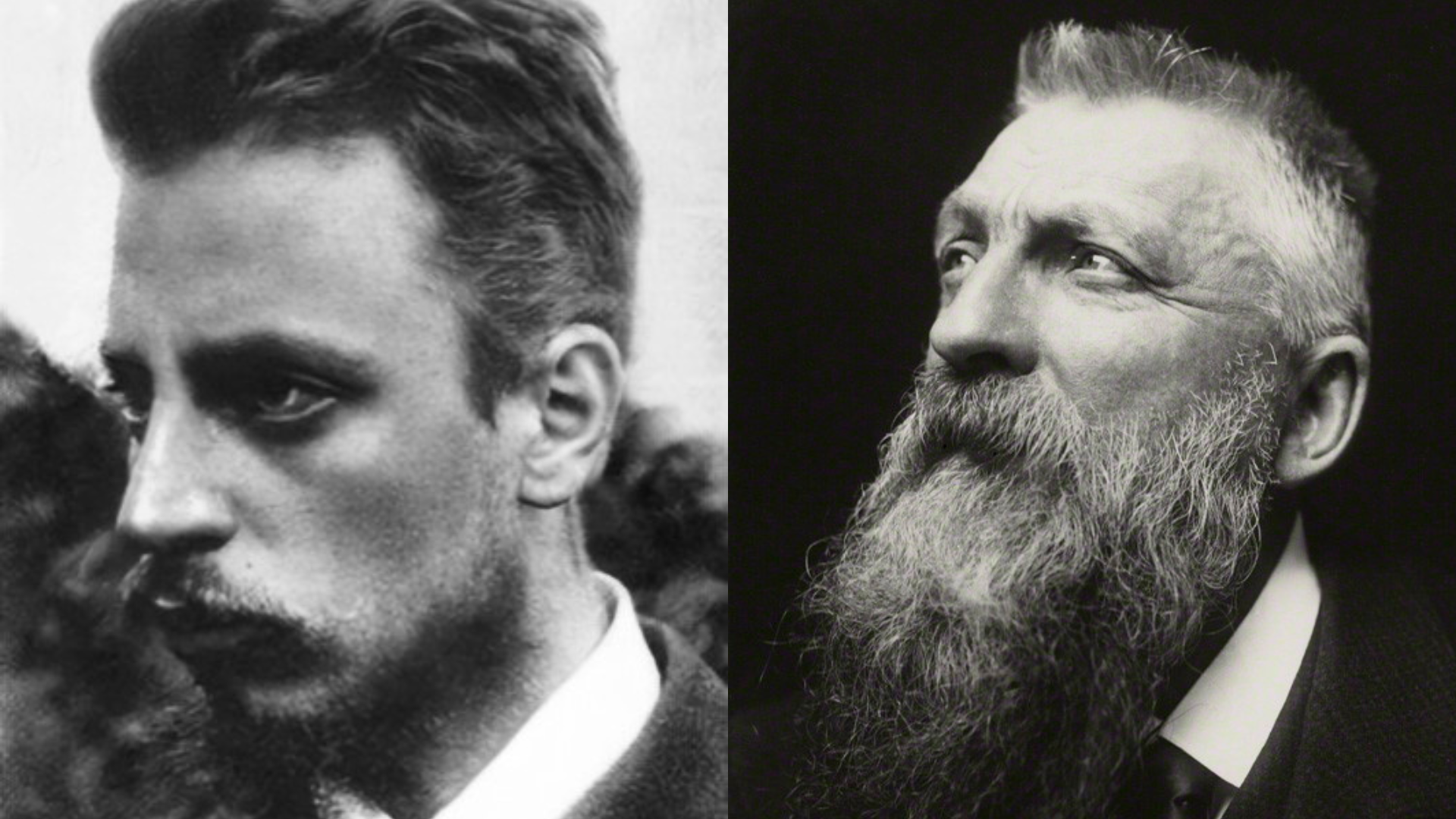
The poet Rilke and the sculptor Rodin. Photo: Wikimedia
Retour sur la rencontre décisive du poète Rainer Maria Rilke avec le sculpteur Auguste Rodin, alors que la Fondation Gianadda proposera dès cet été une exposition consacrée à ces deux artistes majeurs à l’occasion des 100 ans de la mort de Rilke.
Rilke a 27 ans lorsqu’il rencontre Rodin (62 ans) à Paris; il s’y rend afin de s’acquitter d’une commande qu’un éditeur allemand lui avait adressée, une monographie de l’immense sculpteur. Rodin est connu, et son succès en Europe et en Allemagne est retentissant. Rilke, qui se destine depuis plusieurs années à l’écriture, est désargenté; il connaît déjà Rodin par sa femme qui fut elle-même une élève du sculpteur; il lui écrit, lui dévoile son projet d’essai dans un français encore maladroit, et se rend chez lui à Meudon. Ainsi, c’est en septembre 1902 que ces deux représentants de la modernité artistique se retrouvent. Cette année-là, Rilke va peindre avec une finesse inégalée la figure du sculpteur et composer un hymne à son travail. Il va entrouvrir la porte de l’Enfer, lui le poète des Anges, et les deux artistes vont s’influencer l’un l’autre de manière profonde.
In this essay, published in German in 1903, the poet writes: «The artist is the one whose task it is, from many things, to make a single thing and, from the smallest part of a single thing, to make a world.» If this statement applies to every artist, it applies particularly to Rodin. You can't wander around his statues for long without noticing how the bodies are treated: arms, heads and legs are missing, or hands are isolated and seem to stand alone. In fact, nothing necessary is missing, so much so that the energy and life of what we see call forth what we guess. For Rodin's power is such that the viewer's gaze and thought pierce the tumultuous face of stone or bronze to peer inside the bodies, so much so that he has no need of these non-existent limbs on the surface. Redemption comes from the inner gaze, from the amplification of these objects suddenly made great, and this breath, from a single thing, as Rilke wrote, remakes a world.
In Rodin's work, life emerges everywhere, in desire as in sorrow, with the impatience that awakens under the dowser's rod; life dances in bodies, between bodies too. The sculptor liberates it from matter, but it is thanks to this matter that liberation is possible, thanks to this substance and to the artist's genius. It is this body-to-body encounter that gives rise to beauty. Rilke speaks passionately of the work sessions he attended, and he understands Rodin's toil, but he also knows that the poet cannot write every day as the painter or sculptor does. There are long, arid, discouraging periods, and the writer must mount a constant assault against resistance. In Rodin's studio, however, he learned that ease is not enough for creation; it also requires hard work to bring out the essence of things and the meaning of life from the depths. Rilke had a great facility for writing: he wrote more poems in the first twenty-five years of his life than in the last twenty-five. And it was with Rodin that he understood how to combat this facility. In his work, then, there is a before and an after Rodin.
Rilke was to become the irascible statuary's private secretary, enabling him to reflect daily on the isolation of Rodin's statues from the surrounding world. It was an inhabited solitude, which he found again at Muzot (above Sierre) when he moved there in 1921. Rilke observes that Rodin does not work directly in front of the model, but essentially from the material he has stored in his memory. Shall we say that, in artistic matters, it's better to have seen than to have seen? Forgetting is a necessary condition for remembering. This is what Rilke wrote in Notebooks from Malta about poetry: «Verse is not made, as people think, with feelings (we get those all too soon) – it's made with lived experience. [...] And it's not enough to have memories. You have to be able to forget them, when there are a lot of them, and you have to be patient enough to let them come back. For memories are not yet enough. They must first merge with our blood, with our gaze, with our gesture; they must lose their names and no longer be discernible from ourselves.» The artistic material is not the preserved image, but the image brought back from oblivion by some mysterious process. The poet's unconscious, painful and uncontrolled return to the image does not take place in the happy mode he had imagined for Rodin: ugliness emerges, as do death and anguish, which come to claim their due, but which have to be sublimated by dint of hard work, often on the margins of joyful creation. This is undoubtedly his unpleasant experience of Paris. «Paris, this time, was exactly what I expected: difficult», he wrote to Lou Andreas-Salomé.
Rilke brought to Auguste Rodin his finesse of observation, his refined elegance and his pen to defend the often-criticized work, as well as attacks on Rodin himself, who nevertheless enjoyed immense notoriety; through his laudatory writings and his admiration, he removed the obstacles in the wheels. Rodin drew and modeled. Like other sculptors, he then entrusted the execution on marble to third parties whom he directed (Camille Claudel sculpted for him, as did many other assistants), for he believed that art was above all a work of the mind. He creates the plaster, which the sculptor translates into marble, but bends to his style and character. His studio is in fact a hive of activity, with dozens of practitioners under his direction. He produces abundantly and answers numerous commissions from the four corners of the world. Some envious people have attacked him violently, even suggesting that he was incapable of carving stone himself.
The correspondence between 1902 and 1913, in which two voices are interwoven, reveals the characters of both men: Rilke's voice, subtle, admiring and sometimes obsequious, is the voice from above; Rodin's, huskier, more concise and serious, is the voice from below. For both, it's the full wind of creation that brings space.
A quarrel separated the two friends, then a reconciliation. Having reconciled, it was Rilke who brought the «Master» to the Hôtel de Biron in 1908, a superb building that would later become the Rodin Museum. Rilke's fascination with the visual arts owed much to his wife Clara. He met many painters, including Paul Klee. Later, at Muzot, he would pay close attention to Balthus and his budding talent. Rodin, for his part, gradually came to appreciate the importance of photography, whose artistic potential was not lost on him. It was not uncommon to see marble and photographs side by side in his major exhibitions. By the time of their deaths, in 1917 for Rodin and in 1926 for Rilke, post-war Europe had fully entered the reign of the image.
Sometimes, as the shadows of the two creators lengthen in the evening, I think of the fate of two women passionate about the art of sculpture: Clara Westhoff, Rilke's neglected wife, and Camille Claudel, Rodin's volcanic mistress. Both wanted to put wings on the marble blocks, but it was considered unseemly at the time for a woman to work from a nude model. Both men thought they knew women, and indeed they knew many, but they knew nothing of the feminine. Besides, family life wasn't for someone as wandering as Rilke, and Clara didn't get the recognition she deserved for the important role she played in this story. She was the awakener for a husband who was initially little versed in the world of the visual arts. Clara Westhoff had talent. As for Camille Claudel, with her characteristic strength, she immediately impressed the Master. An artistic complicity, a fusion of souls, united them, and she, a gifted artist, became indispensable to the work in the studio. Rodin wrote: «Mademoiselle Claudel has become my most extraordinary practitioner, and I consult her about everything. It was she who left Rodin after ten years of shared passion; she wanted to exist alone, but the separation troubled her mind and she was unable to find autonomy; she was committed to a psychiatric asylum for thirty years. Camille Claudel was a genius.
«Rodin selon Rilke», an exhibition on view from June 26 to November 22, 2026 at the Fondation Gianadda, Martigny (VS).
Former President of Geneva's Grand Council, Jean Romain is a writer.
You've just read an unpublished free-access commentary. Debates, analyses, cultural news: subscribe to support us and access all our content.

You'll also like
 French
  German
  English
Leave a comment