



Perspectives on Persia, Summer 2016
Le Regard Libre No. 29 – Baptiste Michellod (our guest of the month)
I was fortunate enough to spend two months in Iran last summer. An internship organized by the international student association AIESEC gave me the opportunity to live with locals while organizing several activities for young Afghan refugees living in Tehran.
Iran is a country full of mysteries and radiant with beauty. Persia has never ceased to amaze me, from the arid mountain ridges of the west to the imposing ruins of Persepolis, through bustling Tehran, the blue mosques of Isfahan, the monuments dedicated to the poets of Shiraz, and the enigmatic city of Yazd. Given the length constraints of this article, I’ve decided to focus on introducing you to one person and one place that have both left a deep impression on me.
Mr. Eliasi
We all called this man, who made such an impression on me, Mr. Eliasi. He is a cheerful, short man in his fifties, the senior member of a stonemasonry firm, where he serves as the accountant. I met him by chance when my internship coordinator, Mahdi, invited us to visit the mountains north of Tehran for a weekend with Eliasi’s group. I’m certain that my experience in Iran would have been far less enriching without these few getaways from the sweltering heat of the capital. Our group was quite a motley crew; two of its members were devout religious conservatives, while the others took advantage of the solitude of the mountains to let us sample their homemade apple liqueur—even though alcohol consumption is completely illegal in Iran! Despite these differences, which seemed irreconcilable at first glance, the group remained united throughout all our trips. The tolerance everyone showed, along with the mediating role Eliasi played, undoubtedly prevented any friction during our getaways.
It is worth making a brief digression regarding this contrast between conservatism and a lack of respect for religion. I believe that the ability to reconcile opposites is a distinctive trait of the Persians. Every Iranian family has at least one copy of the Quran in their home, but also a copy of Hafez’s *The Divine*. He was a 14th-century poet and philosopher who has attained a mystical status in Persian culture. During winter gatherings, Iranian families ask questions of *The Divine*, and use a randomly selected poem as their answer. It is not uncommon to come across street vendors in the alleys of Tehran who have trained birds to retrieve a poem from a box and give it to you in exchange for a few rials. The poet’s tomb, located in Shiraz, remains a place of pilgrimage to this day. As Bouvier observed, «The people of Iran are the most poetic in the world.» Although many of Hafez’s poems criticize those in power and the practices of religious leaders, his work is considered one of the sacred texts of the Iranian people, on par with the Quran. This ambivalence is reflected in many aspects of the Iranian character, but also in Iranian foreign policy, which constantly oscillates between the two models. Awareness of this ambivalence therefore seems to me absolutely fundamental to understanding the Persian mindset. That being said, let’s return to our dear Mr. Eliasi.
When I got into his car for the first time, I immediately noticed a little figurine of Quasimodo propped up on the dashboard. After our initial, somewhat laborious conversations (Eliasi doesn’t speak English, and my Persian is very limited), I discovered a true literature buff who took an immediate liking to me because of our shared interests.
Over time, we’ve developed a nonverbal vocabulary that has allowed us to overcome the language barrier. Eliasi served as our guide during our travels and never missed an opportunity to tell us the local legends and true stories surrounding the places we explored. Behind this simple, joyful wisdom, I discovered a human tragedy. Eliasi’s only daughter had been sent to Italy, accompanied by his wife, to receive treatment for the rare illness she suffered from. Eliasi, left alone back home, struggled every month to scrape together the money needed to pay for his daughter’s treatment. Despite all this, this man—whom I consider my friend—has always managed to maintain his enthusiasm. His unconditional generosity has been a true life lesson for me, one through which I try to put my own problems into perspective and savor life’s simple joys just as he did.
The Soltanieh Mausoleum
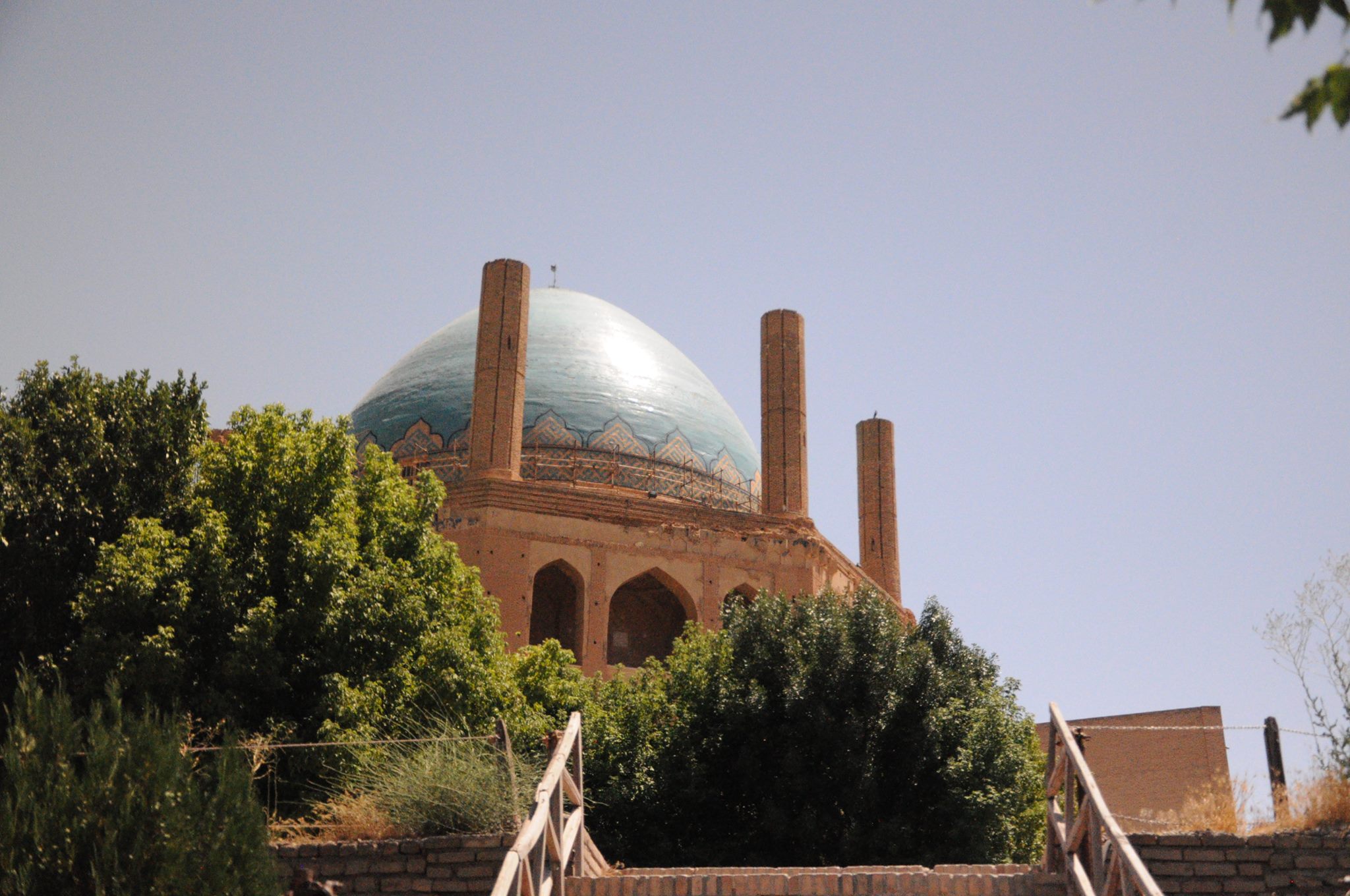
It was during my second trip with Eliasi’s group that I visited one of the most memorable places of my stay. We had set out for a two-day trip to Zanjan Province, in the western part of the country. After camping in a public park in the sleepy little town of Soltanieh, we made our way to the mausoleum located in the center of town. It is the largest brick dome in the world, which some experts consider to be the precursor to the Taj Mahal. The building is an architectural masterpiece; vibrant blue tiles cover the roof of the structure. This blue is commonly used in holy sites, as it symbolizes the sky and the greatness of Allah. The interior of the dome, meanwhile, is adorned with patterns and engravings of mesmerizing symmetry.
The Soltanieh Mausoleum, in Soltanieh (Zanjan, Iran)
An Ilkhanid ruler (the Ilkhanids were a Mongol people descended from Genghis Khan) named Oldjaïtou ordered the construction of the mausoleum at a time when his empire, at the height of its power, stretched from Anatolia to Pakistan. The warlord wanted to make the city the most impressive of all capitals. While the dome still stands proudly in Soltanieh today, the Ilkhanid Empire has long since fallen, and with it, the plans to make the city the center of the world. From the upper levels of the dome, we could make out, beyond the few dwellings, the lush green plains that had drawn the Ilkhanids here.
This place, from which so much glory emanated, seemed frozen in time. I stood there, lost in my thoughts, letting my imagination paint a picture of Oldjaïtou’s dream. I then recalled a passage from The Use of the World, who said the following about the mosques and palaces of Isfahan, worn down by the centuries: «It is precisely through this very human surrender to the passage of time—which is their only imperfection—that they become accessible to us and move us. ‘‘Defying time since the Achaemenids’—no Iranian architect has ever fallen for such nonsense.’»
A thought struck me at that moment, in that small provincial town slumbering on the dreams of grandeur of a collapsed empire. This quest for greatness—which betrayed a fear of sinking into the oblivion of eternity—took on its full meaning as my gaze fell upon the modest homes of Soltanieh, meager remnants clustered around the forgotten giant. When Oldjaïtou gazed upon the construction of his capital from the top of its dome, perhaps he had feared the ruin of his empire. This realization suddenly made Oldjaïtou seem like a familiar figure. I then felt a very strong connection to this place, which was nevertheless foreign to me in so many ways. Just as in The City of Sand by Marcel Brion, I found myself dreaming that the city was coming back to life right before my eyes.
«Am I not, myself, a man from ancient times whom the wind has roused from his deep tomb?»
Although I relived that moment of reverie a few times during my trip, it was never as intense as it was then. Nearly a year after my internship in Iran, I can say without a doubt that this trip changed me. In the end, I decided to let Nicolas Bouvier speak for himself, as he captures the richness of the traveler’s experience better than anyone else:
«A journey needs no reason. It soon proves that it is enough in and of itself. You think you’re going on a journey, but before long, it’s the journey that makes or breaks you.»
Write to the author : Baptiste.Michellod@etu.unige.ch
You'll also like
 French
  German
  English
Leave a comment