




«Dogville», an unforgiving grace

Cinema Wednesdays - Eugène Praz
In 2003 Dogville by Lars von Trier. Set against a minimalist backdrop, it tells the story of young Grace (Nicole Kidman) who, fleeing gangsters, finds refuge with the inhabitants of a tiny, formerly mining town in the Rocky Mountains: Dogville. Here, in the harsh light and degrading humiliations - not for her, in fact, but for those who inflict them on her - she discovers the sordid depths of their souls. The revenge will be terrible. Whether judged or appreciated as divinely cynical or distantly realistic, Brechtian or Dürrenmattian, this work appears like a film noir in which the viewer is either the helpless detective or the complicit accomplice. People prone to misanthropy, please refrain.
Tom Edison Junior (Paul Bettany), an idle writer and son of a doctor named Tom Edison (Senior: Philip Baker Hall), is far from a luminary. Nonetheless, his efforts to provide moral guidance to his small town serve as a hobby, in philosophico-protestant sermons, alongside daydreams about an admirable work he'll obviously never write. Then a fugitive enters his life, followed by gunfire. He hides her at the entrance to an old silver mine and lets his pursuers believe he hasn't seen her.
How fortunate for him that an opportunity to illustrate the generous moral ideas he professes presents itself to the small town, whose inhabitants are described as honest and decent! Their goodness will be magnified, he thinks, but he's sadly mistaken. In reality, in exchange for his secret, the inhabitants of Dogville will ask him to work for them, first a little, then to the point of exploitation, and finally through the daily rape of his body by, more or less, every man in the little town.
What's more, she can't escape, as the police are looking for her and offering a hefty reward for her «delivery». She tries, at an already advanced stage of exploitation, to escape in Ben's (Željko Ivanek) apple-pickup truck, with his complicity, but the man's weakness makes him lie to Grace, pretending that the police are present, raping her as she passes under the tarpaulin and taking her back to Dogville, while keeping for himself the money she offered him, stolen from Tom Edison Senior. This scene of the aborted escape in the van is seen in transparency through this gray tarpaulin. Lying among the fruit, far from Dogville, Grace bites into an apple, probably already the apple of knowledge.
A very slight change in lighting
Divided into nine chapters and a prologue, Dogville has a tightly framed narrative and proceeds like a demonstration, or revelation in nine panels, like those of a folding screen that closes to reveal the moral misery of its characters. He doesn't illustrate; he dismantles and reveals the unglamorous underside of the setting. The absence of visible walls in the homes or shelters of Dogville's inhabitants gives viewers a sense of direct access to their lives, and ultimately to their souls, in an entirely transparent, violent and raw way.
But what the viewer discovers is that the violence lies not so much in the act of seeing as in what is seen. We see Jack McKay (Ben Gazzara), the old blind man, bringing his hand closer and closer to Grace's thigh as the weeks and months go by. Meanwhile, inquisitive young Jason blackmails Grace into spanking him. If she doesn't give it to him, he'll tell his mother that she did, jeopardizing Grace's precarious protection from the people of Dogville; but if she does, nothing will get out. She spanks him, but Jason betrays his word. Fortunately, he is curtly forgiven for raising his hand against the boy. But the reduction of the scenery to objects, pieces of furniture, vehicles and small constructions is compensated for by constant camera movements that lend a vague importance and a kind of life to the smallest of these elements.
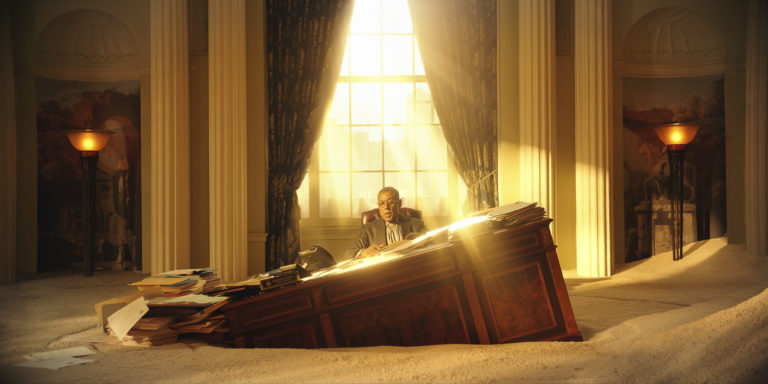
Every part of the set plays a part in the unfolding of an inescapable tragedy, a process that brings the film closer to classical theater. At two key moments in the film, the narrator explains that a «tiny change of light» occurs over the town, which is translated «scenically», reflecting a change in Grace's view of Dogville. First of all, it's the townspeople's expectation of what Grace can bring them that is heavily emphasized and felt in the first chapter. In the ninth chapter, which is the last, the full moon, previously hidden by clouds, casts its rays over the town and, as the narrator says, passes through the buildings and people, exposing all their flaws. Their baseness is at last illuminated to its abyss.
An elephant in the room
Dogville, which owes a great deal to theatrical devices, reminds us that cinema is also dependent on them. But far from erasing the plot's verisimilitude, the stripped-down set lets it unfold without superfluous visual support, balanced on this thread stretched above a moral void that Grace, whether through greatness of spirit, arrogance or momentary blindness, doesn't want to see almost to the end. Arrogance is the flaw reproached to her by her father, who happens to be the gangsters' leader.
But before her arrival and that of her henchmen, who are armed to the teeth, she goes through hell, where, after immense efforts to be accepted by the community, it judges that she never does enough, and crushes her with all its weight. One of the strengths of Dogville, is the multiplication of scenes of violence and humiliation which, taken one by one, seem at best scandalous, but together form a sour bouquet of abjection likely to provoke a retching.
Grace's meagre salary enables her, after many months of effort, to purchase the seven porcelain figurines displayed in front of Ma Ginger's (Lauren Bacall) store. For Grace, these figurines represent all that's charming about the city, in spite of everything. One day, however, Vera the antique-loving schoolteacher (Patricia Clarkson) smashes them all, thinking that Grace has seduced her husband while he was raping her. Testing Grace's stoicism, she challenges her: if she manages not to cry, she'll stop breaking her figurines; but Grace bursts into tears.
We could recount how the arbitrary rules forbid him to cross the small path between the gooseberry bushes set aside for this purpose, how he is chained to a rusty wheel to prevent him from escaping again, or how Tom Edison Junior turns out to be a clumsy, selfish and cowardly lover. Grace having made him doubt himself, and since he can't bear to question himself, he decides to call off the gangsters himself. We don't need to go into further detail to understand the enormity of the situation, which the people of Dogville only belatedly recognize at a final meeting. The impending massacre doesn't seem to cross the minds of Dogville's inhabitants until it's too late, when it's as big as an elephant in the middle of the living room.
Released the same year as Dogville, Elephant by Gus Van Sant, has many similarities in this respect. In the end, Grace reverts to the criminal she never ceased to be, but now understands her mission differently: as a vigilante who must, for the good of humanity, rid it of the despicable inhabitants of Dogville, all except Moses, the invisible dog who finally takes on body and voice. The henchmen will take care of them all, while Grace reserves the task or pleasure of killing Tom with a bullet. When Vera's children are shot, she is subjected to the same challenge as when the little figurines were destroyed. We almost look away, repressing not spittle but vomit. We love Grace for being inexorable.
Write to the author: [email protected]

Photo credits: © Les Films du Losange
You'll also like





 French
  German
  English
Leave a comment