

Spielberg, known for the sharks, aliens and dinosaurs he has featured in his films, has he ever done better than his 1971 TV movie? Duel, his second long metrage, is a classic in the eyes of the general public. Yet it has all the hallmarks of conceptual cinema. How can we understand its magic? Dive into one of the greatest films of all time, still very much in vogue today.
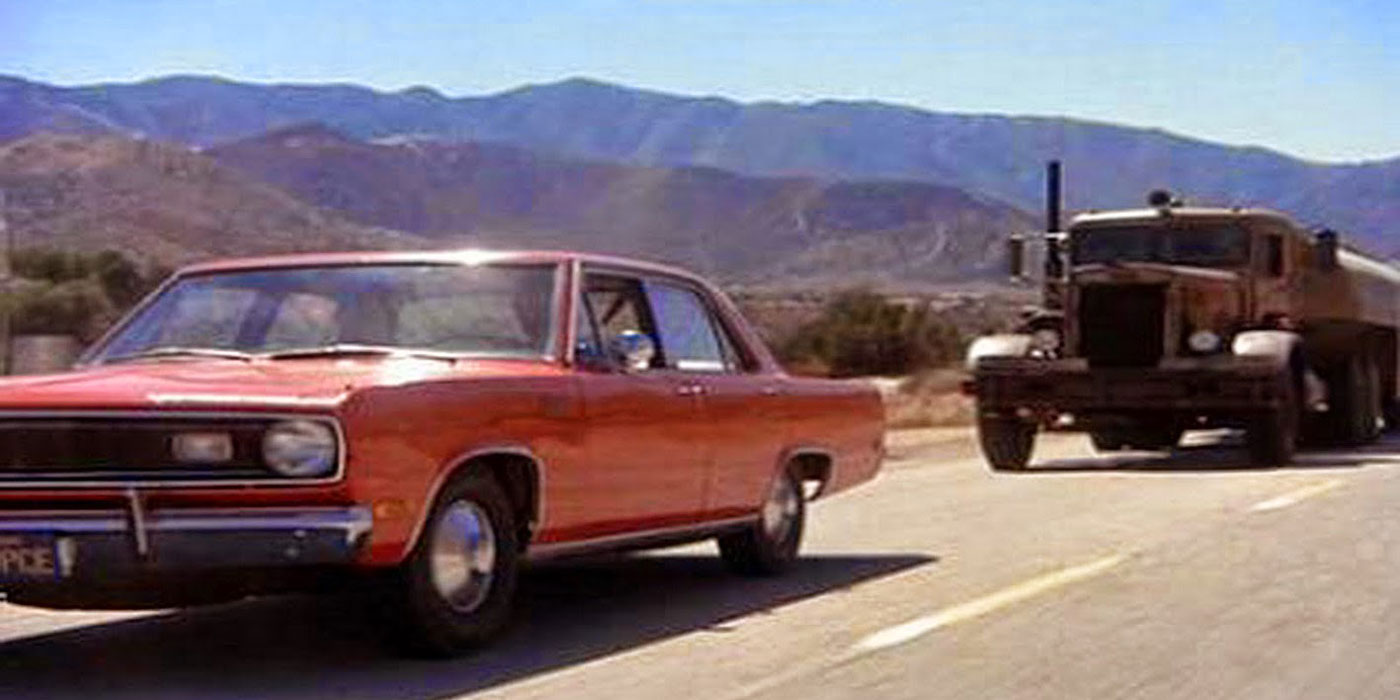
A unique film. Duel, is the car journey of salesman David Mann (Dennis Weaver), who finds himself the target of a truck chasing him for who knows what reason. With almost no dialogue, Spielberg's second feature demonstrates the power of cinematic tools to keep audiences on the edge of their seats: the camera revolving around the car, shot changes, the actor's facial expressions, sound effects, not forgetting of course the oppressive music of another -berg, another mountain, Billy Goldenberg, which alternates with moments of great silence.
It's also easy to forget that, while there's very little dialogue in the film, those that the director has decided to include are worth noting, because they're so funny. A case in point is the discussion between David and the first mechanic he stops at along the way:
«- Say, it's time to change a radiator hose.
- I know, I get that every time. I'll look into it later, thanks.
- You're the boss.
- No, the boss is my wife.»
Multiple interpretations of the heavyweight
But these lines are more important than their offbeat humor. They open the way to several possible interpretations of the film. For if this story of a truck chase for no reason is absurd, there are undoubtedly reasons behind it. How are we to understand this terrifying and aberrant chase? We have to look at the problem from the most basic angle: the truck. This imposing forty-tonner is perceived as a threat. It's more than a personification: this metal monster is more dangerous than any living thing. The human becomes secondary, so much so that we never really see the truck driver's face.
Read also | Poelvoorde in a At the station totally absurd and brilliant
The truck is a threat, and that threat is a character. The truck's horns are its crazy outbursts, mainly to taunt David. Its headlights are offensive eyes, lighting up in a tunnel during the bus scene with the children. The development of this personification is already enough to make the film a masterpiece, where the erasure of the human rubs shoulders with purely cinematic suspense. It's no coincidence that this film is so popular: action and tension are at the forefront. Even though nothing much happens, it's hard to get bored. What's more, it's original!
But there's more. The motif of the woman in charge, which recurs several times, is eloquent. Let's not forget that David has just come out of a family quarrel, and that his wife insisted that he come home on time that night, unlike all the other times. There's also talk of marriage problems in the radio broadcasts we hear at the beginning of the film. This theme of marital power struggles is no doubt one of the reasons for the disproportionate power struggle between a huge lorry and a frail car in the script. One is a reflection of the other. The submissive, «I don't want any trouble» nature of the main character and the castrating nature of his wife, which manifests itself in the truck's attacks, give food for thought.
Which brings us to the film's greatest strength: that of presenting the truck as a threat experienced almost exclusively by the main protagonist. As if, in fact, it existed only in his mind. Although the truck interacts with other characters on two occasions, its behavior on the road is not witnessed by anyone other than David. He is even laughed at when he says that someone is trying to kill him. The magnificent setting of the Californian desert finally invites us to see in Duel a subtle representation of imagination. And therefore fiction. Aren't desert heats conducive to hallucination?
Write to the author: jonas.follonier@leregardlibre.com
You've just read an open-access article. Debates, analysis, cultural news: subscribe to support us and get access to all our content!
 French
  German
  English