




«The Empire: the drift of cathedrals
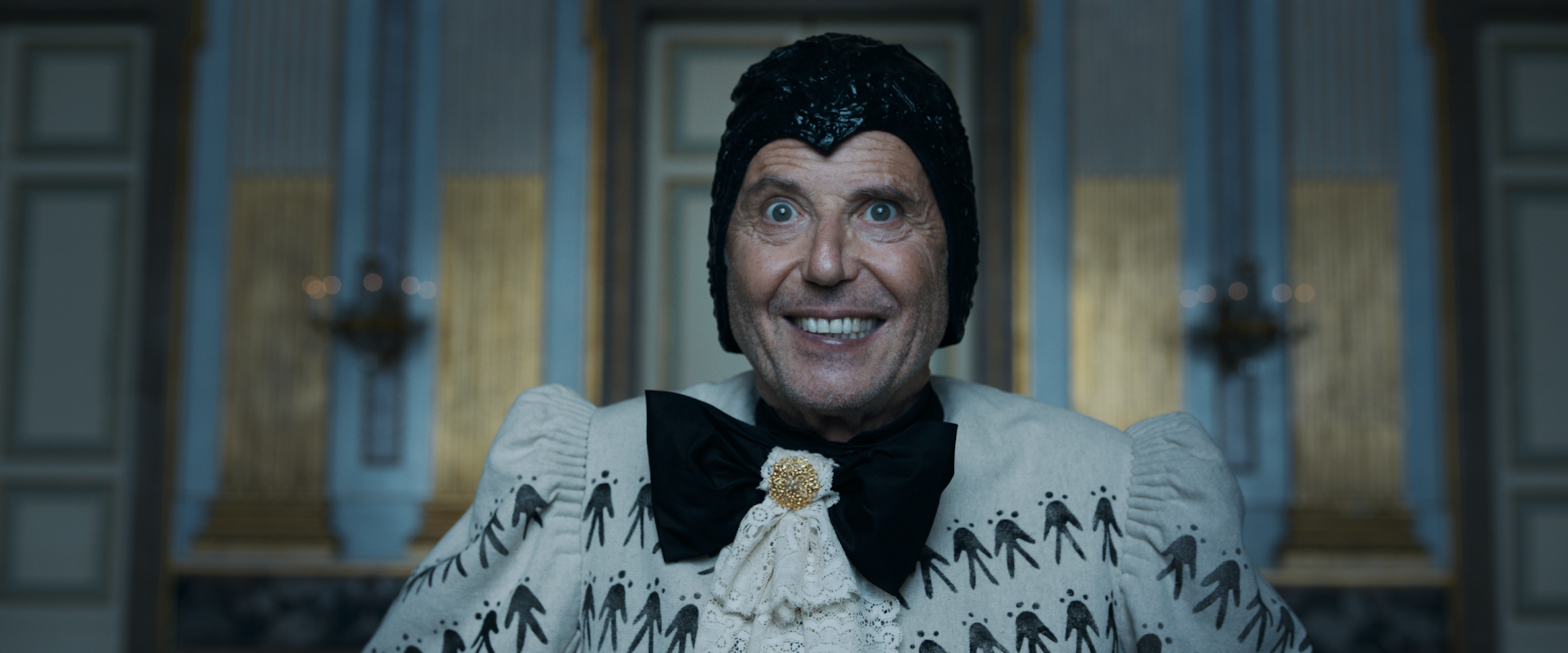
Fabrice Luchini dans «L'Empire» (2024) de Bruno Dumont. Photo: Sister Distribution
Bruno Dumont has returned to our screens with nothing less than a retelling of the Star Wars myth. His film has not failed to divide audiences and press alike. With good reason.
In a village in Normandy, the extraterrestrial forces of Good and Evil clash for world domination. It is on this simple premise that the film develops its philosophical discourse and fascinating universe. Following on from Coincoin and the Z'Inhumains (2018), the action essentially takes place in the middle of the Normandy countryside, in a fishing village whose encounter with science fiction creates an ever so original discrepancy.
Good, Evil and Man
The parallel to Star Wars is not limited to spaceships and lightsabers. It also takes up the myth of the battle between Good and Evil. The latter, embodied by Beelzebub (Fabrice Luchini), comfortably installed in a Versailles castle in space, aims to rule over Earth and humans, perceived as «lame». To achieve his goals, he is helped by Jony (Brand Vlieghe), father of a child, the seed of absolute Evil, who will enable Evil to establish its Empire. To face this danger, Jane (Anamaria Vartolomei), in the service of the Queen (Camille Cottin), will seek the means to stop Evil so that Good reigns on earth where humans are so «endearing». And yet, as they take on human form, both Good and Evil will experience desire, which will guide them out of their absolute ways.
Bruno Dumont's ambition is to convey an idea: to explain boring philosophical ideas simply and playfully. Here, the aim is to show that absolute Good and Evil are not so different after all, and that desire can easily distort our moral principles.
To demonstrate this, the film plays on numerous oppositions: Good versus Evil, Man versus Woman, Earth versus Space. It even explicitly evokes the binary code by opposing 0 and 1, but above all, it translates these oppositions through a cinema that is at once naturalistic, with its rural regions, non-professional actors, and the codes of the blockbuster with its spaceships and digital effects. The mix is often very pleasant to watch, and these images of space cathedrals landing on Normandy beaches are so incongruous that the film offers its share of unforgettable moments.
A cathedral with fragile foundations
Yet despite this sense of spectacle and direction, the film leaves a bitter taste of unfinished business. The show ends abruptly, the characters disappear without being given a conclusion, but above all, the discourse on humanity that accompanied the whole film suddenly falls silent. This unfinished business is all the more apparent when you realize that the human being, at the center of the discourse, largely takes a back seat throughout the film. Reflections and glances are constantly conducted from the outside, and while the approach largely inherits from Montesquieu's Persian Letters, it lacks their effectiveness.
The real problem with The Empire, is that the film becomes a prisoner of its own process. In seeking to be playful, the film's subject matter becomes simplistic. In seeking to be effective, it abandons much of the humor that has been developed in Bruno Dumont's cinema since the 1980s. Ma Loute (2016). In seeking originality, the film becomes unremarkable. Indeed, when you look closely, the message it carries is ultimately the same as that of the model from which it draws its inspiration. A battle between Good and Evil, which cannot exist as absolutes as long as a part of humanity is mixed up in them. It's the symbol of the rebellion of Hollywood's most iconic antagonist, and that was over forty years ago.
Read also | Daaaaaalí! infidelity rewarded
So the film's mission of transmission seems pointless. Its message has already been brought to the screen. But above all, in a form that has had far more effect on its audience. What remains is to the Empire a sense of direction that's as effective as ever, a sympathetic cast and undeniable originality. Bruno Dumont succeeds in creating fascination, whether it's a shot of a cathedral crossing space or a simple boat being towed out of the sea.
In spite of itself, the film is aimed at an insider's circle, interested in the image and its significance, and misses its target of more mainstream viewers, as evidenced by the abyssal gulf between the ratings given to the film by the public and those given to it by the specialized press. The Empire is a film that hopes to educate, but needs to be so to be appreciated.
Write to the author: jordi.gabioud@leregardlibre.com
You have just read an open-access review published in our print edition (Le Regard Libre N°109). Debates, analyses, cultural news: subscribe to support us and get access to all our content!

Bruno Dumont
The Empire
With Fabrice Luchini, Anamaria Vartolomei, Camille Cottin, Lyna Khoudri and Brandon Vlieghe
July 2024
111 minutes

You'll also like

 French
  German
  English
Leave a comment