

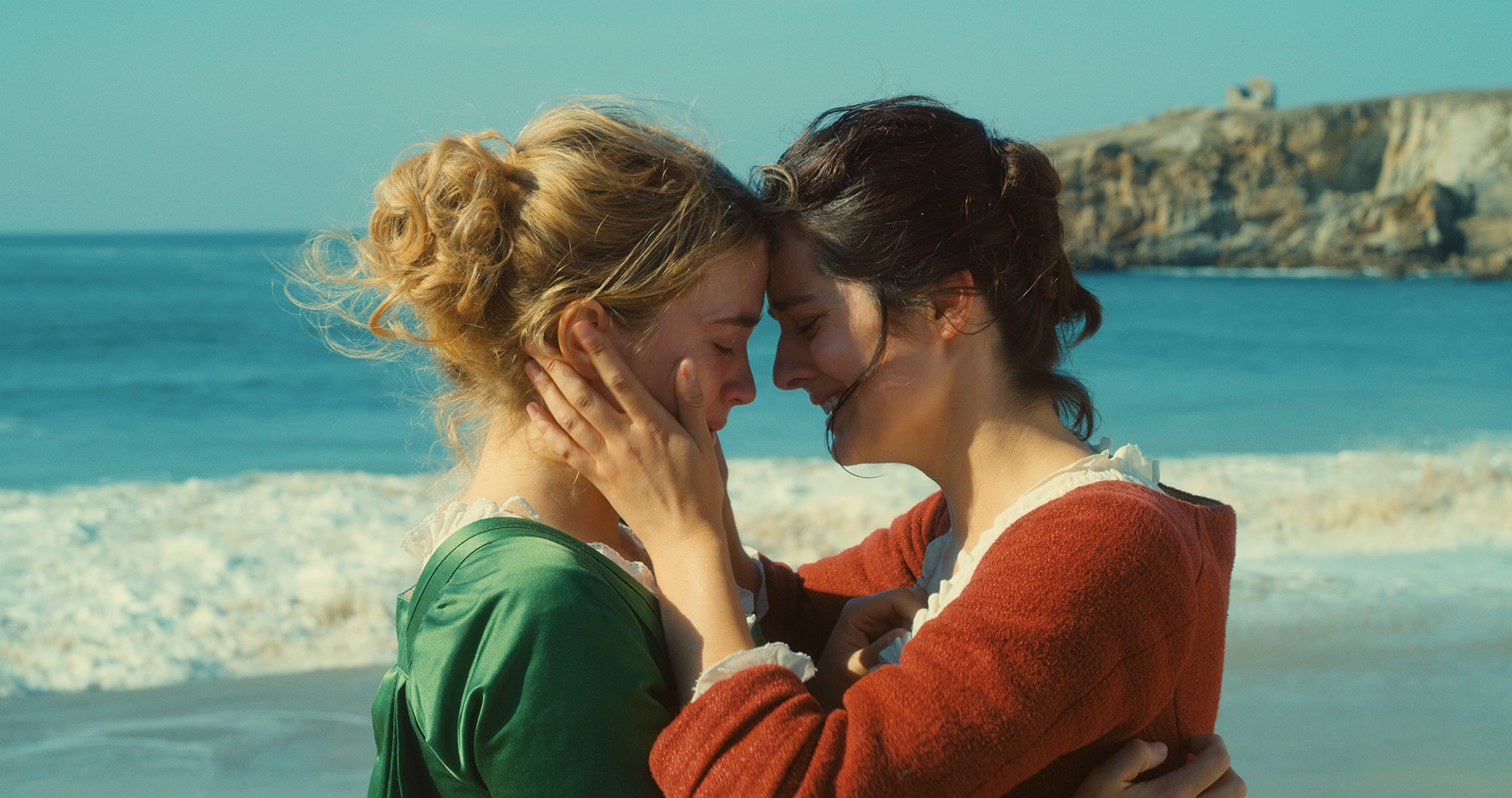
Awarded a prize at Cannes for its screenplay, Céline Sciamma's latest film Sciamma's latest film depicts the meeting and burgeoning passion between two 19th-century women.th century. The director of Tomboy sets the story ablaze with an impressive, impressionistic plot the story of a painter who has to conceal from her model that her mission is to paint his portrait on canvas. An apt reflection on love and memory through the prism of the image.
A chance meeting, a confrontation of two destinies. Following in her father's footsteps, Marianne (Noémie Merlant), an intrepid painter who never hesitates to throw herself into the water to save her drifting canvases in front of astonished sailors, accepts a job from a bourgeois matron. She painted the portrait of Héloïse (Adèle Haenel), the sponsor's youngest daughter. Héloïse is plucked from her convent to take her place in her late sister's destiny. She is to marry a Milanese man who demands a portrait of the young woman before taking her as his wife. Helpless in the face of this crushing reality, Héloïse expresses her disagreement by refusing to play the muse's game, and thus to be an accomplice in this union. Marianne thus succeeds a first painter who has failed: she will have to paint this portrait without the main interested party realizing it.
An aesthetic of concealment
The relationship between the two women is therefore based on concealment. Playing at being a lady-in-waiting for her strolls, Marianne discovers, at the same time as the viewer, the face of her subject. A fierce, wary subject, concealed under long capes and scarves. Gradually, the wind reveals the features of her face. Through the regular use of close-ups and frequent cuts, Marianne's gaze isolates her prey, helping to make visible the artist's process of creation and memorization: capturing in an instant the raise of an eyebrow, the depth of a gaze or a furtive expression.
An even more poignant cut of the subject, thanks to the ambience sound and location. Set behind closed doors on a Breton island, the painter's arrival of the painter aboard a boat amid a thunderous din - waves crashing against her waves crashing against her boat, the screeching of oars in rhythm with the of the oars to the rhythm of the sailors' movements - contrasts deliberately with the almost total absence of music and intermittent characters in the fiction. Outside the world, in a time without time, the protagonists forge an exclusive, forbidden relationship.
A painting of memory
As their relationship evolves, Marianne's certainties and Marianne's certainties, like her attempts to paint a portrait of Héloïse of Héloïse, will be shattered. The woman who seemed to be free by refusing to accept conventions - she smokes a pipe and paints male subjects when she's She finds in Héloïse an unsuspected strength. Without falling into and self-pity, Sciamma builds these women, who seem to be at odds with each other heroines of their time. Far from a single sketch of two singular of two singular destinies, the film evokes a network of women resisting social hierarchy.
In this respect, painting is also the medium of this secret history, when a clandestine abortion is restored through painting. The imprint, the trace of the pictorial image, acts as a memory. Collective or personal, it acts as a reminiscence of a now that has seen itself condemned. What if, as one of the protagonists suggests, Orpheus had deliberately turned back to preserve a phantasmal image of Eurydice? Through her reflections on painting and memory, Portrait of a Girl on Fire makes an impossible love story the very condition of a collective and universal memory, avoiding the pitfall of a pathos redundant. Far from being scholastic, the apparent simplicity and purity of the image offer the viewer a powerful, unadulterated experience.
Write to the author: fanny.agostino@leregardlibre.com
You've just read an open-access article. Debates, analysis, cultural news: subscribe to support us and get access to all our content!
 French
  German
  English