




«The Platform»: no explanation of the film
Saturday's Netflix & chill - Loris S. Musumeci
«Do you know what this hole is for?»
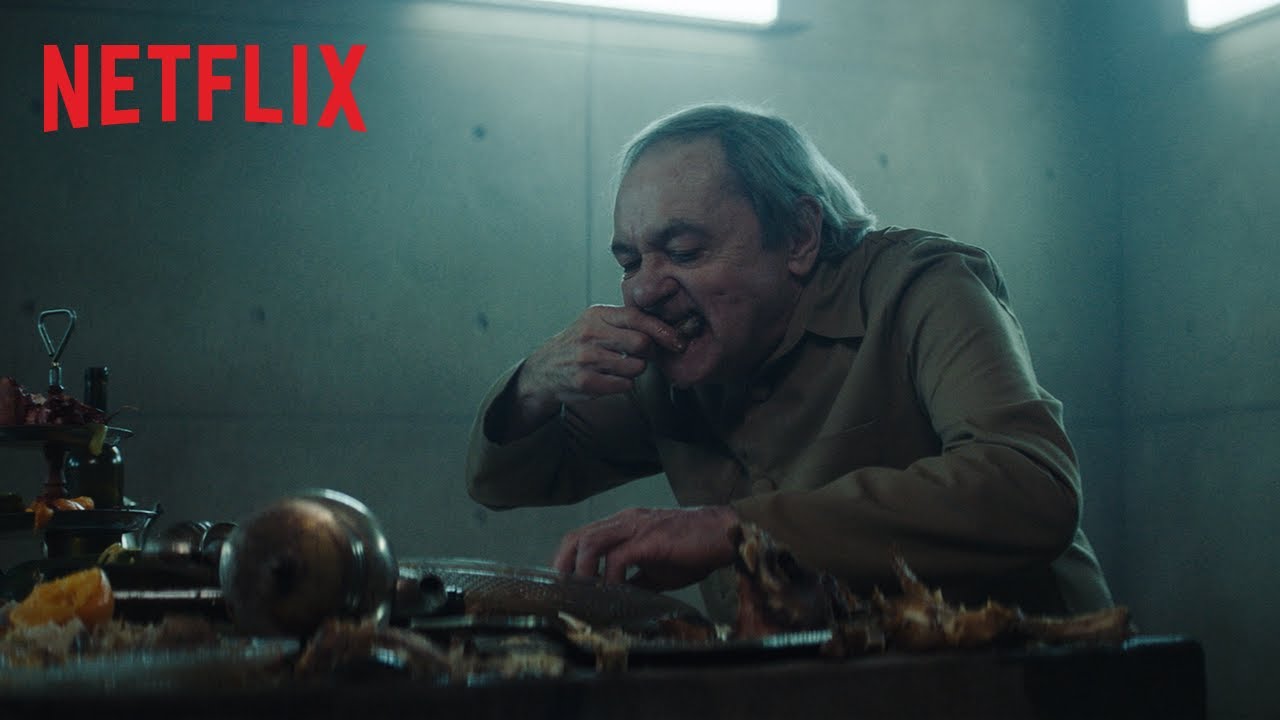
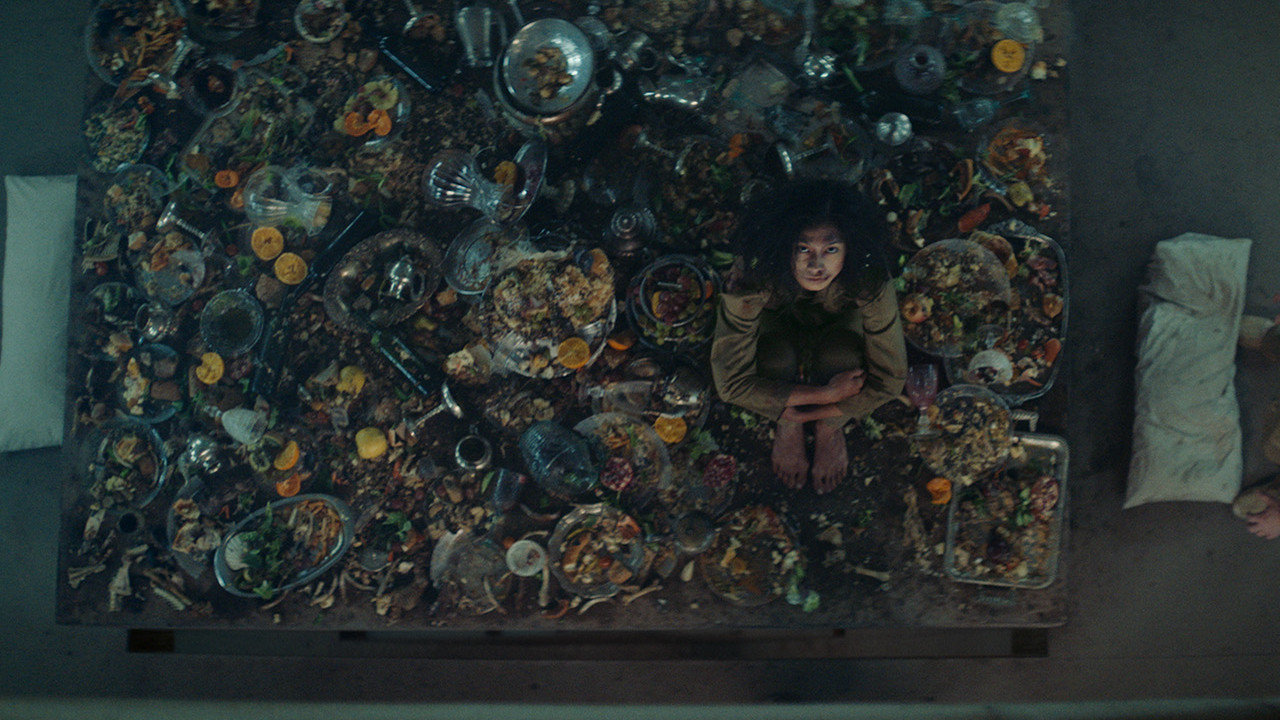
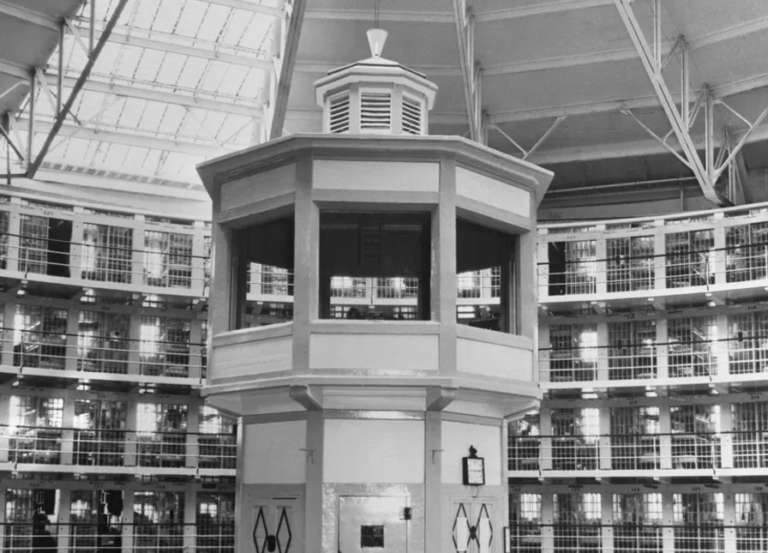
Buffet preparation. Exquisite dishes. The chef checks each dish in detail. It's ready to go. The food is laid out in great pomp, but on a concrete platform. This descends along an underground tower organized in levels that resemble a hole. Each level is home to two residents, who have a few moments - without the possibility of keeping food aside on pain of punishment - to eat as they please. table platform that stops at each floor. To continue its descent. Residents on the upper levels are spoilt for choice when it comes to eating, but the further down the platform goes, the less there is to eat. And what's left is unappetizing, even disgusting. Residents on the upper levels don't hesitate to vomit or defecate on the buffet once they've filled their bellies or licked up crumbs of leftovers here and there.

Yes, because in this tower, there's one rule that's self-evident: people on the upper floors are It's normal that they don't communicate with the lower residents, and helping them is out of the question. And the people on the lower floors are inferior. They deserve nothing but shit and contempt. Goreng, a new resident, is surprised by the way things work, especially as he voluntarily entered this center - a prison, in fact - to stop smoking. He might as well have stopped smoking, since he was only allowed to take one personal item with him: confinement for confinement's sake, he took with him the Don Quixote by Cervantes.
But a book may not be the most useful thing in an environment that is becoming increasingly hostile with each passing week. The misery becomes too great and Goreng revolts: he implements a solidarity plan to distribute food equitably between the different levels. But his means are of little use against the infernal mechanics of the hole, against a barbaric humanity, either selfish and greedy, or hungry and violent, capable of going as far as cannibalism.
A little too simple, but not so simple
Everything is simple and clear. The Platform is a critique of totalitarian, unjust capitalism, which gives too much to some and nothing to others. The tower is a metaphor for society; its levels represent the social classes: from the rich, selfish bourgeois who eat like pigs, with no respect for food or anything else, to the wretched who scrape dishes to try and get something to eat, who fear their superiors who oppress them, who suffer so much that they end up committing crimes as a result of their poverty. Goreng, the embodiment of the socialist ideal, the cultivated man, the awakened spirit who becomes aware of the absurdity of this system, chooses revolt to stop the destructive and absurd mechanism that makes every citizen either an executioner or a victim.
Discussion over. Thank you very much! While the film does indeed take the form of a metaphorical critique of the capitalist system, it is by no means limited to it. However, Galder Gaztelu-Urrutia's direction does disappoint. It's not just simplistic, it's also a little simplistic. At times, it's too demonstrative, too insistent, too tightly woven. The script says too clearly what it would have been better to suggest, with more nuance, less obviousness. As when Goreng's roommate reproaches him for his ideas of solidarity, asking, «But then you're a dirty communist?» and Goreng replies with dubious wisdom, «No, I'm just for fairness.» Okay, but it's a bit easy. A little big, even ideological.
The symbol of the book that the main character takes into the tower also speaks a little too much for itself: inevitably, the only one who has taken a book is the only one who dares to react in the face of injustice, because he is cultured and brave. Culture is salvation; education is the best antidote against crime and barbarism. Not all these ideas are wrong or bad, far from it, but a work of fiction is not a philosophical or societal essay. The message must be conveyed primarily through the experience of the characters, their evolution in the plot, the staging of shots and scenes, and a significant orchestration of sound effects and music.
Some images and set elements, albeit to a lesser extent, try to show too much: the walls are gray, because life in this tower is unhappy, subject to a totalitarian organization; the luminous tiles light up to regulate the rhythm of the day between mealtime, sleeptime and toilet time; and the architecture of the registration office in the center - which appears in a single scene, the only one apart from the opening scene, which is set outside the tower - is too obviously fascist, recovering the formal elements of the fascist architecture that actually exists, but modernizing it with concrete and neon lights. As with the screenplay, the director makes no mistakes or errors of taste in his set design. Once again, he's simply too insistent. We see too much of the thinking behind the result.
Not so simple, and rich in reflections
This doesn't prevent the photography from proving meticulous, intelligent and simply effective. The tower is well designed, and the many low-angle shots reveal the characters« state of mind, crushed by the system, crushed by their own vices. The photography is particularly impressive in its management of time. When Goreng's days are rather peaceful, the camera moves very quickly, cutting the scene into brief shots that show only one action. Actions of everyday life, the life of the average consumer, the life of a normal person in short. And we move frantically between the red light of night and the »natural" light of day, from hands plunging violently into dishes, mouths gulping, bottles of wine clutched, vomiting, to shaving, masturbation and gymnastics. The skill of the scene lies entirely in the identification it elicits in the viewer. As if, in a way, we were all living in this tower.
And since The Platform, The rather superficial critique of capitalism is surpassed by an exploration of the human soul, and of what lies at the very core of the soul: from the most barbaric passions to the noblest aspirations. Not forgetting the philosophy and theology involved in the evolution of history, and the status of a messiah in a society - who is the savior? what is his role? do we really need him? To the words of the Messiah: «He who eats my flesh and drinks my blood abides in me, and I in him.» This statement by Christ legitimizes cannibalism, according to one resident, but we understand that the deeper meaning of the phrase is skewed by the prisoners' misery, insofar as a word of Life becomes a word of Death. In the tower, everything is reversed; just like in our society, where so many words of hope, revolutions and pious wishes for equality result in their exact opposite.
Surprisingly, the articles in’explanation of the film are exploding on the web, but hardly any of them go any further than a critique of capitalism. Besides, what's the point explain a film? All the more so when it's done clumsily, by limiting the film to its appearance. A cinematographic work can be analyzed, interpreted and made to resonate with one's own experience and knowledge, but why explain it? Why pretend, as many do, to have the key to understanding the film's ending? It's all nonsense: the end is open-ended, unlike the tower. The ending, and comments about it, cannot limit the meaning of the film. The PlatformYou have to search, meditate, reconstruct, leave your heart open to what the work is saying.
With this article, you have witnessed a non-explanation of the film. If you haven't seen it and are tempted by vertigo, watch it. And look at yourself in it. Without explaining anything.
Write to the author: loris.musumeci@leregardlibre.com
Photo credits: © Netflix
You'll also like



 French
  German
  English
Leave a comment