




«The Florida Project», a contrast between children's joy and American social reality
Cinema Wednesdays - Loris S. Musumeci
«I can see when adults feel like crying.»
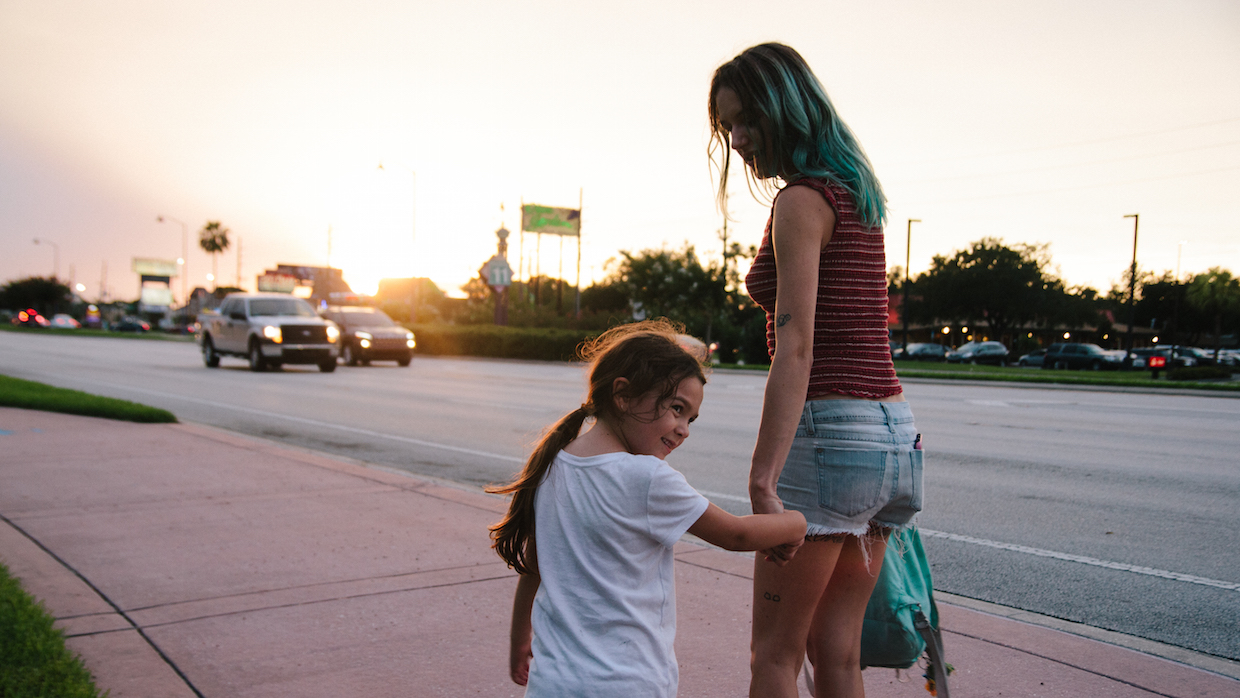
It's summertime. Moonee and Scooty, two mischievous children, are running around, shouting at each other from afar and laughing heartily. They live at the Magic Castle Motel, near Disney World in Florida. The scenery is dreamlike: the sky is blue, the buildings pastel. But then the kids start talking, and a vulgarity emerges that's as funny as it is astonishing. Fucks« punctuate the sentences of the six-year-old girl, and her friend doesn't seem to mind following her in this language. They spot a blue car at Futureland, the motel next door. It's the perfect opportunity to make the new tenant understand that kids want to have fun, without limits. They spit on the car.
Apart from a slight lack of education, Moonee and Scooty seem like normal kids. And they are. The only difference is that their mothers are very young and single. Moonee's tattooed mother, Halley (Bria Vinaite), smokes cannabis in the bedroom, feeds her daughter soda and pizza, and earns a dubious living just enough to pay rent to Bobby (Willem Dafoe), the exasperated but tender-hearted motel keeper. In contrast to the child's overflowing joy, social services get involved in the situation, at the risk of upsetting the little family.
Beware of victimization and caricature
Certainly, The Florida Project is a film whose audience members leave the theater exclaiming effortlessly, «that was a beautiful film!» Director Sean Baker's work is to be applauded above all for his set design. Visit dinners, In the U.S., stores and billboards explode with pastel colors, artificial paint schemes and huge cardboard decorations. In short, everything that's disgusting about the United States, or any Western suburb for that matter. Baker sets a realistic scene for a realistic subject. An «unworthy» mother, in her own words, a cute but uneducated child. In the vein of realism - more commonly known in cinema as neo-realism - the work carries a social critique.
The last two qualities, on the other hand, may have their shortcomings. As far as the story is concerned, there is a risk of victimizing the mother. The film does indeed fall into this trap during the most dramatic scenes. Halley is portrayed as a victim of an oppressive and unjust social system. At the same time, authority figures such as the police and social workers are caricatured with impunity.
We mustn't forget that, while it's illusory and hypocritical to imagine mothers who are always good, brave, kind and, above all, smiling, Halley feeds her daughter poorly, allows her all the most charming expressions of popular American jargon, and makes her participate in his sessions of selfies practically naked in the bathroom. When it comes to criticizing society itself and the Disney universe, the scene of the old pedophile talking to the kids at the motel picnic area is ridiculous. If the director really wanted to equate America's most powerful producer with pedophilia, he could have done so in another film.
A film about childhood
Despite this, there are still other good points to note about The Florida Project. The use of the handheld camera reflects the realism of the work, and the effusion of life that flows from it. In both the crisis and play sequences, the human movement of the filming, following simple human movements, reveals a kind of animated humanist genre photography. On the contrary, the free-standing camera stares at the motel or other dingy, fairy-tale-looking buildings to show the death in them. And every time, the children run in front of this frozen landscape, bringing the image to life. Sean Baker has a great sense of metaphor.
Last but not least, in addition to its scenographic and social aspects, the film is a lively tribute to childhood. Always innocent in the end; jubilant in the face of the details of life, from an insect to a lighter to an ice cream cone; knowing how to appreciate true friendship; faithful. It doesn't matter whether the final scene is one of disillusion or hope, of childhood condemnation or salvation. The Florida Project has said what he had to say, in a work that is both pleasing and poignant.
«You know why this is my favorite tree? Because it's toppled over but it keeps growing.»
Write to the author : loris.musumeci@leregardlibre.com
Photo credit: © clique.tv
You'll also like

 French
  German
  English
Leave a comment