




Marc Bonnant: «Becoming a lawyer is a fine line».»
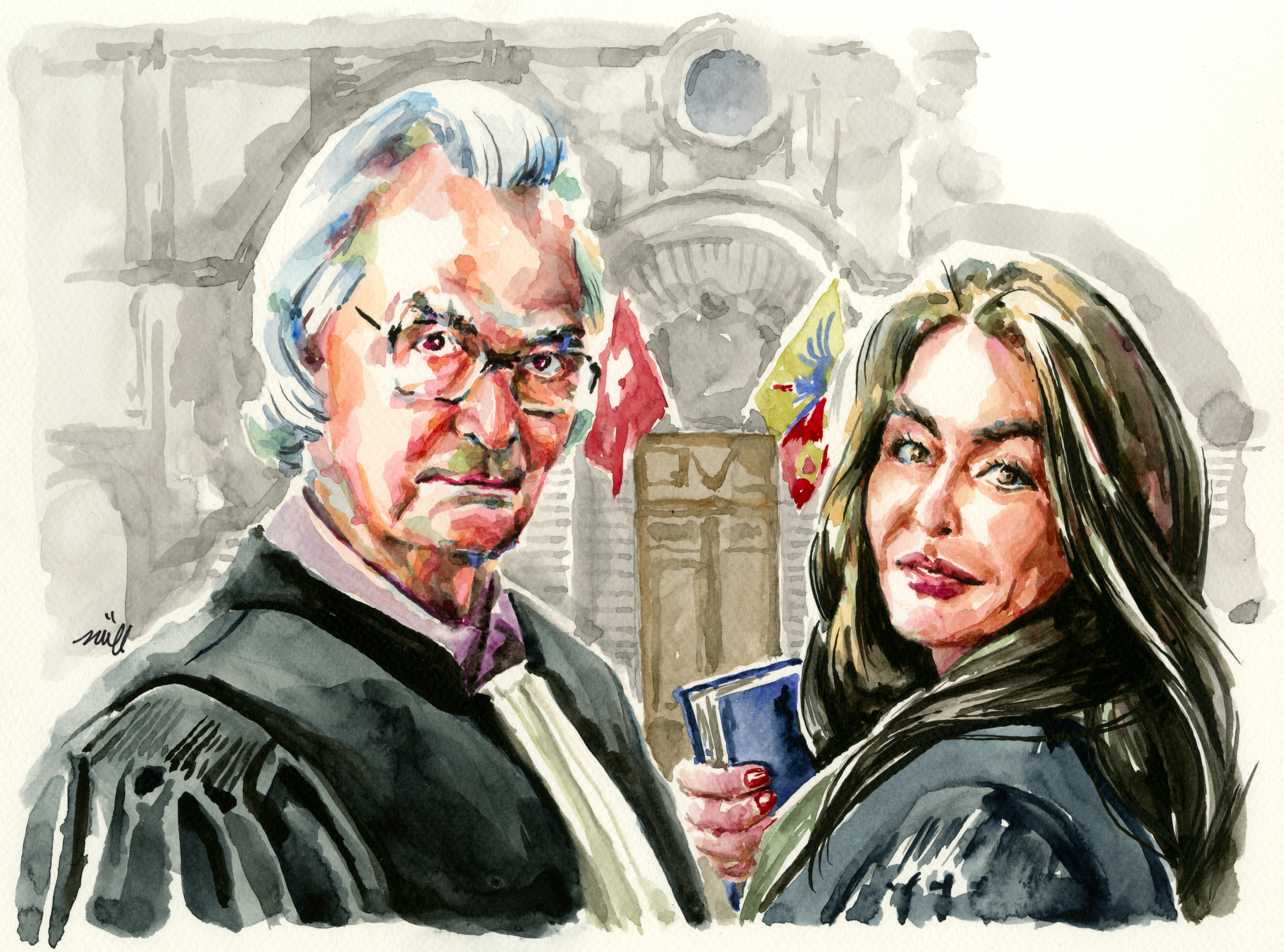
Marc Bonnant and Selma Memic. Design: ZZIIGG for Le Regard Libre
Banking secrecy, sex trials, media justice... The former President of the Geneva Bar Association, named best living French-speaking orator, remains one of the freest voices in French-speaking Switzerland. An intimate conversation.
They have confronted his legendary verve at the Palais, or entrusted him with their defense - sometimes even their lives. They all know that Marc Bonnant is a special figure at the Geneva Bar, and that it is his untrammelled vision that will peruse the case files, perhaps the freest in the legal profession.
But working for him, on a daily basis? It means tasting the demanding pleasure of the Socratic method. Questioning. Debating. Like the time when, just out of detention, I told him over the phone of my exasperation at a body search that I had judged too thorough to allow me to visit our client. A debate on dignity ensued.
Or that moment when, with a wave of his hand, he brushed aside a proposed challenge. He prefers calm combat, and often favours mediation.
Read also | Marc Bonnant: «With political correctness, we are the executioners of ourselves».»
It also means learning a new word in the French language, every day, at his side. «Your favorite word?», I ask him. He replies, «For its content or its sound?» - Its content. He'll say love. The one we give.
He loved them, his customers. And he still loves them. «Their fate has always been important to me. As for me, I wouldn't have liked it if he'd opened the door to another career.
Your name is associated with most of Geneva's major court cases. After so many years and so many pleadings, do you know what makes a great lawyer?
First of all, I'd like to make it clear that I don't consider myself a great lawyer, however you look at it. But it's true that I've been stroked by luck, a lot of it. And I've worked hard. In my opinion, talent is a grace; what really matters is effort. Work, work all the time, work day and night. So, work at what? Of course, reading, memorizing files and thinking. But also literature. I think reading is the living mechanics of eloquence, if eloquence still plays a role in our profession. Which is rather declining. But you have to read, read, read. Basically, never leave your mind alone. Violate your intelligence. Use your memory. Learn by heart, and one day, in a minute or half an hour, you'll be able to recapitulate what took you a lifetime to think. That's what improvisation is all about.
And don't doubt your choice of career. As Voltaire said at the end of his life, the profession of lawyer is the most beautiful in the world. Because it's a profession for others, it's an oblative profession. It's a profession of giving and gifts. It's open hands, it's helping people to live, it's restoring harmony. It's about making justice less unfair. It's fighting judges. It's a superb profession, full of energy and effort, and you have to practice it to the point of exhaustion. To die on stage, to die pleading.
Do you remember a memorable collaboration or mentor early in your career?
Yes, Roland Steiner, with whom I did my internship, and who was a man of marvelous intelligence, but unbearable character. Eruptive, arbitrary, rough. However, I owe him so much, and if one has what one should have, a sense of debt, i.e. recognition and gratitude, I have an infinite one towards Roland Steiner.
Lawyers are also shaped by their character, by their experiences, by what they read... Do you think that the legal profession, and in particular that of criminal lawyer, is a lineage profession that can be passed on to others?
Yes, I think we can be, in happy cases, inspiring. Is it about being a role model? In any case, it's about being a reference that allows you to say to yourself: «This is how I'd like to become. The whole problem of life is to become. This is the famous esti of the temple at Delphi. «Know thyself, gnỗthi seautón. To become. And to be a lawyer is to become. In my opinion, you need references, role models and, above all, a sense of debt and gratitude. That's how you make a lineage... The babies you'll make... I see you smile when I talk about babies?
You know very well that I delay my hour, Monsieur le Bâtonnier.
(Laughter) That's right, you're a modern woman! However, you can tell them that becoming a lawyer is a ridge, an ascent. Sometimes it means climbing to a place where the air is thin, but you can still breathe.
How did your defence instinct, your taste for being a lawyer, come about?
I wanted to be a diplomat like my father, which isn't very original. I liked the way I pictured his job. I went to Berne to apply, but as I was 18, they told me I was too young and that I should do something else. The idea suddenly occurred to me to become a lawyer, and I was lucky enough to be taken on by Roland Steiner. From that moment on, I never doubted that it would be my only vocation, my only appetite and my only desire. Even today, if I had to make that choice again, I would choose to be a lawyer.
In your opinion, should we plead for the beauty of words or for the grandeur of causes?
To bring the idea to life. Basically, the lawyer is a maieutician, a dowser. You have in front of you judges who may or may not be attentive, who sometimes close their eyes out of a desire to concentrate, and sometimes because they fall asleep. Your job is to shake them out of their sleepy state. It's about awakening a conviction in them. Not necessarily a conviction you have yourself, but the one you want them to have. You have to say what you want people to think.
And in your experience, would you say that people plead the same way at 20, 30, 40...?
No. Depending on your age, you plead differently. But it also depends on the era. The pleadings of today have nothing in common with those of 50 years ago. And even less so with the pleadings of the nineteenth century.th century. Body language was much more important, as was the dramaturgy of speech. We gave voice. Today, we plead in a bland whisper. And to put it bluntly and perhaps unpleasantly, we are infinitely less cultured than our ancestors.
When you plead your case, do you seek to change only one man's destiny, or do you also seek to change the very essence of justice?
It depends. Sometimes, when a life sentence is certain for an atrocious crime, for example, you don't just plead for a man. You plead a cause. That's what my dear friend Vergès used to say. I've often had the feeling that what I was pleading had an importance that went beyond the particular case. I plead, therefore I am. And in what way can my words, beyond the singular case, touch the universal, rise above it all. The word exalts. It lifts as it fills.
You spoke of conviction at the start of this interview. Is it conviction that makes sincerity possible, or sincerity that gives rise to conviction?
I'm not convinced that sincerity is necessary. Rather, it's the timeliness of the word. What is the thought I want to bring to life? And why do I want to bring it up? As life goes by, there are also things you wouldn't plead any more. When I was 20, I could plead for a rapist. Since I've had daughters, it's been harder. I could plead for a leftist. Since my right-wing sensibility has asserted itself, I wouldn't want to. I probably could, but I wouldn't want to. I'm talking about the time... 50 years ago, people would argue that the rape had been provoked, which today is unspeakable. It was readily argued that the woman had experienced pleasure, and proof was given if there had been golden rain.
What do you do when you don't believe in your client's innocence? Should you say so? Plead it differently? Convince your client first, not the judges?
No, you have to plead the case. Conviction is subjective, it doesn't carry any weight. You have to say: «Here's what the file allows us to think, and here's what the file forbids us to think. And always leave room for doubt, with the idea that it's better to set a guilty man free than to condemn an innocent man.
Working with you, I quickly realized that behind the defendant there's often a politician, an artist, an intellectual... is it also the lawyer's responsibility to make the client exist outside of what he's accused of having done? To lift him up?
Of course, you have to tell the man's story, knowing that as long as you don't plead the case, but tell the man's story, your word doesn't carry the same weight. The case is objective. But when you bring in the subjective part, i.e., here's the man, his childhood, his wounds, his cracks, you're telling a story, and sometimes you can't document it. There are a lot of rape cases these days. Sometimes the rapists have been raped, sometimes the traumas they inflict are traumas they have suffered. You have to tell that part of the story too.
In the course of your career, have you encountered the impossible defense? I'm not talking here about conflicts of interest, but about absolute evil, or the word when you realize that your client is someone else after all.
Yes, but there's still something to be said for explaining why man is what he is, and why he's perceived that way.
How do you plead on the victim's side and how do you plead on the defendant's side?
Always with fervour. Trying to be as talented and persuasive as possible.
You're a role model when it comes to arguing against public opinion. How do you view public opinion and the newspapers that read the plaintiffs' statements before anyone else?
Media justice is a horror. Firstly, it is not adversarial. Secondly, it ignores and flouts the presumption of innocence. What's more, it is often ideological. Behind it lies a a priori thoughts that are never in doubt. I find it absolutely appalling the place the media has taken in justice and its proclamation. Bear in mind, too, that when you are implicated by the media and after a few years justice clears you, those years are irretrievable and the damage is irreversible. What's more, the decision that exonerates you is usually the subject of three lines. Besides, public opinion is the opinion of a few. It is very often anything but public.
As someone with a taste for debate and conversation, are you worried about the disappearance of this type of exchange within my generation?
Yes, I think you'll be debating less and less because there will be consensus on most ideas. And supposing someone disagrees, they won't want anyone to know, because they'll risk being banned.
I found some notes dated 2017. I had attended one of your lectures at the University of Geneva, where you said: «Self-love is a first condition of wisdom, or the passage from self to other. From decoration to devotion. To pass from self to other, you have to be satisfied with your own conditions. There is no generous man unless he possesses self-love.» Isn't this a fine definition of a lawyer?
(Laughter) Yes, you have to settle accounts with yourself. And we have a lot to settle... childhood, real memories and invented memories.
You're viscerally attached to secrecy. Professional secrecy, banking secrecy... Where does this visceral attachment come from?
I think there's an element of intimacy in human beings that shouldn't be betrayed. Not everything is available to everyone. Not everything should be visible to some. I prefer shadow to light, I prefer night to day. I regret that, under pressure from the US in particular, we have abandoned banking secrecy.
Have we really given up on him?
Yes, very widely. In treaties that provide for the exchange of information. In tax law, too. And bankers themselves, out of an abundance of caution, no longer insist on it. Today, bankers feel obliged to tell everything. Spontaneously, even, he tells the authorities everything! Basically, bankers today are informers.
There's an important part of your day-to-day work as a lawyer that I didn't discover until working alongside you: mediation. Dialoguing with judges, with the prosecutor, with the opposing party... After all, didn't you win your biggest cases outside the courthouse?
I have indeed found solutions through mediation. Today, it's getting harder. Back then, we spoke to judges in complete confidence. When we said that it was under the reservations of the Palais or those of custom, it was like that. The judge kept the secret. Now, the judge tells you that he's talking to you, but that it will appear in the file in one way or another. It's not that they're betraying secrecy, they're just telling you that secrecy isn't possible. The secret is gone. However, in spite of everything, we must continue to mediate, always trying to reach agreement by saying: «Sure, war is pretty, but what's built on ruins?»
Trainee lawyer, Selma Memic signs his first article for Le Regard Libre.
You have just read an interview published in our paper edition (Le Regard Libre N°116).
You'll also like


 French
  German
  English
Leave a comment