

Fatti non foste a viver come bruti.
«You weren't made to live like brutes.»
Asking the question of an author's topicality exposes us to a double peril: on the one hand, the exhaustion of interest, and on the other, the refusal to accept the topicality of what is old. This often happens, either because everything that belongs to the past seems to have only the attraction of old-fashionedness, or because an ideology imposes the refusal of an author's contents, especially if he is medieval and fundamentally Christian like Dante.
And yet, in my view, it remains interesting to question this fact and attempt a tentative answer, even if we have to be content here with only glimpsing a few brushstrokes.
An upheaval in our habits
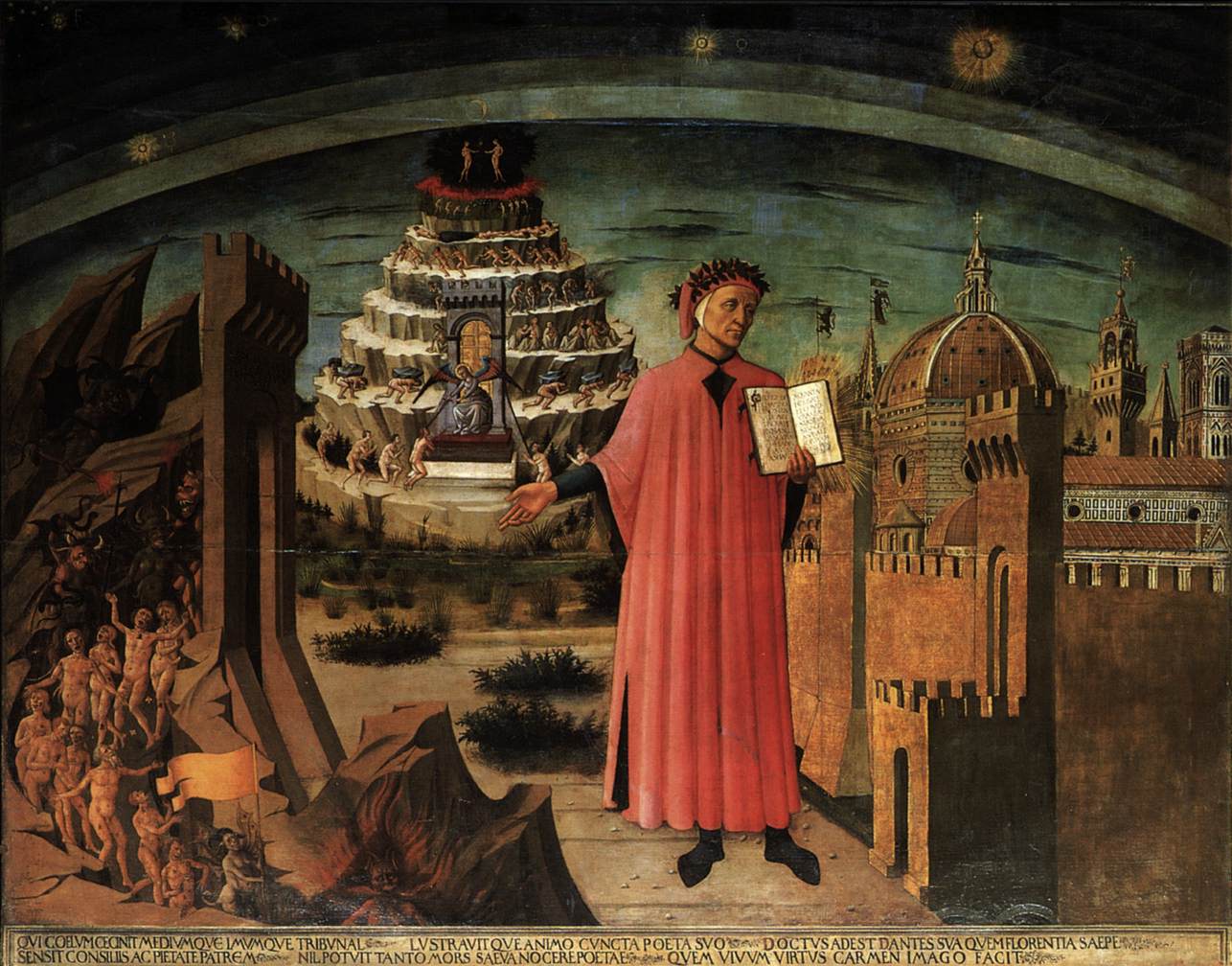
The Divine Comedy - in Italian La Divina Commedia - is the poem that recounts the singular and incredible adventure of a man. Lost in a dark forest of human darkness and sin, he is invited by the man he has always seen as his master, Virgil, to take a journey into the beyond. He will learn about and become aware of man's evil deeds and their consequences, in Hell; of the arduous and painful path to forgiveness and true freedom, in Purgatory; and finally, accompanied by the woman he has loved, of the heavens becoming «visible» in Paradise. In this way, he will experience true happiness: the beatific vision. His mission will be to bear witness to this to other men through this literature.
In terms of content, it's hard to understand why such a tale should still be of interest: is it really about an afterlife? It may please if we stick to a literal reading, following the story of the character in an astonishing «fiction». But are we prepared to follow him when he claims to tell the truth? Or when he rises from the letter to allegory, to symbols? And are we willing to accept the religious side, the moral, metaphysical and theological teachings, and even the seven-century-old astronomy and anthropology?
Some literature teachers devote The Divine Comedy a reading that defuses its explosive potential, which lies precisely in everything that makes it seem «old-fashioned». They're fond of literary genius, which they can't do without on a formal level, but they're not interested in the deeper motivations behind its writing. It is, in fact, because such a poem does not follow fashion, that it can speak today, and because it goes so far as to flatly contradict the fashion of our time, that it is completely current. This, insofar as it helps us to rediscover what is truly beautiful, what is worth living for and desiring.
In fact, Dante passione. The proof: on several occasions in recent years, I've had the opportunity to introduce the poet from Florence to French-speaking readers, and the result has always been very positive. Marked by astonishment, those who discover him realize that they have not been suffocated by a dusty book. On the contrary, they are surprised to have found a work full of realism, yet describing the unimaginable, showing the universal while starting from the story of a particular man, moved by the testimonies of people who died long ago.
If these paradoxes are possible, it's not only due to the author's literary genius, but also to what motivates his poetry, evident in every line.
Dante, poet of desire
As contemporary interpreter Franco Nembrini aptly puts it, Dante is the poet of desire. The desire for true happiness and salvation, the very reason for the work. As we learn in XVIth chant du Purgatoire, in which the author confides the profound meaning of human action: the search for a free and happy existence. The problem is that freedom is fulfilled in the good, and the faculty of desire, believing itself to be aiming for the right means of happiness, can err. Particularly when it lets itself be guided by material pleasure, which is only the first tool of desire to arouse men, without playing the role of finality. Dante tells of the possibility of «real», uplifting desire, with the simple fact of living at stake. He knows something about this, having almost lost his precious life in the dark forest, and having suffered humiliation and exile in reality.
Certainly, in an age of hedonists and lazybones, despairers and nihilists, the poet shakes things up, because there's a quest for happiness, but also a risk of losing oneself! Who wants to hear that? Should we read poetry to receive a moral lesson? But the seriousness of the issue is there for all to see. That's why it's so important that Dante isn't afraid to assert that the road to happiness is difficult, yet accessible to everyone. He himself did not deserve to see the «spiritual lives one by one» (Par. XXXIII, v. 24), but he was chosen precisely because he was lost. And just as a hand was freely extended to him, so he offers his poem to awaken his reader, admonish him and enable him to hope again.
In praise of virtue and knowledge
In Canto XXVI of the first Càntica, in the middle of Hell, Dante meets Ulysses. A scandal for the modern mentality: the Christian poet places Ulysses there because he dared to go beyond the limits of the known world on his last voyage. Has the thirst for knowledge been punished? No, not at all: it's arrogance and fraudulent cleverness that are blamed on the adventurer. Instead, the author praises the desire for knowledge, leaving Ulysses to express it himself. What led to his death, he realizes, was his last voyage, the one he undertook with some of his crew who had survived the Odyssey. Ulysses had reminded his men to consider their origin: they were not created to live like brutes, but to follow virtue and knowledge (Enf. XXVI, vv. 118-120). Even in the damned soul of the hero with superb inclinations, there may be enough clarity to recognize which is the true desire that should guide man. Not pleasure, as in the case of the lustful, the greedy, the avaricious and the prodigal, but virtue and knowledge.
Intellectual abstraction? No. Dante, holding the reader's hand, reveals that through the arduous path that passes through the perils of Hell and the roughness of Purgatory, one can obtain this happiness - namely, knowledge, which is the most delectable good there is. And this is not intellectualism, because it is the knowledge of God, which is the most concrete and complete joy. Just to understand that this is possible, a path of purification is necessary. Dante himself, tired, risks falling down again and again; that's why Virgil, Beatrice and St. Bernard will be at his side.
Cato, at the start of Purgatory, scolds lazy souls who don't want to go up straight away to purify themselves and enter Paradise. The protagonist is encouraged to repent by Beatrice in the Garden of Eden at the top of Mount Purgatory. This helps him reach his goal: to desire nothing that is not God. The saints repeat this over and over again. These too will be on the poet's path, and he will meet them in Paradise, before attaining the supreme gift: a moment of beatific vision. It cannot be described, for it is inexpressible. Ineffable, burning, life-giving joy!
The Divine Comedy remains a poem that can strike a chord with contemporary readers. It invites dialogue and points the way. It touches on the laws that are at the heart of man, the same laws that created the universe: «the Love that moves the Sun and the other stars» (par. XXXIII, v. 145).
 French
  German
  English