



Quite a mess

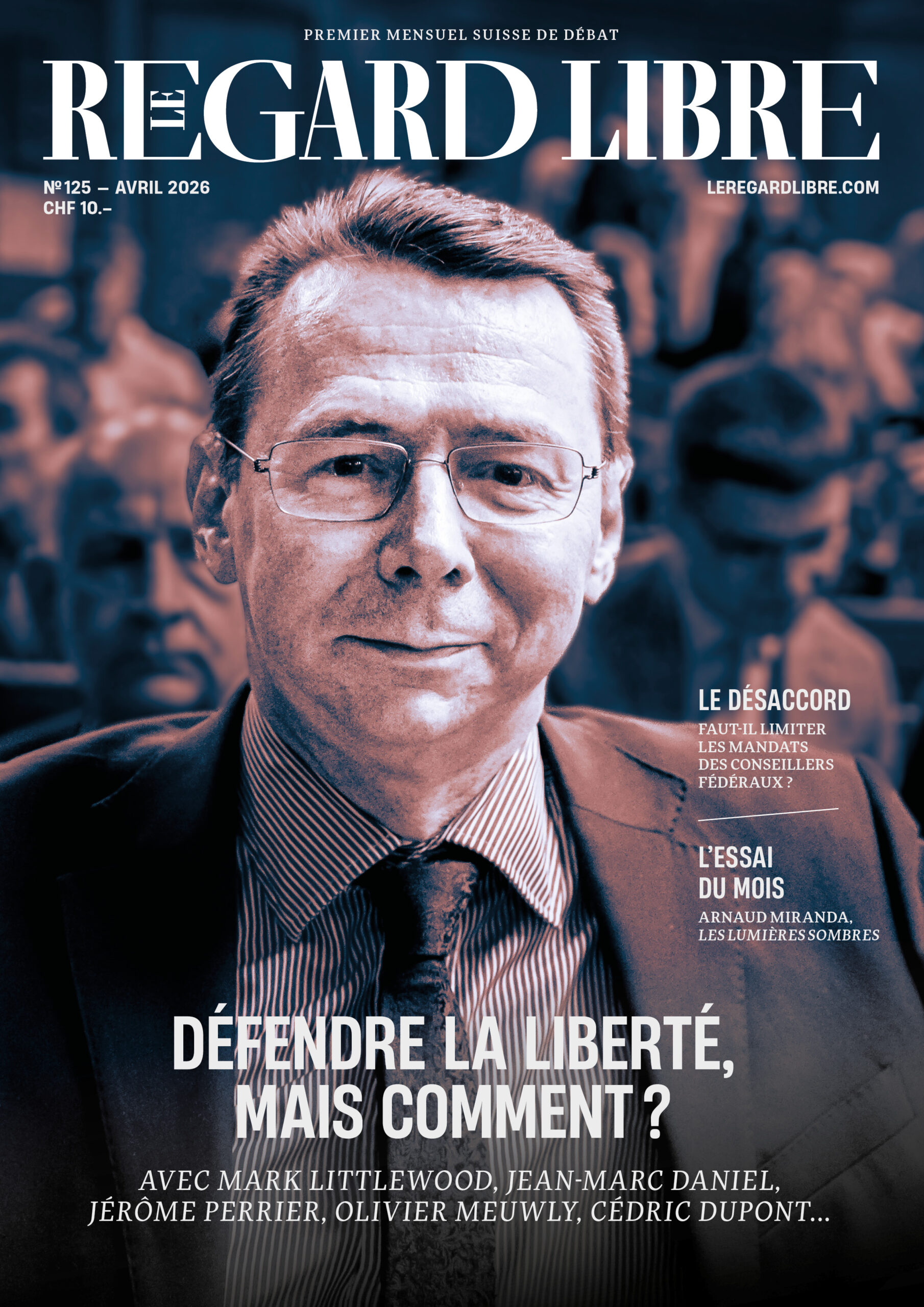
Antoine-Frédéric Bernhard, deputy editor-in-chief of Regard Libre. Drawing by Nathanael Schmid
The second half of the 20th century was marked by at least two major events: the massive decline in traditional religious practice and the advent of the consumer society. One thing, however, has not changed: human nature, which in one way or another always manifests the need for a relationship with the sacred.
The sacred is defined as that which «belongs to a separate, inviolable domain, privileged by its contact with divinity and inspiring fear and respect» (TLFi). A clear boundary separates the sacred from the profane, which cannot be crossed without the requisite respect, on pain of «sacrilege», i.e. precisely the «profanation of what is sacred». This boundary can be signified by symbols (architectural or clothing, for example), ritualized gestures (genuflecting on entering a church, going on pilgrimage, taking off one's shoes to enter a mosque, etc.), but also rules and prohibitions (one does not touch the body of the king, one does not take the life of an innocent, one does not use a sacred object for profane purposes, etc.). In a broader sense, the sacred is the domain of absolute values, hierarchies, verticality and stability. It contrasts with the profane, the realm of the relative, the interchangeable, the horizontal, the moving. While we can dispose of the profane as we wish, we approach the sacred ritually.
Today's consumer society could be roughly summed up by the omnipresence and domination of money, which has become synonymous with success, achievement and, above all, omnipotence: everything can be bought and sold. It's the triumph of the profane. Whereas what is sacred has a value for what it is, an intrinsic value, that of a good traded on a market depends on fluctuations in supply and demand. An old car may be worthless for a long time. If, one day, however, its value soars due to a sudden interest on the part of collectors, it will sell at a premium. Consumer goods have only relative value.
It's becoming clear that contemporary consumer society, by its very nature, is incapable of satisfying the need for a relationship with the sacred, inherent in the human condition. It is unable to fill the void left by the massive decline in traditional religious practice, which until the 20th century was the main means of access to the sacred for the overwhelming majority of the population. Symptomatic of this void is the constant emergence of new forms of relationship with the sacred, potentially as numerous as there are individuals. The first to come to mind is the success of practices such as meditation, personal development and even certain forms of New Age spirituality. Traditional religions haven't said their last word either, and it's common to see them gradually transforming from institutional religions into membership religions, with a sometimes large influx of new converts, sometimes resulting in a shift towards more radical religious practices.
More diverse, and sometimes contradictory, trends can also be observed. In a resolutely pluralist society, devoid of any unifying principle such as religion once had, we can observe, for example, the coexistence of the sacralization of individual sensibility with all its drifts, as well as a tendency to sacralize science, or a certain idea of science, which appears to be the ultimate source of authority and objectivity. To which we could add the radical, quasi-religious militant commitment behind certain causes such as ecology, animal rights, anti-racism and others, all of which are manifestations of a phenomenon that this issue of Regard Libre attempts to shed some light on.
Write to the author: antoine.bernhard@leregardlibre.com
You have just read a free editorial in our paper edition (Le Regard Libre N°106). Debates, analyses, cultural news: subscribe to support us and get access to all our content!

You'll also like


 French
  German
  English
Leave a comment