



«Anyone who wants to innovate is more likely to fail».»
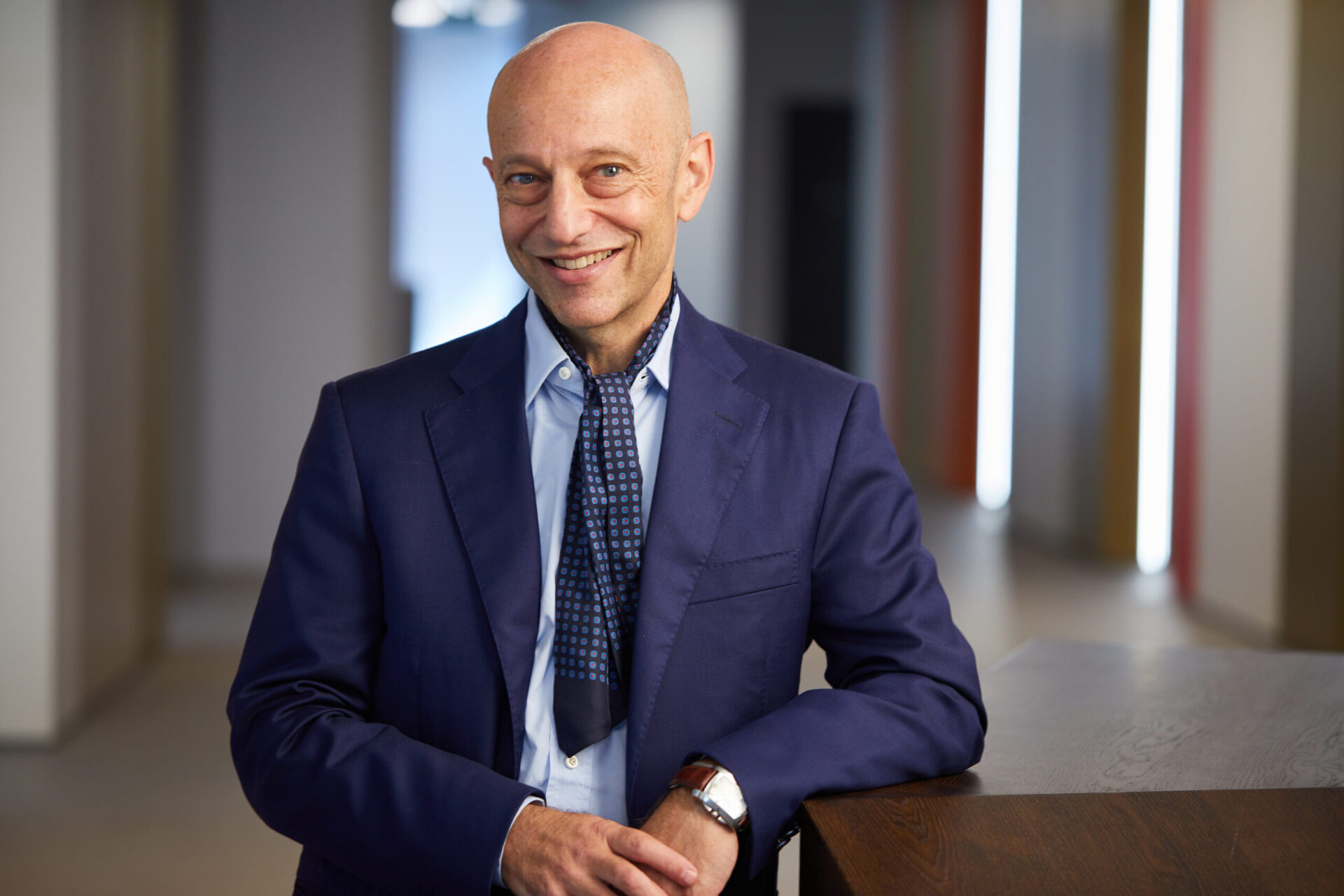
«I knew how difficult it was to change consumer habits, but I wanted to try anyway,» says Daniel Bloch.
Without crises, there would be no real progress, says Daniel Bloch, owner of chocolatier Camille Bloch. For him, success is partly a matter of luck.
The conversation starts immediately. «I'm not really afraid of failure as an entrepreneur, otherwise I wouldn't have become an entrepreneur,» says Daniel Bloch, CEO and Chairman of the Board of Chocolaterie Camille Bloch, named after his grandfather. «I am driven by a fundamental confidence in my ability to accomplish what my two predecessors have already achieved.»
Daniel Bloch has run the family business, which includes the renowned Ragusa and Torino brands, for three generations. Founded by his grandfather Camille in 1929 in Berne, Daniel Bloch took over the reins of the company from his father, Rolf Bloch, over 20 years ago.
His father once told him that you don't have to be a genius to run a business.
What didn't seem like an enthusiastic compliment at first glance actually turned out to be a liberating realization. After all, entrepreneurs are rarely the visionary supermen that the media like to portray. «Most of those who possess these qualities fail,» says the chocolate boss with conviction. Of course, there are exceptions. However, we shouldn't measure ourselves against the exceptions, but against the rule.
A redundancy as a turning point
For Daniel Bloch's entourage, it was almost a foregone conclusion that he would one day become the director of this company, but for himself, this was not the case for a long time. After training as a lawyer in Bern, he wasn't immediately drawn to the solitude of Courtelary, a village in the Grand Chasseral region and the birthplace of Ragusa. Instead, he went abroad to New York and Paris, where he also obtained an MBA.
The 63-year-old from Bern didn't want to join the company simply because the logic of his biography demanded it, but out of personal conviction. However, this question remained unanswered for a long time, not least because of other professional opportunities. The real test came with the handover. The father was always present and the son had to take over, a situation which, in family businesses, is rarely free of tension.
Read also | Productive self-doubt
Daniel Bloch felt that it was not enough to simply carry out the plan that life had in store for him. He even felt an inner block. «Something was holding me back, and I didn't know exactly what it was.» His radical response: resignation. It was an affront to his disgruntled father, but it also had the desired effect.
Within 24 hours, the transmission plan had been renegotiated and adapted to his ideas. His father's project became his own. He withdrew his resignation. «It had to happen,» says Daniel Bloch today. We like to talk about handover, but we also need a takeover, an active assumption of responsibility. The crisis created a new equilibrium. From that moment on, his commitment to the company was total, both emotionally and intellectually. «And finally, my father was also reassured that I wasn't just a part of his plan.»
The boss isn't always right
I ask «Mr Ragusa» where he failed. He doesn't have long to think.
A particularly rewarding experience for him was an international expansion strategy that focused entirely on the Swissness and competence of the chocolatiers, and less on the products themselves. To this end, an umbrella brand was created with the attractive slogan «Chocolat Camille Bloch - mon chocolat suisse». But even after five costly years, success was slow in coming. Worse still: in the Swiss market, the strength of the Ragusa and Torino brands suffered.
Daniel Bloch had led the project. And it was he who sounded the alarm - much to his surprise, despite strong internal resistance. «Our mistake was to focus too much on new consumers and not enough on existing ‘Ragusa fans‘. The brand's fans should always be the center of attention, not the ones we'd like to have,’ he explains today. And what has he learned from this experience? It's essential to be able to admit failure, both to others and to yourself. The ability to let go is an important quality for an entrepreneur.
Read also | «Anyone can become an entrepreneur»
Daniel Bloch draws my attention to a particular form of failure that can also result in success. This is when, in the «ideation process», a bad idea turns into a good one, and a supposed mistake becomes a good decision. This is what happened when Daniel Bloch, looking for a well-known brand ambassador for Italy, first thought of Michelle Hunziker, but then abandoned the idea on the advice of his colleagues in favor of a strong ambassador for Switzerland.
This paved the way for a long-standing partnership between Ragusa and skier Lara Gut-Behrami. «My initial idea led to a counter-proposal and ultimately to a very sound decision.» For Daniel Bloch, this is more than just an anecdote: it's the expression of a corporate culture in which contradiction is possible and desired.
This example also shows that the boss isn't always right. He doesn't particularly like being contradicted, but he accepts it, he says, probably half-jokingly.
Silent capital in the company
Daniel Bloch doesn't see failure as the simple opposite of success. Rather, he emphasizes how failure and innovation are closely linked.
«Anyone who wants to innovate automatically fails more often,» explains the boss. For him, this is not a tragedy, but a logical consequence. Daniel Bloch, for example, failed with his idea for a Ragusa variant with reduced sugar and higher hazelnut content, because the chocolate bar proved brittle and unstable. But here again, the process gave birth to a new idea: Ragusa-coated nuts. They were a great success and expanded the Ragusa family. «Incidentally, I also failed with my rather technocratic name idea “Ragusa 60%” in favor of “Ragusa So Nuts”. Fortunately,» says Daniel Bloch with amusement.
Read also | «Switzerland must not become the world's library».»
In contrast, the innovative coffee «So Nuts» were a flop. The idea of edible coffee pastilles was developed by a start-up and adapted by Camille Bloch. «I knew how difficult it is to change consumer habits, but I wanted to try anyway.» The further you get from the core of the brand, the riskier it becomes. «When everything goes well and you succeed, you learn surprisingly little,» explains Daniel Bloch. But that's okay. You can simply enjoy success and not try to learn something new every moment of your life.
On the other hand, mistakes force us to question ourselves. Provided you're prepared to admit your mistakes. «Realizing that you yourself are part of the problem is a difficult art. As a lawyer, I also have a tendency to blame others for mistakes,» he says with a wink. For Daniel Bloch, it's also important that the knowledge gained from all those unsuccessful attempts remains with the company as a kind of silent capital. «Curiosity and a thirst for knowledge are more important to me than whether someone makes a mistake or fails with an idea,» explains the entrepreneur.
Niche market in Israel
In his almost 30 years at the helm of Camille Bloch, he has not been spared situations that have threatened the very existence of the company. He makes no reference to the US tariffs, which only apply to 3% of sales.
«I shouted louder than it hurt,» he declares, referring to his (also unsuccessful) political campaign to reintroduce the «chocolate law».
However, the boss experienced a «critical moment» due to the explosion in cocoa prices. Starting from 2,000 US dollars per ton at the beginning of 2023, prices peaked at 12,000 dollars per ton at the end of 2024. For Camille Bloch, this meant that the price of cocoa butter had risen from 5 to 40 francs per kilo. ’I really didn't know how we were going to finance this.« Significant price increases were necessary, which is always tricky in a price-sensitive market. However, it's not possible to guard against every worst-case scenario. »One should not commit a desperate act for fear of failure.« We find this fundamental confidence here. In the meantime, prices have stabilized.
Read also | Entrepreneurs are freer people
Camille Bloch has found a particular niche with its kosher products, which sell particularly well in the USA and Israel. Coincidentally, the brand also has a strong presence at Tel Aviv's Ben Gurion airport. The local buyer was initially turned down several times, as Camille Bloch normally delivers only to importers and not to individual outlets.
«In the beginning, we were very defensive, even arrogant,» says Daniel Bloch today with slight regret. «It was only on his third visit, when the buyer told me his wife was a Ragusa fan, that I gave in.» Forecasts were for annual sales of 50,000 francs. However, in its first year, it achieved over half a million sales and quickly passed the million mark. Today, the Ben Gourion Duty Free is the world's largest point of sale.
The Chinese market is not currently a priority for Camille Bloch. He has deliberately chosen not to rush into China like many others. The chocolate culture there is still underdeveloped. In general, you don't enter such a market until later. Daniel Bloch also recalls an ambitious project with potential Chinese partners: to produce liqueur chocolate with the Chinese alcohol Moutai. The commercial potential is enormous. So are the risks. However, the company didn't let itself be dazzled and gave up. «Often, the best things are those we don't do», concludes Daniel Bloch.
The journalist Fabian Gull is an editor at Schweizer Monat.
You have just read an open-access article from our print edition (Le Regard Libre special issue N°7). Debates, analyses, cultural news: subscribe to support us and access all our content.

You'll also like


 French
  German
  English
Leave a comment