




In praise of the long sentence

Photo: Prateek Katyal (via Unsplash)
In an age of slogans and elusive attention spans, the short sentence is a must. They click, hit and sell. And yet, some spaces resist. In the meanders of literature, language catches its breath.
We live in the reign of the short sentence. This is due to the commandments of communication: capture attention, impress the message, convince instantly. Strolling through social networks, the contemporary individual is inundated with sentences that get straight to the point. Texts proudly display their slightly forced anaphoras. It's brief, it's cadenced, it's repetitive. You have to entice, create rhythm. Dynamic. Direct. Short.
Make no mistake, this is a legitimate cause. You have to be clear and concise to be understood. Long-winded sentences lose a constantly stimulated audience. Attention is hard-won. Like architectural minimalism, the short sentence purifies. Nevertheless, in a world of pastel Swedish lofts, there are still orthodox churches of language, spaces where words stretch, commas pile up, digressions flourish and sentences entwine.
Literature is the place of linguistic ecstasy par excellence. Its perfect instrumental uselessness gives authors the freedom to let language breathe and dare the superfluous. Ornamentality is no longer suspect, and the reader can still wander through the layers of text as if exploring a baroque palace. Take Joris-Karl Huysmans, a writer of absolute refinement, describing the splendid painting Salome dancing in front of Herod by Gustave Moreau (see opposite) in A Rebours (1884):
«Around this statue [Herod], motionless, frozen in the hieratic pose of a Hindu god, perfumes burned, releasing clouds of vapors that were pierced, like the phosphorus eyes of beasts, by the fires of the stones set into the walls of the throne; then the vapor rose, unfurling under the arches where the blue smoke mingled with the golden powder of the great rays of daylight that fell from the domes. (...)
Her face solemn, almost august, she [Salome] begins the lewd dance that is to awaken the slumbering senses of old Herod; her breasts undulate and, as her necklaces swirl, their tips rise; on the moistness of her skin, the diamonds, attached, sparkle; her bracelets, belts, rings, spit sparks; on her triumphant gown, seamed with pearls, branched with silver, lamé with gold, the cuirass of goldsmiths whose every mesh is a stone, enters in combustion, crosses serpents of fire, swarms on the matte flesh, on the tea-pink skin, as well as splendid insects with dazzling elytra, marbled with carmine, punctuated with aurora yellow, diaprés of steel blue, tigréed with peacock green.»
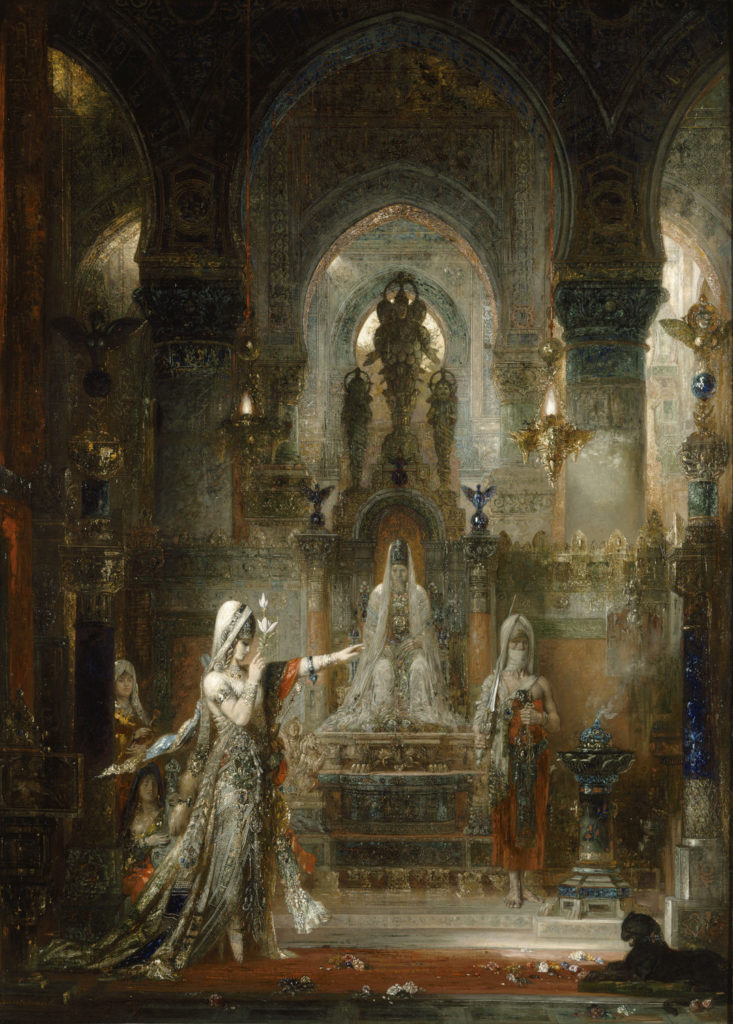
What a whirlwind of words to describe a simple dance! But beauty remains a fundamental need, even an imperative. In the face of the profitability of words, the literary experience elevates the individual. The relationship with words takes on a deep, voluptuous quality. It is in literature that the contemporary citizen, bombarded with «impacting» phrases, can take refuge, losing himself in an aimless stroll and relearning to live language in a slow, continuous breath.
Journalist and consultant, Pablo Sánchez is an editor at Regard Libre. Write to the author: pablo.sanchez@leregardlibre.com
You have just read an open-access article. Debates, analyses, cultural news: subscribe to
to support us and access all our content.
You'll also like




 French
  German
  English
Leave a comment