



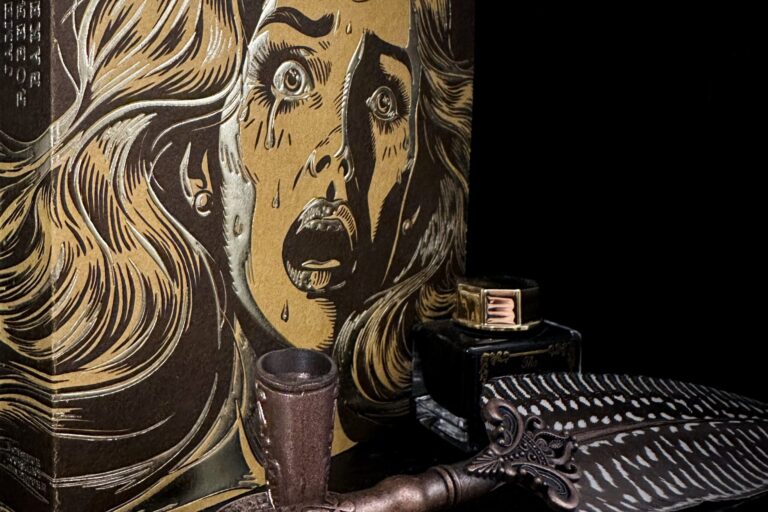
The Life of Andreas Altmann: A Powerful Account

Tuesday's books - Amélie Wauthier
From his parents, Adreas Altmann had only kept the copy of Mein Kampf the couple had received for their wedding. A book, and bad memories.
While young Andreas’s first few hours of life were far from easy—his mother tried to smother him when she learned she had given birth to a fourth son—things weren’t really going to get any better as time went on. From his early years, Andreas remembers the pain he inflicted on himself to get his mother’s attention and be loved by her. To no avail. As for his memories of his father, they date from after he turned nine and are hardly any more pleasant.
Franz Xaver Altmann is a man whose mind and heart have been ravaged by World War II. Though he once had everything going for him and seemed destined for success in life, he now finds himself stuck running the family business—a rosary shop passed down from father to son. He never stops tormenting his wife—and, after kicking her out, his children as well. It is in this climate of war—both physical and psychological—that young Andreas, his brothers, and his sister will try to find their way in the world. In Altötting, a town where—as if that weren’t enough—Catholicism also thrives and runs rampant.
«So I also stole to stave off my hunger—and to keep from getting even paler, even more anemic. It seems absurd: a son who has to steal from his own father to keep his gastrointestinal tract functioning. It’s important to note that we weren’t living with a working-class guy, or an unemployed drunk, but with a rosary maker—a devout member of the Roman Catholic Church—who belonged to the affluent middle class.»
In this autobiographical novel, Andreas Altmann recounts his childhood, scarred by the violence inflicted by his father and moralizing Catholic teachings, which gave rise to many neuroses and fears within him, such as his fear of women. These two toxic institutions are equally culpable when it comes to abuse and mistreatment. We follow Andreas’s struggle to find a purpose in life—amidst a string of failures in school, music, and sports—his need to find a surrogate father figure, his questioning of the reasons that shaped his father into the man he became, and more.
The memories he recorded in his diary enrich this poignant, deeply moving story, which you can’t put down despite the extreme brutality of the events. The reader is drawn in by the author’s style, which successfully conveys his desire to rebel. One feels an irresistible urge to find out how the young boy will fare—if he survives at all—as well as what will become of his various tormentors.
This testimony explores what shapes us and conditions us as individuals and as human beings connected to other living beings. How much control do we have over ourselves—from the development of our own personalities to the choices we make to fulfill our potential? What determines our ability to follow or reject a doctrine? Like Andreas’s father, who was himself influenced by his own father and excessively replicated a pattern that was familiar to him. At what point can we break free from and break the cycle of a family pattern that has been repeated for generations?
Andreas Altmann has this desire to understand who his father is and this determination not to repeat the same mistakes his father made. His father serves as an example of what Andreas does not want to become. The young man, who cannot stand the role of victim, is driven by a fierce determination to find a way to free himself from this father whom he has so often dreamed of killing. He has found in his hatred a means of survival—the driving force that has helped him get by, but also the bond that has allowed him to forge or strengthen certain relationships, as was the case with his brothers and sister.
«What bound us together was our anger toward »the old man.» That’s what we called Franz Xaver Altmann.».
This is the heartfelt cry of a man whose voice others have tried to silence his entire life, and who is now speaking out to protest the injustices he has endured. A free and dignified man whom nothing and no one has been able to silence.
Write to the author: [email protected]
My dad's shitty life, my mom's shitty life, and my own shitty childhood
Andreas Altmann
Actes Sud Publishing
2019
325 pages

You'll also like




 French
  German
  English
Leave a comment