




Staying in «a crazy country»

I would tend to say that The Pushkin estate is a novel about existential questions. Existential questions about a man caught up in his (ex-)wife's plans for exile. Existential questions about art and creation. Existential questions about the life choices of a man in his thirties. And all this against a backdrop of Soviet dissidence. That's a lot for a 140-page book. So, no, we don't understand everything right away. I'd even say some parts are better than others. And yet, the writing is worth the detour.
Dovlatov is an author who should be read in the morning. Go figure. I didn't feel the same way about The suitcase, but his work, The Pushkin estate, In any case, it's best enjoyed before noon, accompanied by a cup of coffee and, why not, a typical Spotify playlist. Sunday Morning. Avoid trying to decipher it on a techno net, in the evening after a day's work. The hubbub of the 5 p.m. train is not recommended either. That's been my experience. But I'm a morning person. If you're an evening person, my theory might not work...
Let's just remember that to read Sergei Dovlatov, you need to be in great shape. On an empty stomach too. Unlike his hero. Boris Alikhanov is a writer and drunkard - and the character's margins are wide - who's trying to get on with his life as best he can, while trying to write, why not, an intelligent masterpiece that's adored by everyone. Note that this is a rather dark and acidic tale. With a number of witticisms that are extremely well enhanced by translator Christine Zeytounian-Beloüs:
«I have a drink before I go downstairs, and my condition improves. Dozens of books have been written on the evils of alcohol. And not a single brochure devoted to its benefits. I see this as a gap.»
The USSR or exile
This is the story of an (anti-)hero, Boris Alikhanov, who, in the 60s and 70s, is hired as a guide at the Pushkin estate. The estate is a real-life museum complex built around the core of the 19th-century classical poet's family estate.th century Alexander Pushkin. The latter, ultra-famous for his writings, was also exiled for calling for civil disobedience in the face of the state. Some might say that Pushkin was always more liberal than revolutionary. The fact remains that he was lumped in with his Decembrist friends - a group of intellectuals who demanded a constitution that would guarantee the Tsar freedom of opinion and expression - and so was driven out.
A similar analysis could be made of our aspiring writer Boris Alikhanov. In the first pages of the book, he is asked, «What's wrong with you? You're red.» And his answer: «Only on the outside. On the inside, I'm an old-fashioned constitutional democrat.» It must be said, at this point in the chronicle, that Boris Alikhanov collaborates with dissident magazines. It soon becomes clear that he is being followed by the KGB. The secret services caused him few problems. Dovlatov himself is said to have taken advantage of the organ's help to go into exile at the end of the 1970s. The parallels between the author's life and those of his hero are perpetual.
«Emigrating was like being born a second time.»
Exile. Exactly. Another important element of the story. The problem could simply be summed up as «to flee or to face?» Our hero's ex-wife, Tania, has decided to move to the USA with their daughter. A heartbreaker for Alikhanov - who, by the way, doesn't take much care of his little Masha (that was another era) and is still sleeping with the mother (as if anything had changed).
«- The only honest way is through mistakes, disappointments and hope. Life is about discovering the boundaries of right and wrong through personal experience... There's no other way... I've reached a stage... And I don't think it's too late...
- They're just words.
- Words are my business.
- Still others. It's all been decided. Come away with us. You'll live another life.
- For a writer, it's death.»
Two visions collide. Tania asks why he doesn't want to emigrate. He replies «There's nothing to explain... My language, my people, my crazy country... Even the Soviet cops, I like them». She retorts, «Love is freedom. As long as the doors are open, it's fine. But when the doors are closed from the outside, it's prison». But he doesn't give up. Especially as he's attached to his language. Russian. «When you're forced to express yourself in a foreign language, you lose eighty percent of your personality. You lose your ability to joke and your sense of irony. This idea alone frightens me.»
«Behind his back, a swear word was drawn in chalk. An insult with no addressee. Art for art's sake.»
A life of anguish and museum
It has to be said that the poor boy is tormented. He drinks, as we mentioned. And beyond his image as a pedantic-intellectual-egocentric-ambitious-rat, we quickly understand that he is above all on a desperate existential quest. «On the surface, I was a full-fledged man of letters. In fact, I was on the verge of a mental breakdown», he asserts. For Boris, the intermittent drunkard, is above all the blank page through which Dovlatov questions the purity of artistic production. The phrase: «At thirty, you must have solved all your problems, except those directly linked to the creative process» appears at least twice in this little book.
And perhaps it's these assertions that compelled me to enjoy the book in the first place. Following the adventures of a thirty-something in the throes of anxiety about the choices he's going to make in his life is something you can only face at your best.
The story is punctuated by anecdotes from daily life at the museum. Told, of course, with a great deal of irony. First, the styles of the visitors, from the disinterested to the ultra-cultured. Then the guides, from the eloquent to those suffering from acute flamingitis. And finally, the women who gravitate around this little world: looking for men; only men; no criteria.
In conclusion, even if at times I felt overwhelmed by the numerous references to Russian authors, to supposedly familiar places and to the turbulent Soviet context, what I really enjoyed was this hero's inner journey, driven by a desire to experience freedom in his own country. With casualness. Perhaps just the opposite of Dovlatov, who eventually leaves.
Write to the author: diana-alice.ramsauer@leregardlibre.com
Photo credit: Mikhailovskoye Pushkin Memorial Museum-Reserve © DR
You've just read an open-access article. Debates, analysis, cultural news: subscribe to support us and get access to all our content!
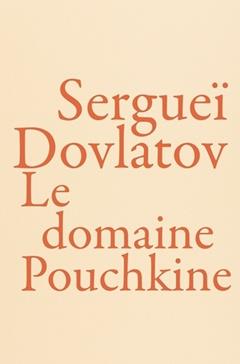
Sergei Dovlatov
The Pushkin estate
Translation by Christine Zeytounian-Beloüs
La Baconnière
2022
147 pages
You'll also like

 French
  German
  English
Leave a comment