



«Temptation» to become a tragic and social western

Tuesday books - Loris S. Musumeci
The novels awarded the Prix Médicis are not renowned for their accessibility. But for their quality, their originality, their work on language, their literary research. This was the case two years ago for Hold on to your crown by Yannick Haenel, a masterpiece in my opinion. This was also the case a year ago for the autobiographical account by the great Pierre Guyotat Silly, which left me perplexed without questioning its richness. This was the case last November with The temptation by Luc Lang. A novel of struggle. Bloody writing. A bloody ending.
A story in blood
François knows blood. He smells it. He sees it every day. A renowned surgeon and skilled hunter. Able to treat the most serious wounds, he is also capable of finishing off the most graceful beasts. Especially the stag, king of the forest. Until one day, with his eye on the sights of his rifle, he can't bring himself to kill the sixteen-horned beast, motionless, serene and strong. Clumsy, anxious, he finally shoots. The stag is wounded, but he immediately nurses it back to health with its antlers and rock. François is no longer the same, he realizes. Nor is his environment the same.
Alone, he was abandoned by his wife Maria, in search of mystical thrills, from monastery to monastery. Mathilde, his daughter, left to study medicine, and ends up as the companion of a dangerous gangster. Mathieu, his son, no longer shares his father's complicity. An opaque banker, he is flush with money and success in New York. But François is reunited with Maria, Mathilde and Mathieu at the turning point in his life. He finds them in the shock, anger and love of a father. A love that is struck by truths that surface, by a revolting reality, by a gap in values that cannot be bridged.
«Index finger on the trigger, cheek on the stock, eye in the scope, he scans the animal, a sixteen-horned stag in the golden light of an October day, standing, powerful, camped in heraldic splendor, hooves buried in a puddle of snow, head turned to his side with a kind of affectation, as if staring death in the face. Had the man been downwind, the beast would already have fled. It's a seven- or eight-year-old stag he'd observed through his binoculars the previous autumn, vigorous but too young and whose antlers were not yet in their fullness. This year, the growth is complete, the empaumures are vast and regular, like two hands with spread fingers, the andouillers of the massacre are themselves of considerable amplitude.»
A death drive
Luc Lang plunges his reader into the most classic of tragedies: the family. The family, society's first unit, perhaps, but above all the original unit of violence. Of heartbreak. Which is written into the very nature of this natural institution. Two people unite, giving life to beings for whom they are responsible, but who do not belong to them. Just as the wife does not belong to the husband, and vice versa. François, who has built a brilliant career, has also built a family. But the individuals who make it up are turning away. Each takes flight, to places geographically and morally miles away from the father's landmarks.
The temptation is a struggle that begins with division within a family. Interesting point: perspective. Insofar as the novel doesn't recount the division through the eyes of each family member. But only through the main character: François. A neglected man, wounded by betrayal, who also has his share of wrongs. A surgeon and hunter, he enjoys the power of life and death over those around him. And at the tipping point when he fails to kill the deer, he becomes aware of the two antagonisms that inhabit him.
Clean-cut styling
From this realization, a whole chilling tale unfolds from a single point of view. The story of a father wounded in his paternity. The story of a husband wounded in his conjugality. The wound of substance is combined with the wound of style. The characters printed in the book bleed. First, in the dry, clipped writing. Short sentences. Impersonal. Non-verbal. Slicing the page with their blades. Second, the dialogue. Devoid of introductory dashes, the exchanges violently alternate between interlocutors. Luc Lang makes the effect even clearer with his abundant use of suspension points between lines. Annoying and cumbersome to read at the start of the novel, they embrace the author's entire literary construction so well that they become enjoyable.
Even if not everything is pleasant to read. In its richness, the style becomes suffocating in certain passages. Descriptions take up too much space. Too much space for details that cut the violent rhythm of the story. Another heaviness is the overly philosophical, even mystical digressions. One sometimes gets lost in them. And yet... It's a joy to read an author who thinks as he writes. Just like today's high literature, of which the novel is a part, The temptation offers the reader a piece of luggage to keep with them once the book is closed. I was reminded of the texts by Yann Moix which, with all their faults, always manage to leave a wealth of useful information on their pages. Nourishing the reader.
A violent film
Food, in letters and pictures. I don't know if the project is already underway, but The temptation would be powerfully adaptable to film. Everything is already present in the novel to provide the screen with a popular work. A mountainous, tragic, family and social western. The script, well-written but spontaneous, would click from scene to scene, giving them the same fascinating rhythm as in the book. The characters. Fine enough to shine, caricatured enough to become archetypes. François, an anti-hero. A lonely man. Akin to my favorite figure in literature and cinema: the idiot. From Dostoyevsky to Matteo Garrone, From the "Madonna" to the "Mister Bean", this figure lives in a constant state of disconnect. His wife Maria flounders between a Madonna figure and a whore. I've already got a few ideas for sublime actresses in their fifties to play her.
«Francis had done nothing to recall her to a more ordinary existence, he found a kind of rest in it, all Maria's attention monopolized by a quest for God that sheltered the children from his morbid perversions, his death wish towards their daughter, his immoderate, almost incestuous, and equally deleterious love towards their son. He was therefore accustomed to the excesses of this woman, whom he continued to love and desire. His flamboyant Catholicism instructed, eroticized, so to speak, their still frequent embraces, with the same power as that of Italian painting, which had succeeded in turning the suffering body of Christ on the cross into a picture of suffocating sensuality.»
The temptation by Luc Lang is hard to get into. Between its delightful richness and its repulsive heaviness, this is a trying novel, but one from which we emerge stronger. Filled with feelings and reflections. To which I hope a film adaptation will add images and music, giving François a face. Perhaps as frowning and dark as Luc Lang's. Perhaps as suffering and wrinkled as his. Perhaps as suffering and wrinkled as Yann Moix's. Perhaps as lost and ridiculous as Mister Bean's or Marcello's in the excellent Dogman (2018) by Matteo Garrone. In any case, it will always feature a man in struggle, a wounded man. Who's going to have to pull out all the stops. To protect those he still loves, despite everything.
Read also: Pain is the artist's breeding ground in the’Orleans by Yann Moix
«He'd like to embrace it, forget himself in it, lose himself in it, but maybe the icy wind... it moves away, becomes an image, an empty background, out of reach. And now it's coming back up again, this damned subjectivity, this overflow of subject that isolates him, these stringed thoughts, these poisoned words, Mathilde's felony, and then Maria, the whimsical or crazy one, depending on whom he picks up in less than three days, finally Mathieu who announces he's in France and gives no sign of life. It overflows inside him, invades him through his inability to embrace the landscape, like the harpies spoken of by the Greeks, who harass the blind man and steal his fruits. His dearest ones sow bitterness that binds him and confines him to a corner of himself, the least glorious, the most shrunken, the most petty, incapable as he is in the moment of embracing, yes, at his feet, the unfolding splendor.»
Photo credit: Juan-Carlos Muñoz for AFP Photo
Write to the author: loris.musumeci@leregardlibre.com
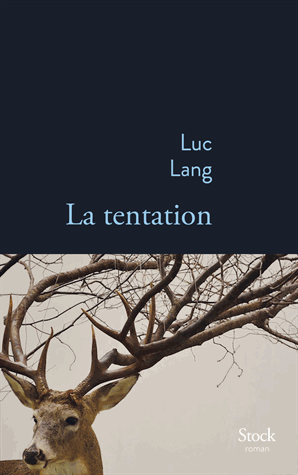
Luc Lang
The temptation
Editions Stock
354 pages
2019
Vous aimerez aussi

 French
  German
  English
Laisser un commentaire