




«The Girl with the Leica»: Strega Award for war photographer Gerda Taro

Le Regard Libre N°51 - Loris S. Musumeci
Literary awards special report
The girl with the Leica by Helena Janeczek, winner of Italy's most prestigious literary prize, the Premio Strega. A book which, despite its flaws, will introduce you to the fascinating figure of Gerda Taro, war photographer and companion of Robert Capa.
Does Gerda Taro ring a bell? Probably not. But if you mention the illustrious name of Robert Capa, everyone knows who it is. Even if you can't quite place it in your memory, Capa's name immediately rings true. He was one of history's greatest war photographers. And so was Gerda Taro. In fact, the two worked together as a couple. In her account, which resembles a historical account, Italian author Helena Janeczek gives voice and image to Gerda Taro, who deserves to be known.
As is often the case, collective works are only rewarded in part. It's a bit like Capa and Gerda Taro. However, this seems to be due more to historical circumstances than to manipulation. The photographers met in Paris in the 1930s. Jewish and convinced anti-fascists, they left to cover the Spanish Civil War. Capa returned, but Taro did not. She died crushed under a tank in July 1937. Her career ended there, while that of her companion continued until May 1954, when he too was killed by a mine in the middle of the Indochina war.
Capa will certainly be remembered. It's not impossible, however, that Taro will join him. This novel, which has been awarded Italy's most prestigious literary prize, is not without significance. More and more historians, writers and photographers are taking an interest in Gerda Taro's work, and in her heroic and fascinating life. Despite her obscurity, she was much loved by this circle of bohemian, communist artists, often Jewish or immigrants from Paris. So much so that her funeral was attended by over a thousand people, with a eulogy by Pablo Neruda and Louis Aragon. We learn all this in the book.
Criticizable in many ways, in fact. If it was awarded the Strega prize, it was no doubt in honor of Gerda Taro. In terms of style, Helena Janeczek loses herself a little too much in the heaviness of the sentences she watches herself write. And her presentation of the subject at times becomes a headache as she wants to mention all the names and tell the whole story. So, a little tedious at times, a little too stretched to try out a style that wasn't worth the trouble, with numerous French mistakes in the original version - some expressions are in French in the Italian-language book to make it more Parisian -; but The girl with the Leica doesn't make for unpleasant reading.
On the contrary, it allows you to discover this Gerda Taro, Gerta Pohorylle by her real name, who I assure you will live in your thoughts for a while; and to discover a whole atmosphere. Communist speeches in the cafés of Montparnasse, the precarious lives of artists, love affairs here and friendships there. All the big names of those years are there. The repression of the Jews raises questions of why and how. The difference between Hitler's Nazism and Mussolini's Fascism. Europe to build. The world to explore, through its wars. Truly, the story is rich. It makes you think, through the viewfinder of Gerda Taro's Leica.
«Making art wasn't their job, but they knew what the quality of an image depended on: they had integrated the aesthetic ideas of the time along with political and social ideas, and they were aware that it was precisely there, in art, that a revolution was already taking place.»
Write to the author: loris.musumeci@leregardlibre.com
Photo credit: Wikimedia CC 3.0
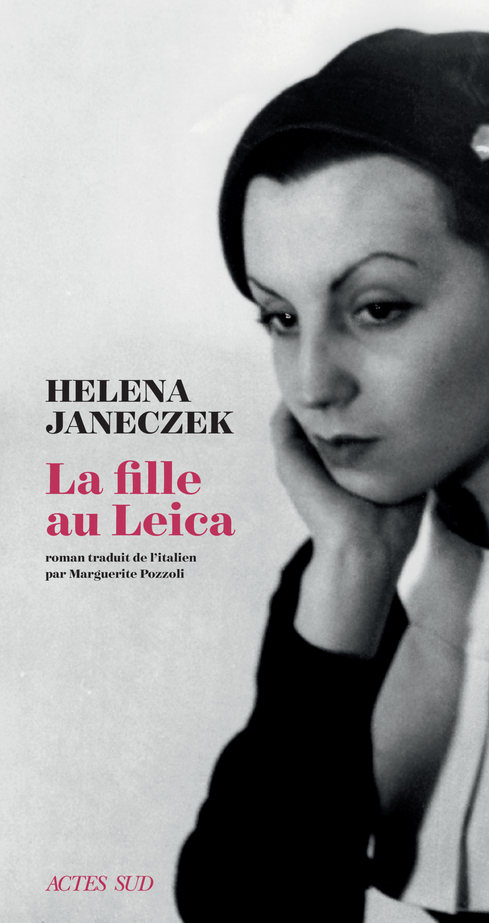
Helena Janeczek
The girl with the Leica
Actes Sud
2018
384 pages
You'll also like



 French
  German
  English
Leave a comment