



The «Arpeggios» of a friendship, between letters and colors
Tuesday books - Jonas Follonier
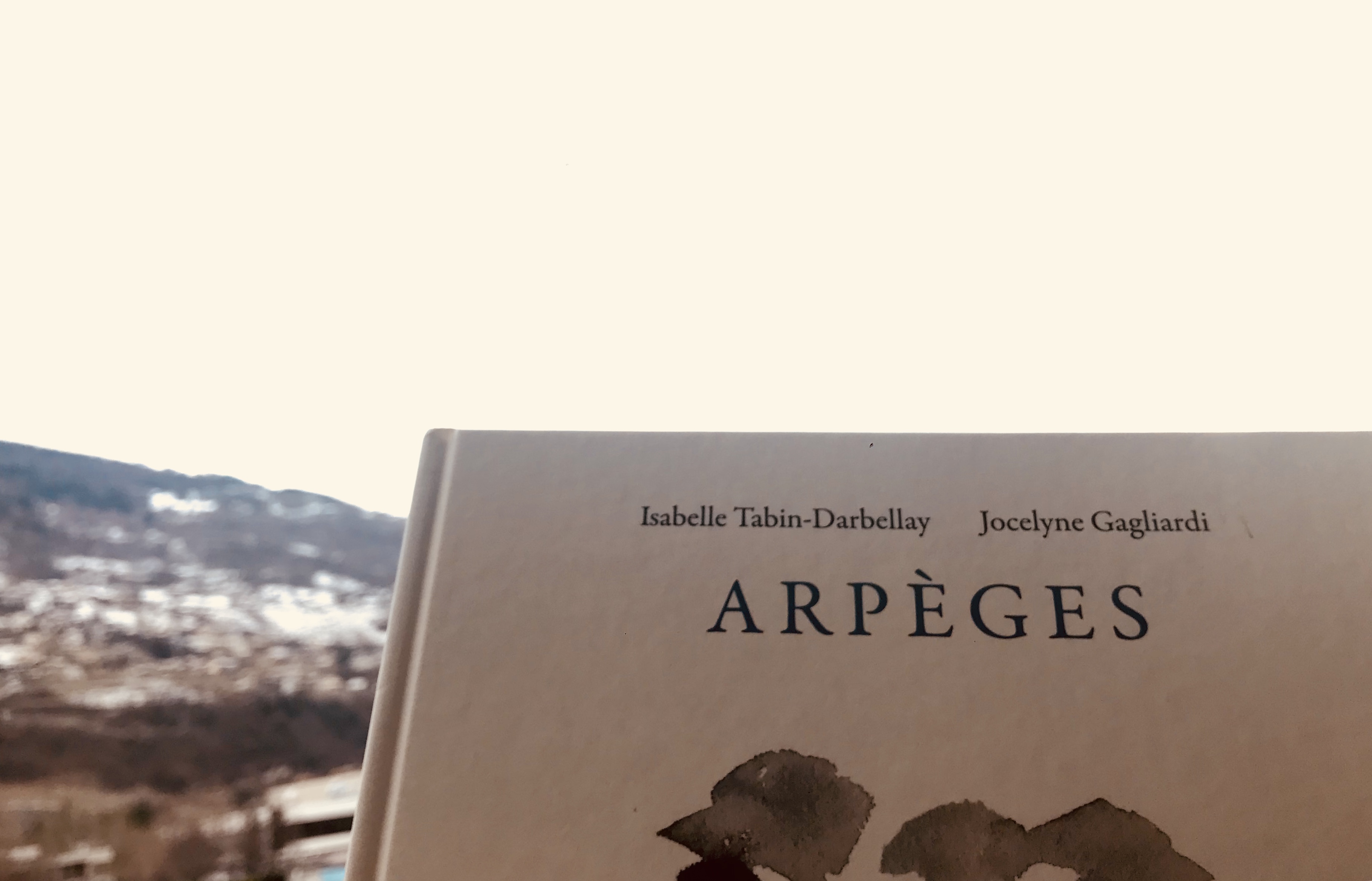
Arpeggios is the union of painting and words. Published by Slatkine following the death of Jocelyne Gagliardi, who taught literature and art history in Valais, this book celebrates her friendship with the painter Isabelle Tabin-Darbellay. Through a selection of letters she sent her. A real favorite.
«Jocelyne and I had the idea of writing a book together. Not for the book itself, but to materialize our storms, our dazzles, to confront this quest together, to complete our soul as she used to say. To complete it through the unlimited demands of work, in pursuit of an inner realization that always eludes us: to be freer and simpler. This desire, amplified by friendship, was laughter, wonder, silence and pain. It took on the colors of the seasons of life. But life decided otherwise.»
Jocelyne Gagliardi died in 2017 in Ypresses, in the Valais commune of Vex. Basically, her letters could only concern her close circle. But that would be to misread them: this woman's words are of such depth and singularity that.., right, it was addressed to the world. This is the hallmark of every successful literary work: to speak to each and every one of us. If Miguel Torga had skilfully expressed that «the universal is the local minus the walls», Isabelle Tabin-Darbellay puts it another way in the preface to’Arpeggios, In this book, she has chosen to combine some of her watercolors with letters sent to her over the course of her life by her great friend, a lover of art and reflection:
«Going back in time to our complicity, I found some precious correspondence. Arpeggios was born of a desire to share these snippets that touch on something universal. The result is a score improvised to the rhythm of our follies: nothing but free-writing letters to a friend, thrown out like a cry or a laugh, and the dance of colors in response. Watercolor extends the murmur of words into its own language. Silence and light melt away.»
And I think she's right: it's the union of painting and literature that gives this object in our hands a transcendent as well as personal dimension. Personal, in the sense of the deeply individual character of this series of letters, but also in the sense of the echo of these texts for us readers. So why would this transcendent added value come from a marriage between painting and literature? Perhaps because these two fields don't simply juxtapose: they coordinate and eventually melt into each other, without ever merging. And this allows us to touch on the mystery, you know, that set of little things that elude us on a daily basis.
«The attention of both painter and writer is drawn to reality. And so, yes, the mystery creeps in. It's always so close. Art reveals it. To live truly is to confront the ultimate.»
Once again, Isabelle Tabin-Darbellay convinces us not only of the legitimacy of this particular collection, but also of its purpose. We can then begin the epistolary discovery itself. And if Jocelyne Gagliardi's reflections can sometimes disturb us with their almost mystical character, this dimension is much more often at the service of an undeniable reading pleasure. This book should be taken as an intellectual yet simple journey, best defined by the author herself in front of the excellent watercolour Autumn in Ferpècle.
«Deep down, real journeys are still, silent, infinite. They begin in front of a landscape we see every day, and whose light, the vibration of the air or that of our soul make it other. Infinite.»
No doubt, Arpeggios teaches us that the art form closest to poetry is not the novel, the theater or the short story, but painting, which is also designed to express in the most intense way landscapes that transpose the artist's state of mind. In this respect, Tuscan vine painted by Isabelle Tabin-Darbellay can evoke many feelings. And these are as much the inexpressible order of things as the feelings of each reader, as was the spectator Jocelyne, who had a front-row seat. And she made no secret of her ambivalent sensitivity.
«I'm fed up with being constantly tossed back and forth between the trivial and the sublime, the paramecium and the eagle, Métral and Cohen, Tapie and Mother Teresa. There's chloroform in the mediocre and so much anxiety in the sublime. Basta.
I wish you bold soulbeats there. And too bad if they're painful, because what's worse, can you tell me, than saving your soul?»
If these sentences are so obvious, others come out of nowhere, but they too sound, give, detonate and astonish. «Tomorrow, sweetheart, our nephews» world will be populated by lunatics; who cares, they'll have beautiful bodies." These unexpected flashes are simply delicious. And they are intimately linked to the Greek ideal of beauty and goodness, the kalos kagathos, Physical beauty cannot be conceived without the goodness of the person - and vice versa. It's the harmony of body and mind, too often forgotten today, and recalled in the form of’Arpeggios, A fine musical find for harmony in the broadest sense.
«I'll never come back from the Brenne, land of the only luxury now inaccessible: silence and nights where you get lost for lack of street lighting and daytime in the infinity of the sky.»
Passages like these immediately make you think that Jocelyne was a proponent of degrowth. But then you realize that she wasn't, because she was certainly a complex, profound person. Just like the Auvergne, whose portrait she paints is sensational. Just like the Tuscan wind, which she describes on several occasions and to which she dedicates a sublime phrase that approaches verse in its musicality: «It blows a crazy wind that comes from who knows where.» How delightful it must have been to be the recipient of this correspondence, a testimony to something even higher than friendship. It must have been a genuine mutual admiration, mingled with an artistic connection:
«In addition to the talent you admire and verify time and time again, I loved the sincerity with which you translate the essentials of this world into beautiful lines, colors and shapes.»
Inhabited by melancholy, autumn, September light, nostalgia, joyful sadness and tragic lucidity, Jocelyne Gagliardi was, in short, a whole soul. Arpeggios will have brought her back to life, for us, for everyone, and her published letters have joined the ranks of immortality, alongside the work of an exceptional painter in full activity.
«Then the sudden solitude and bird silence make an unbearable racket that makes me dream of summer terraces, babbling and shopping, all those things that are done without danger of nostalgia.»
Write to the author: jonas.follonier@leregardlibre.com
Photo credit: © Jonas Follonier for Le Regard Libre

Isabelle Tabin-Darbellay and Jocelyne Gagliardi
Arpeggios
Editions Slatkine
2018
pages
-
 Standard subscription (Switzerland)CHF100.00 / year
 -
Support subscriptionCHF200.00 / year

You'll also like


 French
  German
  English
2 comments
Dear Marie-Claude,
Thank you so much for your feedback, which means a lot to me.
See you soon!
Jonas Follonier
Dear Jonas,
Bravo Jonas pour ce bel article. C'est un hommage sensible et bien écrit au sujet de Jocelyne que nous avons bien connue et aimée.
Good luck with your studies and I look forward to seeing you again!
Marie-Claude Dupont Mettan
Leave a comment