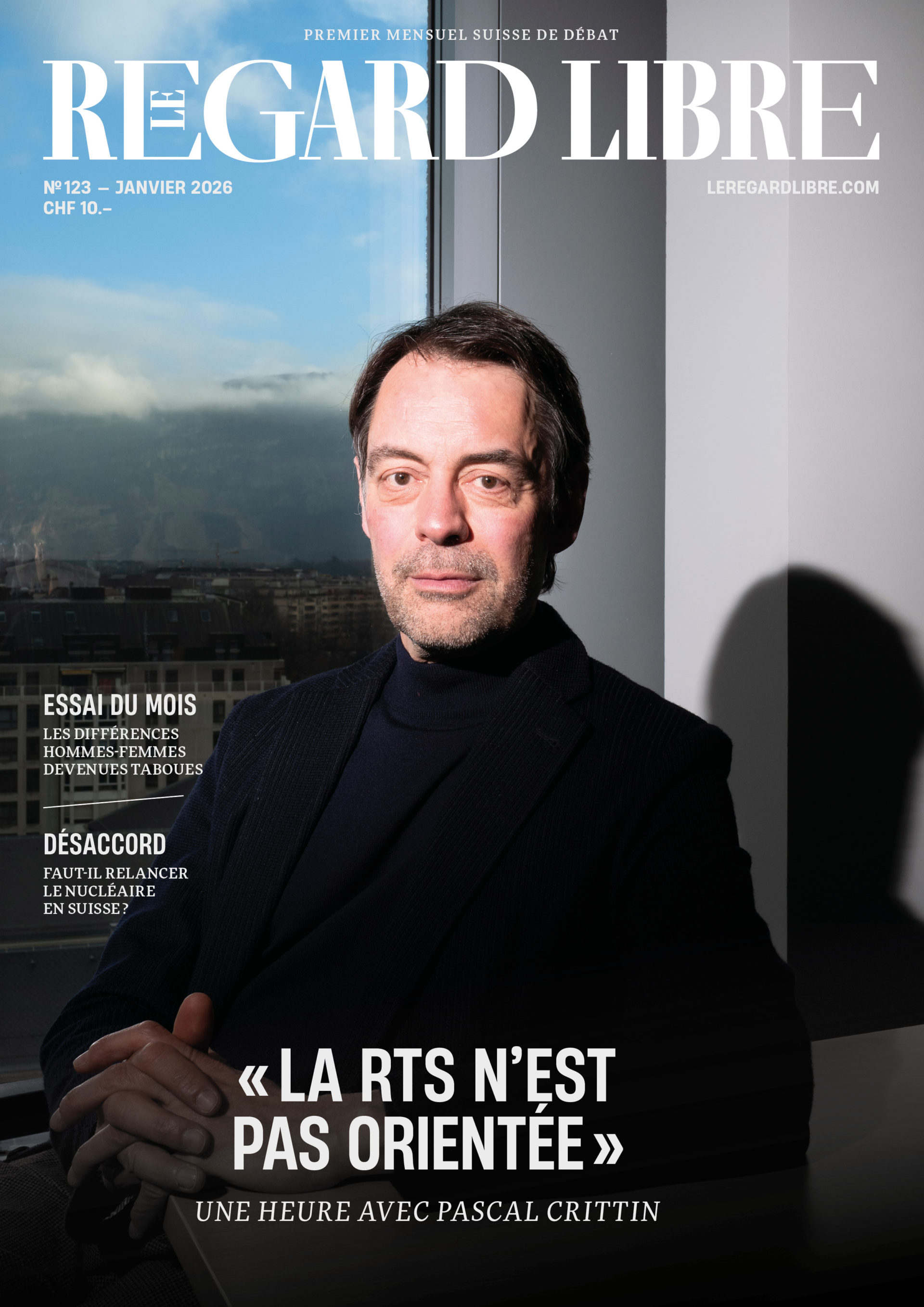




With «Le baiser d'Anubia», Dunia Miralles reveals herself
Torticolis et Frères
With her poetic, impulsive and prevertiginous writing, Dunia Miralles signs Anubia's kiss, This is an intimate book about personality disorders, transforming her individual story into a universal one.
Carl Jung wrote: «Depression is like a woman dressed in black. If she arrives, don't expel her: invite her to the table.» We could add to this quote, to better fit Dunia Miralles« latest book: »Eat together face to face, before she leaves, embrace her like a member of your family." Because just as you don't choose your family, you don't choose to be afflicted by a personality disorder, to endure the roller-coaster ride of depression, or to brood. On the other hand, and this is where Anubia's kiss achieves a tour de force: we can always prevent the dark from crushing us by learning to live with it, and it also gives us hope.
Fragments of a life
Putting fragments of her daily life down on paper, Dunia Miralles invites us into her head as much as into her heart. She questions her daily life and, by extension, that of others. She confides in us, talks about her mother's illness, wonders about the way the days pass, writes about her last appointment at the optician's, her love of Maupassant and flowers. But what stands out the most are her disastrous appointments with the shrink, or rather shrinks, her relationship with the drugs that wreck her body and mind, and her passionate relationship with Orlando, who adds color to the book with love, passion and desire.
«Orlando
who loves me
when all
to him
I am.
Orlando
who loves me so
with time
all his
now
I am.»
As the pages turn, several artistic figures punctuate the reading experience. Frozen on paper, they come in all shapes and sizes. These artists are musicians, writers, directors, actors, singers, stage directors... They all have one thing in common with the narrator: a disorder. Like her, they are borderlines. Others are depressive, schizophrenic, psychopathic, bipolar... In short, they suffer, and through their cracks, Dunia Miralles identifies with them. For her, a certainty emerges from her observation about them: they are the ones who change the world, for good or ill. Their dream transactions with reality come from their suffering. Their works are merely a consequence.
«Feminist,
defender
of the LGBT cause
Kurt Cobain,
suffers
upset stomach
that drive him
to heroin.
Diagnosed
manic-depressive
with attention deficit disorder
hyperactive.
His death
plunges me
in sadness
infinite,
still not
finished.»
Singular becomes plural
Why Anubia? Because Dunia Miralles' first effort to live with her disorder, the definition of which she doesn't know at the start of the book, was to name it. She takes her inspiration from the dog-faced master of necropolises and embalmers, the god Anubis. He transforms himself for her into the goddess Anubia. She had to wait several months for the verdict to come down, so that she could finally know what was eating away at her, and then heal herself. The expert certifies that, in addition to chronic depression, she has borderline personality disorder. According to the statistics quoted at the end of the book, 78% of people with borderline personality disorder attempt suicide in their lifetime. This is the disorder that kills the most people by suicide. With discernment, Dunia Miralles learns to live with it, overcoming the ordeal, and socializing seems less complicated, as does the difficulty of confronting a certain norm.
Poetic, violent and at times prevertive, Dunia Miralles' writing does not seek to shock or surprise. She simply says. Just telling. With accuracy, she tells the story of her daily life. Her story is self-sufficient, her pace is her pace, flowing like a hidden river that asks nothing of anyone. If you feel like taking a dip, all the better; if not, too bad. Move on. Anubia's kiss was not written to be read.
Straddling the line between poetry, diary and narrative, the words, constantly coming back to the line like an inventory, decipher a particular life that ultimately speaks of everyone and to everyone. The singular becomes plural. Someone else's life, written down in a little notebook in a drawer, becomes an encounter, contradicting Sartre. It would seem that hell is no longer other people. There's always something light and enchanting about others, as if inherited from paradise. Because even if they are tormented, they keep us away from solitude; better still, they confirm to us that any solitude can, through their fissure to be bridged, end up disappearing.
«On the radio, the late Johnny.
I turn up the volume.
Orlando and I shout out the lyrics with Jojo.
Tenor.
Viola.
To say “I love you”.
That we love each other.
We laugh.
We laugh.
I'm getting serious again.
“I'm crazy and you love me?”
“I love you with your madness. That's how I love you. A diagnosis won't change who you are. I love you the way you are for who you are.”
That I love you.
That I love her.
He loves me.»
Write to the author: arthur.billerey@leregardlibre.com

Dunia Miralles
Anubia's kiss
Torticollis and Brothers
2022
274 pages
You'll also like



 French
  German
  English
Leave a comment