




That strange lady who liked clean toilets

Tuesday's books - The retrospective - Amélie Wauthier
The hardest thing about writing a retrospective review of a book you'd really like to recommend is finding a book in your library that's worthy of the time and effort you're going to devote to it. A major problem then quickly got in the way: the «wait, this book is so great, you absolutely must read it» trick. Closely followed by the famous «who the hell did I lend this book to? So I have a quantity - which I refuse to measure - of »too great« books that surely serve as a doorstop for my so-called friends, while I stand, arms flailing, staring blankly at the Jean Giono and Chrétien de Troyes that populate the floors of my library.
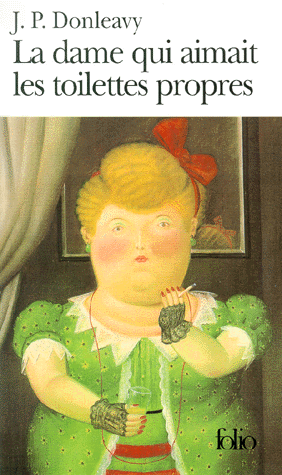
And that's when the little miracle happened, among the dust and useless knick-knacks. A novel that I, in turn, have surely never returned, as I must have forgotten the identity of the person who generously lent it to me. A story I've never read before, but whose cover, a painting by Botero, and title, The lady who liked clean toilets, I think I may have found what I was looking for.
Quite a pedigree
Jocelyn Guenevere Marchantière Jones is forty-three, with two children she doesn't see very often, an ex-husband who ran off with a twenty-five-year-old girl and a very large house in the New York suburb of Scarsdale. Her mother and grandmother, both from high society, have taught her to be a «lady». But this didn't stop Joy - who loathed the nickname - from slipping gently and surely into a state of immense loneliness and deep depression. Perhaps this state of mind explains why our heroine suddenly decides to blow up her TV with a 12-gauge shotgun when she doesn't like the program, or to consider prostitution as a profitable way of making a living.
A life increasingly devoid of meaning, from which a massive ingestion of pills would peacefully deliver our protagonist. Jocelyn Guenevere Marchantière Jones is seriously considering it, while her love of the arts is the only thing that keeps her out of the house, taking the train to the museum in town every two weeks. Her escapes from home are also an opportunity for J.G.M.J. - who is no stranger to the laws of nature - to scour many and varied establishments in search of immaculate toilets, as she has been taught to do. Her grandmother's strange, but no less invaluable, advice gives the rest of her life a whole new twist.
«My darling, planning will keep you from being nostalgic, but in the meantime don't believe in all this equality stuff, your snobbery is the most precious thing you own in the world, cherish it. Avoid spineless men, and when you're deprived of the security of your toilet, only go pee in the cleanest places.»
So yes, of course, this book is a critique of an absolutely detestable and hypocritical American bourgeoisie, and of a pseudo-elite whose education, however refined, isn't always enough to hide its vices and foibles. And he's quite right - I'm not going to hold it against him. But it's also wildly funny and terribly gripping. The heroine, in the midst of a sentimental, financial and personal debacle, sinks slowly, but always with class and a certain panache.
«She had flirted briefly but seriously with the idea of becoming a lesbian, and had bought a book on the subject. At least it would be a long-term relationship, free of the unpredictability of a guy turned on by the first intriguing idiot she came across.»
From lady to feminist icon
The woman who refuses to be called Joy, since joy is now cruelly lacking, reveals herself to be an extremely touching and authentic woman, torn between protocol and freedom. I'd even go so far as to call her a true figure of feminism, one who «would be alone, free and not just an extra baggage». Over the course of sometimes absurd situations, and stripped of her enviable social status, Jocelyn, who is now neither a wife nor a mother, rediscovers and assumes her true self, even going so far as to oppose the education that her mother and grandmother, «proper» ladies, have instilled in her.
«- But, good God, Joy, married as you've been and coming from the background you come from, you've turned, excuse the word, into a woman of little virtue.
-I think the word you're thinking of is fuck. And you can't afford one. I mean, I'm afraid the fact that you're broke doesn't turn me on very much. And I'm simply doing you the favor of giving you a price for providing you with a service.»
With this novel, written in the mid-nineties, J.P. Donleavy has written a short, dense and breathless story that can be devoured in one go, with no mercy for the characters or the reader. Without being the nugget of scathing humor I was looking for - and will continue to hope to find one day - this book is very fresh and not lacking in character. Get it or borrow it before the end of the summer.
Photo credit: © Amélie Wauthier for Le Regard Libre
Write to the author: amelie.wauthier@leregardlibre.com
James-Patrick Donleavy
The lady who liked clean toilets. Chronicle of one of the strangest stories to come out of New York.
Editions Gallimard
2000
138 pages

You'll also like





 French
  German
  English
Leave a comment