



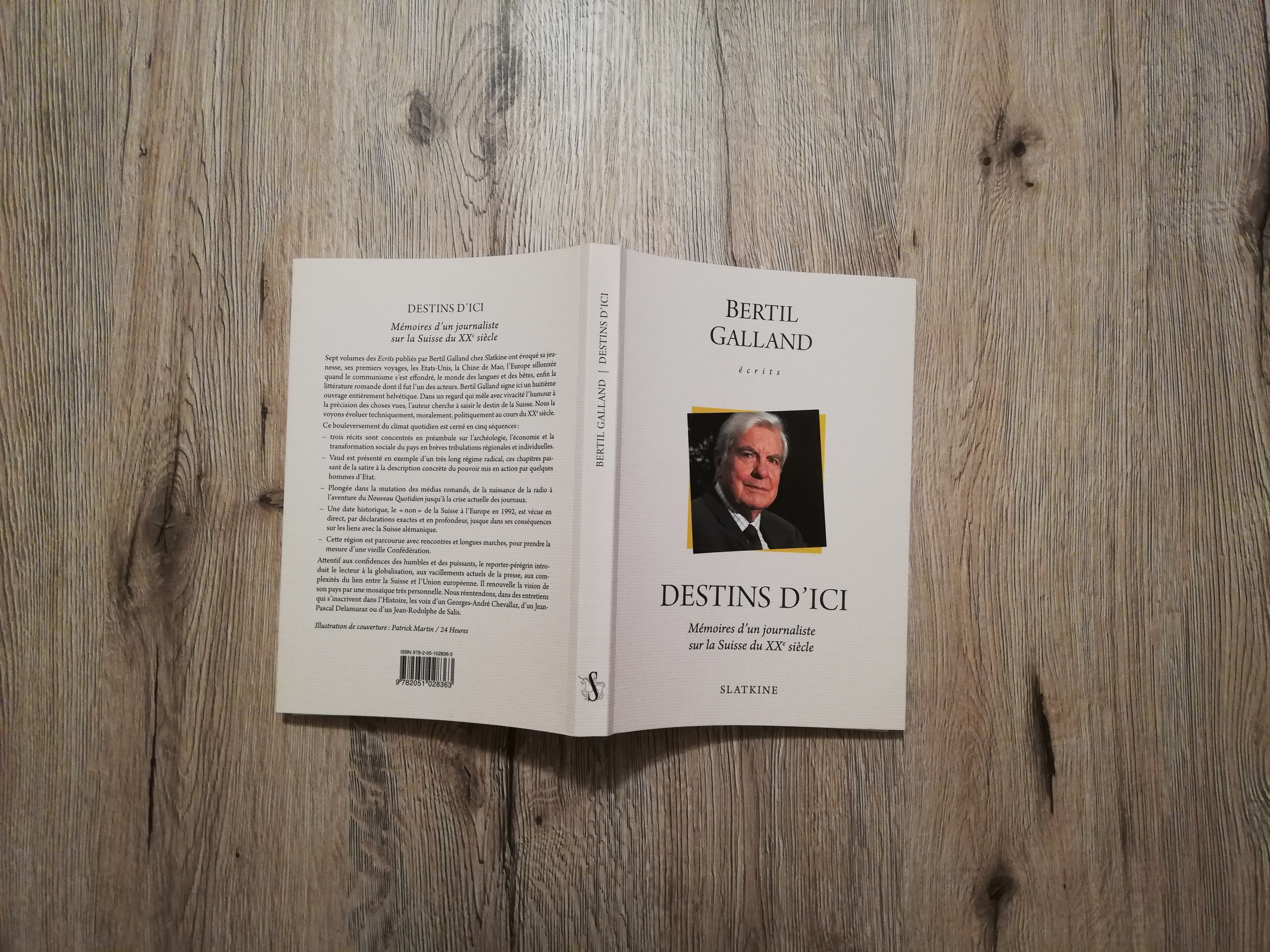
«Destins d'ici», a testimony to an era to better reflect on the future
dav
Tuesday's books - Alexandre Wälti
Unpretentiously, to write a life. Bertil Galland's project is simple. And what a life! This man of letters from French-speaking Switzerland has published eight volumes with Editions Slatkine. Destinins d'ici: A journalist's memoirs of twentieth-century Switzerlandth century concludes a series of fascinating, protean books. The publisher and journalist revisits an era, recounting it through the destinies of several characters, both anonymous and public. A thought-provoking look at the times we live in.
The writing flows effortlessly. We immediately sense that Bertil Galland has spent much of his life writing and that he has a deep passion for words. We know this because he told us so in early November. The in-depth interview he granted us will be published in the The 46th issue of our magazine, published in January 2019. That is why we wanted to discuss his latest book before letting him speak.
Bertil Galland writes as someone who is passionate about the characters he describes, whose portraits he paints from one chapter to the next. The family of former Federal Councilor Georges-André Chevallaz thus shares the page with media personality Jacques Pilet, the first female Federal Councilor in Swiss history, Elisabeth Kopp, «the arbiter of the arts» Frank Jotterand, and National Councilor Jean-Pierre Pradervand. These figures share the pages with Denis de Rougemont, Max Frisch, Charles-Ferdinand Ramuz, Maurice Chappaz, and Jean-Pierre Vouga. Jumping back and forth between the lives of those who shape society politically and those who reflect on it is the central theme of Local Stories.
If some of these figures don’t ring a bell, you’ll come to know their commitments and distinctive traits as you turn the pages. That is the very essence of Bertil Galland’s success! Building bridges between eras in an effort to better understand them. In this sense, the book strikes me as profoundly humanistic, in that the human being is always more important than the public figure or the thinker. The perspective is interesting and fully embraced, as Bertil Galland suggests in the preface.
«These memoirs by a journalist about Switzerland are not presented as a history book but as a collection of stories that sketch a portrait of a country. Encounters and interviews—with everyone from the most humble people to federal councilors—suggest how our diverse Confederation weathered the 20th century.”th century. As an adult, I’ve only lived through the second half of it, working in the media with periods of intense activity. I was part of the editorial staff at 24heures for twenty-six years. I worked for Le Nouveau Quotidien »during its seven-year run and seeks to capture in these pages the spirit that drove that adventure. It sheds light on the crisis currently facing the entire press."
The writing is often slightly fictionalized, yet it strictly adheres to the commitment to truth and the verification of sources that is so characteristic of a journalist, as evidenced in particular by certain interviews that the author includes without any obvious separation as the pages unfold. This choice runs throughout Local Stories and lends the sketch of a «portrait of the country» a very distinctive tone. Style, then, is not overlooked. It generally emerges as illuminating threads within a portrait such as that by Jacques Pilet.
«Jacques Pilet reminded me of a lion tamer who lightly snaps the tip of his whip in front of his beasts» muzzles. He didn’t like to see his editors nodding off. He never thought of punishing anyone, but out of fear of enduring his contempt, we would sit up straight. He inspired us even in those small journalistic triumphs that offer the reader—as he unfolds his newspaper in the morning over the steam rising from an espresso—a double pleasure.”
This ability to shift from a strictly informative style to the pleasure of evoking certain figures—whether public figures or friends—sets the tone for the entire book. Bertil Galland has divided it into five parts, ranging from the most specific to the most general. He begins by telling «three stories to gain insight into Switzerland» and concludes with «Switzerland’s secret geometries.».
In particular, the author devotes more reflective pages to the European question and the issue of the media. The former found an initial resolution with the referendum of December 6, 1992, and is currently being debated once again in a different form. The latter has never been more relevant than since the alarming emergence of fake news. This constant back-and-forth between the era described by Bertil Galland and our own provides a fascinating foundation for reflecting on the future we wish to build.
A letter from Bertil Galland to Jean-Philippe Leresche, a professor at the Institute of Political and International Studies at the University of Lausanne, introduces the book; an excerpt best sums up his main intention with this eighth volume:
«I took certain artistic liberties—as I noted in the text—drawing on the example of Kokoschka, who would dance around the man he was painting and was thus able to breathe life into his brushstrokes. Or Mahler, whom I listened to a great deal while typing on my keyboard—shocking his Viennese listeners by suddenly bringing forth folk tunes from his native Moravia, or drawing from unusual depths to create beautiful classical structures. It is a tribute to Chappaz and his poems of’Laugh Until You Die.»
Write to the author: alexandre.waelti@leregardlibre.com
Photo credit: © Alexandre Wälti for Le Regard Libre
Bertil Galland
Local Destinies: A Journalist’s Memoirs of 20th-Century Switzerland
Editions Slatkine
2018
227 pages
You'll also like


 French
  German
  English
Leave a comment