




Between cars and niole, «Plume-Patte», the reflection of a peripheral France

Tuesday's books - Diana-Alice Ramsauer
When a book kicks off with Brassens« »copains d'abord« (friends first), the tone is immediately spat out: ready-made phrases - »everything is relative« - morals - »the important thing is to be well surrounded« - and hackneyed metaphors - »it doesn't smell like a rose! Well, not at all. Plume-Patte, is a luminous depiction of a France on the outskirts of the sixties and seventies, the poetry of a garage life, the everyday life of those who «don't set any conditions, nor do they claim any».
Plume-Patte - is the story of a «novena». Nine chapters that tell the story of this young man's retirement: a selfish but salutary escape from his partner's home; the need to get back to what he loves: cars, guts and bad wine with friends. A few days (perhaps nine?) in which to discover the France of the «60s and »70s, "La France d'en bas" (France from below) in the words of Jean-Pierre Raffarin, quoted by author Philippe Villard.
The story takes place, if the descriptions are to be believed, in an area between Grenoble and Chambéry. Plume-Patte is an ageless fellow. Let's say around forty. Maybe even fifty. He has no children, is unmarried, but lives with a woman he once loved, whom he nicknames «La Rombière»: «She was gnawing at her brake, the brake of a freedom she had never known how to take. (...) Was she just this woman tied to the representations of her imaginary conventions?» This couple is a mystery, a pairing of circumstance. Certainly because having a little woman is something you do. Period.
«Fucking proletarian pincers».»
«Plume-Patte's] body was beginning to vibrate with a call to take to the open sea. The open sea wasn't far away. It was called Garage or Chez Loulou. One was his den and the other his landmark. At the den, Plume-Patte cultivated the right to recycle by reassembling wrecks. Through these roundabout channels, he would return to the market, or rather to a gray market, or to a sub-market, with products transformed by himself, the umpteenth hand of the last zone. He knew nothing of the moral economy, but in his niche, he had carved out a small, discreet and pleasant place in the shade. He was solidly in the solid life. And at the “repère”, he quenched his thirsts and hit the cardboard.»
The main character lives on what he can. He works as a night watchman on construction sites, and above all, he repairs cars. His garage is his livelihood, but it's also a crossroads of solidarity. A place where «le Grand Gégé» brings vegetables from his garden. Where the bodybuilder known as «le père La Balme» turns up to ask Plume-Patte for help. Where we feast on offal brought in by our butcher friend. Where stolen benzine and poached wild rabbits are exchanged for a helping hand on the sly. It's a down-to-earth philosophy, far removed from the administrations and modern institutions of the big cities.
The wet kiss of a millstone and a breechblock
This story is a far cry from the symbolism of today's car. In Plume-Patte, The car is a fact of life: owning a garbage can or a gleaming one simply shows to what class you belong. This object is not really political, as the Gilets Jaunes revealed at the end of 2018; while the question of state centralism is suggested in the book, it is not underlined by the possession of a carlingue. The latter is part of a daily routine: «Plume-Patte rode in crappy cars that he dumped to the rhythm of their failures or when the ashtray was full too.» If you don't have one, a friend will play the role of cab.
Read also | The «gilets jaunes»: some thoughts
On the other hand, tinkering has a higher dimension: it belongs to craftsmanship. A sensual art, even: «He deftly took hold of the hardened grinding wheel and presented it to the breech for a long, wet kiss. He stretched out his arms and, as if in a long, slow coupling, moved his body from shoulders to pelvis, and in the same movement, he passed the grinding wheel over the piece in a meticulous polishing that was carried out gently and always in the same direction.» Is this a symbol of manual, sensitive know-how being lost to increasing digitalization? Alienation from mechanics? Perhaps. Those who love the combustion engines of the time could certainly enlighten us.
«Baby-feeding to luter the heart»
«At Loulou's, people were joking, laughing and drinking as dusk crept in and the first orange glow from the streetlights. [They were] there, relaxed and happy, carefree and oblivious, proud and satisfied with their quiet virility. (...) For them, the world was simple. So simple. (...) [They] were there, curled up in the warmth of the bistro, lulled by the euphoria of mondeuse and gamay, intoxicated by success at cards, dabbling, macerating, marinating in the sweet happiness of being among men.»
Another central, unpretentious venue is the «bistrot»: Chez Loulou, L'estaminet du Nord, Mère Turbo, Le Fruitier. Alcohol is very much a part of everyday life. Seen from the inside, it's not really a problem, as long as it remains basic alcoholism. Sometimes, however, abuse reveals the cracks in these drunks« character. You can sometimes guess that they've stumbled, perhaps had an accident, or that there's been some tragedy. Death, as part of life. But as with the rest - social condition or precariousness - Philippe Villard's view is in no way condescending or moralizing. “There was no class consciousness in Plume-Patte (...). Maybe he knew he was ”small», but that didn't scare him or cripple him as long as he wasn't prevented from being happy, right there, right then, when the opportunity presented itself."
Words and reality that escape us
This book can be seen as a kind of manifesto against elitism written by a nerd. As a letter writer, we find ourselves having to underline words we don't know. It's like being a teenager again, with a German literature book in one hand and a dictionary in the other. Not that Philippe Villard uses technical terms or complicated sociological concepts. It's just that we're talking about another language, that of slang: «besicles», «pogne» or «godillot» for the simplest. «Lorgnon», «cibiche», «rancio», «billot», «arpion», «brodequin» or «croquenot», for the more obscure.
«Sitting on the edge of his improvised litter, he took the time to lift one more buttock to let out from his intestinal depths a long hail of mephitic perlouzes, the stench of which submerged the usual atmosphere of his den for a few moments.»
While certain passages may give us the impression of witnessing vile scenes - the human being reduced to his deepest animality: a stomach, a sex and arms - of distressing baseness, it's worth remembering Brassens. The song «Les copains d'abord» certainly provokes hints of déjà-vu, a little melody that annoys with its litany of déjà vu/entendu a thousand times. But that's exactly what Brassens is trying to remind us of. Plume-PatteThis simplicity may not be that of the so-called «intellectuals», the progressives or the urbanites, but it is that of the silent majority. Because this life - unlike the book itself - «isn't literature, whatever the spell casters say».
Write to the author: diana-alice.ramsauer@leregardlibre.com
Photo Credit: © CH/P
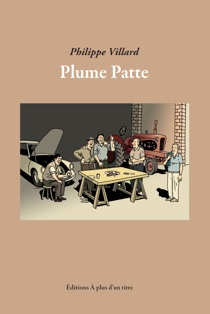
Philippe Villard
Plume-Patte
A plus d'un titre Editions
2021
184 pages
You'll also like




 French
  German
  English
Leave a comment