






I drink, you drink, he talks, we laugh, you smile, they dream

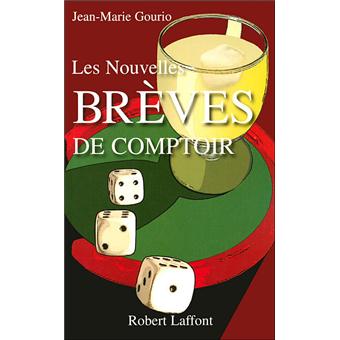
In times of confinement, reread in short bursts News from the bar by Jean-Marie Gourio is to laugh out loud, soothe yourself and remake the world on command. And maybe open up a new way of thinking about dreams.
The confinement forced by the current coronavirus health crisis is an exquisite opportunity for a certain type of reader, the most daring, to fill in their ignorance in spades by reading Melville, Proust or Tolstoy. In other words, to embark on a long, slow and careful reading, taking full advantage of the unusual power of literature, which is, as Mona Ozouf puts it, to multiply existence.[1], change role and skin, why not go whale hunting, change century and age, why not return to childhood, change city and country, why not wander the streets of St Petersburg or Moscow.
But then, every odyssey has its downside. The downside of the literary voyage is that it makes you thirsty. A wolf's thirst. A monkey's thirst that makes you leap to the treetops to drink from the first cloud that comes along. And it's because of this supreme thirst, lurking in the back of the throat, that the audacious reader will put aside his audacity, just for a moment, and close Melville, Proust or Tolstoy to reread in small, delicious bursts, News from the bar by Jean-Marie Gourio. To read these short stories is to drink immediately, to bathe your palate and wet your throat. It's like leaving home, leaning on the zinc of a bistro counter, Le Napoléon for example, and be drawn in by the presence of your neighbor of the moment who has become, at a glance, fraternal. And who randomly tells you: «Alcoholics aren't carbon-dated, they're Pastis 51.»
A stroll from bistro to bistro
Since 1987, Jean-Marie Gourio, editor for Charlie Hebdo and Hara-Kiri, the scriptwriter of hit TV shows such as «Les Guignols de l'Info», wanders from bistro to bistro, noting down the little phrases said by people leaning against counters, sitting on terraces or sitting next to toilets. In short, people who go out to drink to friendship or love, to drown their sorrows or the piranha fish that gnaws at them, to joke, to rant, to split hairs and to dream, as the author himself writes in the preface: «When busy people pass in front of the café. And we just stand there. Upright, but not all of us. Talking. About everything. About nothing. Messing around. Empty. Filling up. Complaining! What a pleasure! Given the price of petrol, it should be served with champagne cookies! To dream. To drink. Shoulder to shoulder. Dream against dream. Vive la fraternité de comptoir.»
These revolutionary little sentences, immediate, rough and ready, with their primitive allure blazing like sparks, put the sometimes gray everyday into colorful words. We could say that these little phrases are funny, tonic, lightning-fast, that they play hooky from refined and polished thought, tempered too, to take us on vertiginous slopes, steep, greasy and slippery, from which we fall bursting with laughter, like the child we were. The alcohol does its job perfectly. And these little sentences carry a sling of poetry and humor, of belated revenge, of national lament, of absurd enthusiasm that make us smile and make us «clear-eyed through shame and fog".[2]».
From sport to politics: «You bend de Gaulle in the middle, and you get two Sarkozy's»; from art to the military: «A nuclear submarine shouldn't blow bubbles»; from medicine to research: «With nanotechnology, they're building little trains in a hair, but to go where?», from philosophy to sociology: «A family with four kids fits in an egg carton», from architecture to religion: «God made man in his own image, except for housing», from ethnology to ethology: «A sled dog in a cab is usually the one driving», from sexuality to gastronomy: «Kangaroo is good meat, plus there's a pocket to put the French fries in».»
But these little sentences set against each other would be nothing without the collective aspect that emerges from such journalistic investigation. Humanity is at the heart of these short stories. The everyday human, who welcomes life's tribulations as much as the small pleasures like a living caress. Beyond the laughter, the drink and the bar, beyond the contingencies of reality, there is the dream that dislodges us all from the same place. And dreaming is universal. It's like the most precious fluid on the planet.
[1] Making life lighter, Mona Ozouf, edited by Alain Finkielkraut.
[2] Meditative, Paul Eluard
Photo credit: © Juliana Styles/Pexels
Write to the author: arthur.billerey@leregardlibre.com
Jean-Marie Gourio
Les nouvelles brèves de comptoir (Volume 1)
Robert Laffont
2008
416 pages
You'll also like




 French
  German
  English
Leave a comment