



Pasolini as Daedalus: «Oil», a labyrinthine novel

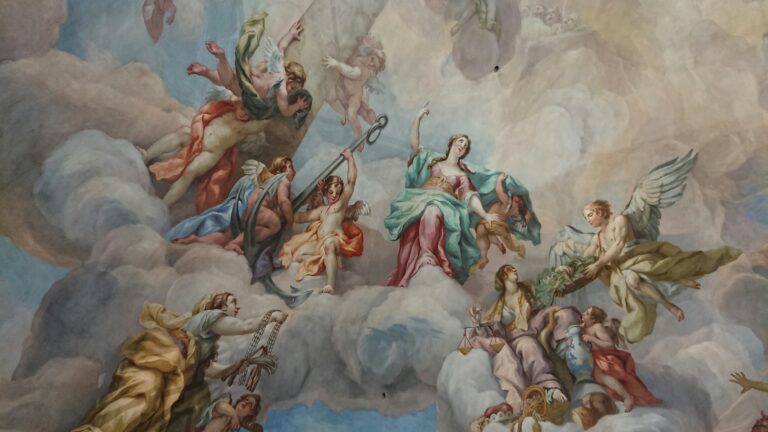
Hieronymus Bosch, *The Last Judgment*, after 1482 (close-up)
Considered the greatest filmmaker of his generation, Pasolini was also a poet and a left-wing activist. According to experts, his posthumous book, Oil, is said to be one of the best novels of the 20thth century. So, is this novel a niche book or a masterpiece?
Rome, May 1960. Carlo, a Catholic from an upper-middle-class family and an executive in the oil industry, moves into a new apartment in an upscale suburb of the Italian capital. One day, on his small balcony, as he contemplates the view while mulling over his successive failures and his existential angst, he faints. From that moment on, he sinks into a second sleep—a state of neurosis—where two beings fall from the sky, fighting over his body. The angel is named Polis and the demon Thetis. The former will keep Carlo’s body, while the latter will take possession of his inner evil. To do so, Thetis pulls a knife from his pocket and removes a fetus from the body of his master, Carlo; he lifts it toward the sky and then watches it grow. This marks the birth of a new man, named Carlo 2.
That’s how the two Carlos meet, while the angel and the demon head out to enjoy an aperitif in the sunshine, arm in arm. As metaphors for good and evil, the two deities appear regularly throughout the novel, like old friends chatting about this and that. In contrast, Carlo 1 (Carlo’s outer shell) and Carlo 2 (his inner self) have nothing in common except their mediocrity—the former being petty-bourgeois and the latter a sex maniac. A neurotic who will embark on tumultuous adventures—with young women, men, and ultimately with anyone who crosses his path.
You don’t need to know about the author’s scandalous reputation to quickly realize that the book will feature obscene scenes and stories with a hint of scandal. For Pier Paolo Pasolini is, above all, a provocateur, as he himself said in his last interview, conducted on October 30, 1975:
«It is a right to cause outrage. To be outraged is a pleasure. Anyone who denies themselves the pleasure of being outraged is a dull moralist..»
A labyrinthine novel
Oil is to literature what Salo: The 120 Days of Sodom is in theaters. A masterpiece for scholars; an affront to ordinary people. Keep in mind that the film, inspired by the Marquis de Sade’s book, is extremely violent in a sexual sense, filled with scatophilia, torture… In short, the worst of which human beings are capable. Oil is a book that, thankfully, is much less violent, even though it’s still full of profanity.
Pier Paolo Pasolini wanted to write an unfinished novel (over 2,000 pages long); this came to pass not because of his own will, but due to his sudden assassination. Reissued in a more complete version than the original publication—which took place seventeen years after the author’s death in 1992—this new edition incorporates all sorts of notes and handwritten passages into the text, making it a work intended more for scholars than for general readers. The fact that this fragmented novel consists of various typewritten pages makes for a truly tedious read. The reader is forced to navigate between snippets of the novel, travel notes, the author’s commentary, mythology, and passages with no obvious connection to one another.
A Mysterious Death
A Call to Mystery Novel Lovers, Oil can also be interpreted from a political perspective. First and foremost, because of Pasolini’s well-known and self-proclaimed political commitment, which is evident in this work, but also because it may have been one of the possible causes of his mysterious assassination. Let us recall the circumstances of his death: the man was killed on a beach, perhaps by the Mafia. The filmmaker was a thorn in the side not only because of his work, but above all because of his political activism and unwavering loyalty. Indeed, in his story, he sought to expose mafia crimes linked to the oil industry—hence the title of this novel.
The fact that the full circumstances surrounding Pasolini’s death have never been fully clarified makes his manuscript all the more intriguing. Indeed, the original version contains a multitude of blank pages. Were they still to be written? Or perhaps the initial pages were stolen, for fear that certain names might be revealed? According to Hervé Joubert-Laurencin, an expert on the Italian artist, it could also be a matter of the author’s desire to reveal the structure of an unfinished novel to the reader. The problem—and it’s a major one for interpreting the work—is that he was murdered. No one knows the true ending, the one he would have deliberately intended.
Missed Appointment
After finishing the book Oil, even if one manages to finish it, it is highly likely that one will not have understood everything. Yet one may get the sense that something profound is happening within it. The author of these lines doubts, however, that a true encounter with Pasolini can take place solely through this text. It is only when considered as part of a whole—his body of work, including his films and poems—that Oil is worth reading, because its author is always worth getting to know better.
Read also | Stéphane Marti: «Reading is an act of freedom»
Nevertheless, unless one is an expert on Pasolini’s universe and sees in it the quintessence of this philosophy, Oil remains too difficult to access to be considered on par with the masterpieces of 20th-century literatureth century.
«That’s when he (Carlo) realized, pleasantly surprised and thoroughly amused, that doing all this had made him very aroused. He was determined that his grandmother witness the phenomenon with her own eyes, if she refused to believe it. He undressed in turn, unbuttoning his pants with an even louder, more joyful laugh; he took one of her hands and made her grasp and squeeze his member, which stood proudly erect like a baby’s. His grandmother’s weak, bony hand, though moving back and forth without hesitation, was unable to bring him to orgasm, so he pulled it away from him, placed it on his thigh, and quickly finished himself off, ejaculating on her, staining her beautiful old white dress.»
Write to the author: [email protected]
Photo caption: Hieronymus Bosch, The Last Judgment, after 1482 (zoom)
You've just read an open-access review. Debates, analysis, cultural news: subscribe to support us and get access to all our content!

Pier Paolo Pasolini
Oil
Translated by René de Ceccatty
Editions Gallimard
The Imaginary Collection
2022 [1992]
900 pages
You'll also like




 French
 German
 English
Leave a comment