



Meeting with Claire May
Le Regard Libre N° 45 - Alexandre Wälti
Claire May is intrigued by binationality. She discusses this subject in Oostduinkerke in the same way as it examines the intimate tensions that are sometimes rooted in a certain social and cultural determinism, as in the case of its two main characters: Emma and Charles. That's what you realize when you close the last page of the Belgian-Swiss writer's first novel, published by Editions de l'Aire.
The questioning of dual nationality now accompanies me on my way to the Café du Simplon. Already, the place bears signs of dual nationality. The Simplon, the pass that links Switzerland and Italy. Although I'm probably over-interpreting the situation a little here. The café adjoins the Lausanne train station. In summer, the terrace is often filled with the hubbub of conversation. In autumn, the atmosphere is more subdued and it's indoors that the rumor of discussions gives rhythm to the day, as on this October 29, 2018. A few customers are reading the newspapers; three of them, between the bar and the toilet corridor, are talking about Jair Bolsonaro's election in Brazil. Someone flushes the toilet. No, they don't! Too bad.
The need to write down origins
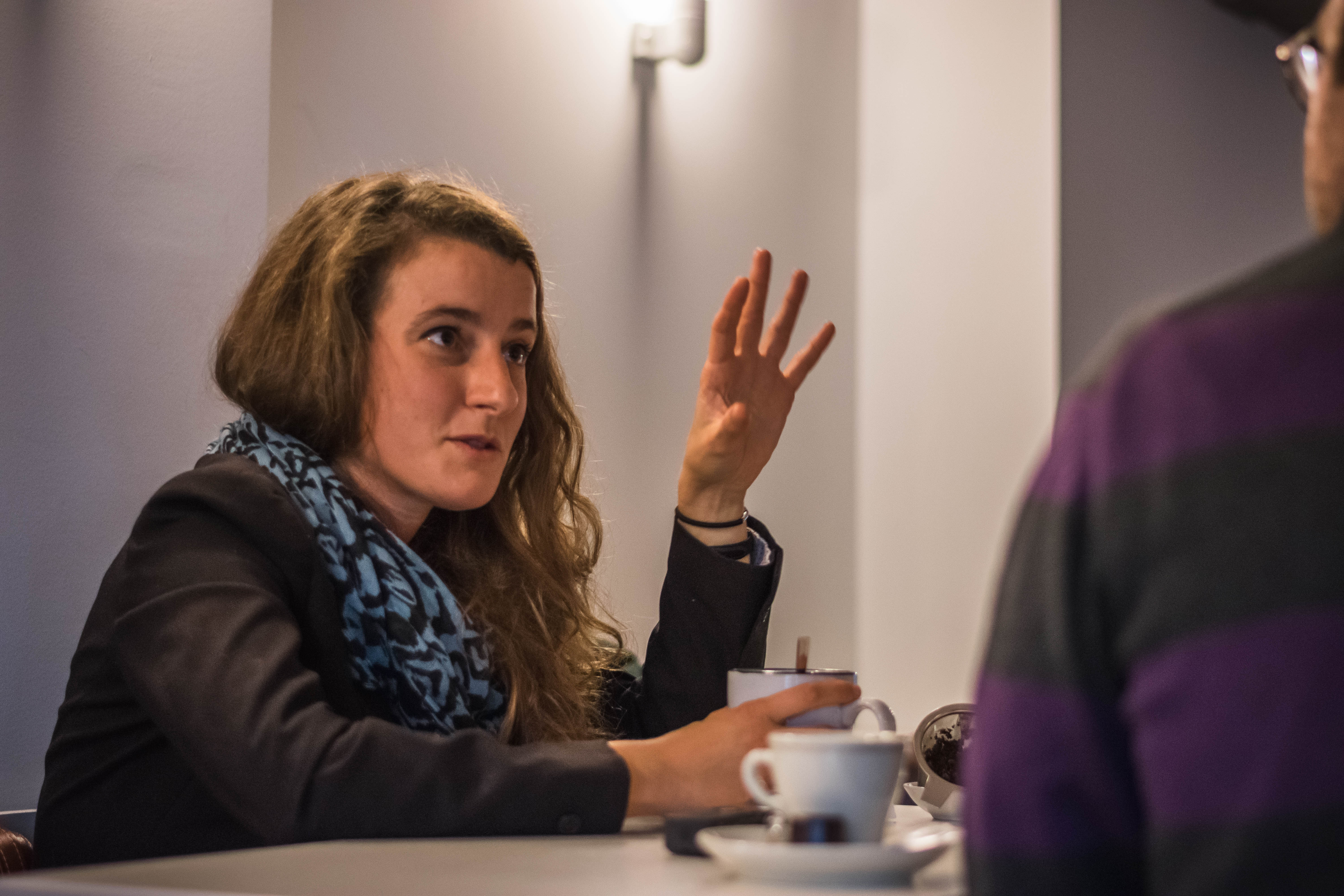
A woman enters, still wrapped in her turquoise scarf with black spots, and looks around. The light grey walls are lit by small round lamps. I ask her if she isn't Claire May. And yes, that's her! A first contact that puts spontaneous smiles on our faces. We then settle down on the quieter benches at the back of the café, near the window. She orders a cup of tea. We immediately talk about the need to question our origins: «For Charles, it was all intuitive, whereas Emma discovers this need because she loses a landmark when she sees the family home disappear. She's trying to find her place in the world. I personally feel a similar need. In particular, I've written Oostduinkerke because I'm the product of an era, a history, a determinism, and I was born in 1991, like Emma.»
Customers are intrigued by the clicking sound of our photographer's lens. I myself am not yet used to his presence. This feeling will soon disappear. The exchange prevails. Claire May rubs a packet of sugar between her thumbs and forefingers. I won't ask about the proximity of Emma and the author herself. Claire May tells us in a firm voice that there was an urgency to write this first novel, because of the obviousness of the theme. She is, after all, Belgian-Swiss. She adds, with a sudden gesture of her right hand, that she has been taking part in short story competitions for several years, and that she finally wanted to free herself from the constraints of this format.
Two people with nothing but love to share
Emma's character loses a part of herself when she learns that The Apicula will soon have a new owner. It's as if a part of our childhood will disappear with this family vacation home. This building has been marked by time and existence like a stuffed toy you can't part with. It has lived, lives and still vibrates in Emma's heart. The Apicula could become a villa with swimming pool, heating and all the comforts of a holiday home near the North Sea. Dying without dignity. This emotional break, which punctuates the novel, adds an endearing dimension to Emma's introspective, almost cold and somewhat withdrawn nature. As Claire May puts it, with a smile on her face, she does her best to detach herself from this «very Swiss» character trait.
«He knew I was vulnerable, Charles - especially these days. But with me, he was learning that vulnerability and violence were not enemy sisters. He was tender. Never a word above another. Never a hand raised or a door slammed. A debonair man. A true lamb.
Let's just say that at the time, I still thought so. It was only the next day that I realized he was also hiding rage. A rage less conspicuous than mine. But a rage far more dangerous than my absurdly raised fist in the air.»
Charles is Emma's opposite. The German-born waiter is «voluble», in Claire May's own words, seems exuberant, handsome and confident. Her tone of voice relaxes as she approaches this character. She places the sugar sachet on the table. After a sip of tea and a few words about Charles, she's overcome with enthusiasm and seems rather proud of her creation. Charles hides behind history and his «nostalgia for the East» so as not to reveal too much about himself, and in particular about his sudden flight after the fire he started in his family home in Wannsee.

The writer further informs us that «the construction of this character was based on collectivity, unlike Emma, individualistic and withdrawn from the world, who, as a Swiss, has always felt at a distance from history in her little Swiss island.» Beyond the love story that brings the two characters together, the novel's interest lies above all in the dialogue they maintain and the influence they have on each other. As if they were one and the same.
This peculiarity is formally apparent in Claire May's writing. It is most evident in Chapter V. There are no explicit markers for dialogue. «Yes, it's true, in fact, when we laid it out, the dashes were added and I didn't want them,» she laughs, adding that she wanted «this game of doubt about “who's talking“ and to keep the text very raw». Finally, she stresses how lucky she is to have been edited in this way.
«I wanted to know what happened next. What had brought him here, to Oostduinkerke - not an ordinary place, Oostduinkerke, after all. I almost answered him something crude.
Cut the crap, Charles! Tell me what the fuck you're doing here!
He talked a lot but hid the essential - it smacked of the unspoken. Or maybe, on the contrary, he was methodical and within a few words, everything would become limpid, lulled by light and the obvious.
[...]
Shit, I crushed a crab.
Then he turned around.
Come on, Emma.
The guy was crazy. But that madness suddenly attracted me. Anger had given way to desire. I couldn't understand it.
Come on, Emma.
Never mind. I'd understand later. I started running.»
Literature, again and again
Our photographer no longer exists. He made himself so discreet that we didn't notice him anymore. We were by the North Sea with Emma and Charles, in Belgium. Flaubert and Brel were not far away either. Now we're back in Lausanne, still between two countries, at the Café du Simplon, discussing literature as usual at the end of a meeting. Claire May's eyes suddenly sparkle with enthusiasm as she tells us about her literary favorites. She explains why she enjoys Estive by Blaise Hoffman: «What I like about him is that he acknowledges his powerlessness to describe Nature. I love that admission. He had the luxury of spending a summer in the mountains to write. The natural setting is wonderful, but he comes to describe the chalet in which he slept, his contact with the hostess and the other humans. He writes about the mountains by describing the cowherd rather than the landscape around him.»
She redoubles her enthusiasm before suddenly thinking for a moment. I wait impatiently. She speaks spontaneously of Georges Perec and his What little bike with chrome handlebars in the backyard?. She points out that he «amazes everyone with this sort of droll thing that resembles nothing, this delirium that gives readers recipes for cooking.» She particularly likes the freedom of this second novel by the French writer. Last but not least, she also admires Cadiot for the way he completely extracts himself from the narrative in A magician in summer. A novel that readers don't have to start on the first page. A bit like Marelle by Julio Cortázar.
The fire of life
Did we mention binationality? No, we haven't. I can feel your frustration as you read this line. What right does this so-called literary critic have to play us like that? How dishonest! It's a frustration similar to the one Claire May provokes with her writing, in which she never ceases to build tension, often cutting it off abruptly at the climax. In this way, she builds up the pieces of emotion that unite Emma and Charles, and which the reader must then assemble using his or her own experience. A wonderful reading experience.
The writer told us that she had been criticized for this way of writing. She added that «in the end, this is so much what happens when love is born between two people.» It's true that we get excited when we meet someone we're attracted to. The next moment, we despair. We remember, then we want to forget. We don't know anymore. We doubt. We insist. And sometimes, as in the case of Emma and Charles, we burn to live.
Write to the author: alexandre.waelti@leregardlibre.com
Photo credits: © Loïc Seuret for Le Regard Libre
You'll also like



 French
  German
  English
Leave a comment