




Storytelling disorders

Theatrical walks (3/6)
Le Regard Libre N° 16 - Loris S. Musumeci
«THE BARD. If I agree with Javotte, some of you want the tales to change and some of you don't?»
[...]
«THE BARD. We could combine the two. We keep the stories the same, so that the tradition is maintained. And in return, you swap costumes and roles. That way, those who want to change will be able to experience adventures that aren't their own, and those who don't want to change will end up with stories that perpetuate tradition. And generations to come will continue to read the fairy tales we've always read!»
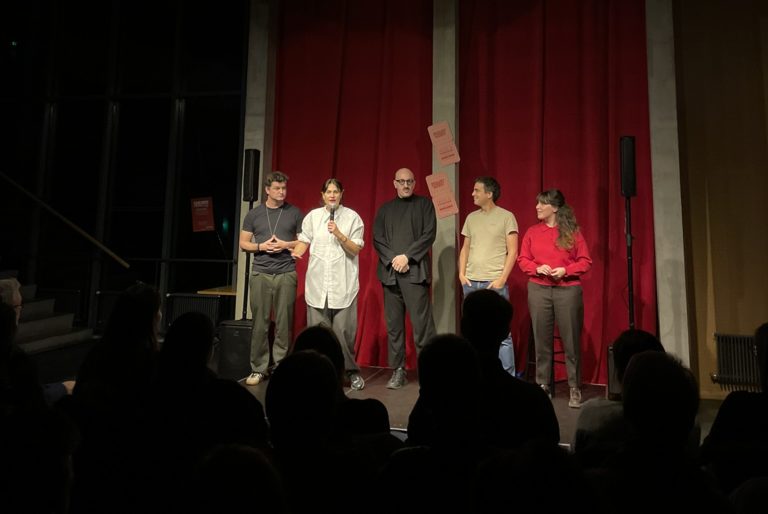
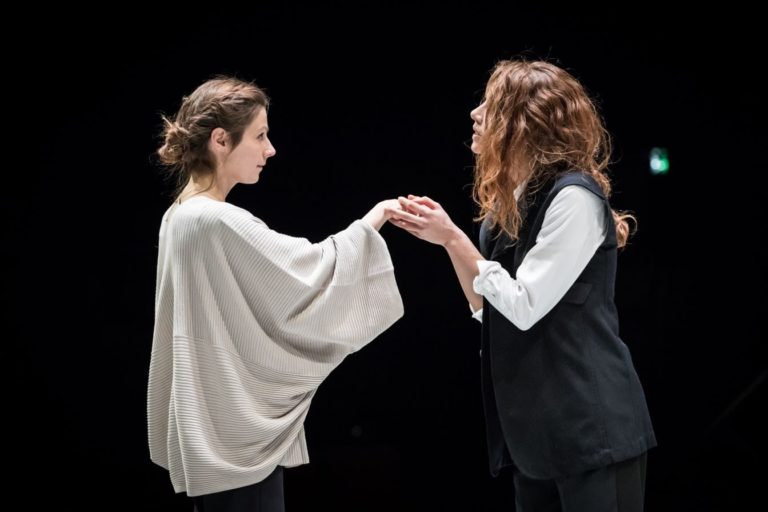
Far from the vital and serious stakes of a tragedy, we move on to the lightness of an original comedy: Fairy Tales in Pergrimland. The play was recently written by Cédric Jossen, a Valaisan with a passion for theater, who is gradually becoming a true professional. Four performances criss-crossed the Valais between February and March of this year, much to the delight of the audience, who enjoyed a great deal of laughter and entertainment.
The play, as its title suggests, subverts fairy tales by settling scores with the sacrosanct tradition of untouchable stories that must be told without ever changing a single comma. Mr. Jossen takes us on a wild ride of parodies that veer into social caricatures, illustrating just how relevant these tales can be today.
The curtain rises on a living room where the reader, eager to savor sweet and enchanting timeless tales, places a large book on his lap. Throughout the play, however, he will find himself quite confused by the characters’ behavior as they rebel against their own story; they also clash in a struggle between progressives who want to reject their tradition and conservatives who are willing to do anything to keep their tale exactly as it is. Thus, the various plotlines intertwine and unravel, much to the despair of the bard, that faithful storyteller who seeks to deliver them with dignity.
To learn more about the author and his play, we met with him last month. Cédric Jossen introduces himself and shares his thoughts with us.
Le Regard Libre: You’re a father, a docent at the Valais History Museum in Sion, and have also been involved in theater for some time now. What inspired you to enter the world of theater and even start writing plays?
Cédric Jossen: Ever since I was a child, I’ve been entertaining everyone in my family and at school. One day, I decided it was time to take the plunge. That was in 1993, in Courtelary, in the Bernese Jura, where I was living at the time. I performed with the Clos-Bernon troupe. But it wasn’t until 2007 that I really caught the bug. I was performing with the Malacuria troupe in an adaptation of Carmen in Sion. It was a very intense experience. From then on, everything happened very quickly. I began to take an interest in directing. First, the troupe in Salins asked me to direct; then the one in Lens, the Toc’Art; next, the one in St.-Léonard, the Arlequins; and finally, the one in Val d’Anniviers, Les Compagnons de la Navizence. Today, I continue to direct plays for the first three troupes. I’ve also started my own company, the Compagnie Catharsis. In addition, I studied dramaturgy at the University of Lausanne and at La Manufacture. It was through all of this that I felt increasingly drawn to theater—not only through these experiences but also through meeting people who were passionate about acting and performing on stage. My goal is to give them the opportunity to do just that, to have fun and to bring joy to others.
Fairy Tales in Pergrimland seems to stem from a deep reflection on the meaning of children's stories. What was the impetus and the main source of inspiration for writing this comedy?
During my training in playwriting, in fact, we worked a lot on fairy tales—and especially on how to approach them in a different way. I really enjoyed doing that. Also, this year, there were a lot of people in the Salins troupe who wanted to perform. I’m not really into contemporary comedies with a large cast; so, since nothing was inspiring me, I figured I’d have to write something myself. So I asked everyone what their favorite fairy tales were. Based on their responses, I chose six. Then, over the course of several weeks, we met to brainstorm ideas, all while following a general outline. After that, for two months, I drew on those ideas to write the play. Through this process, I wanted to show both the actors and the audience that you can adapt fairy tales however you like. Besides, I’m also a storyteller myself: naturally, fairy tales speak to me in a special way. But what interests me most of all is challenging the common misconception that fairy tales are exclusively for children. In fact, I almost never tell stories for children—I tell them almost exclusively for adults. And I’d really like to see that notion disappear so that adults can let themselves get swept up in the magic again. Fairy Tales in Pergrimland, it was a way to move in that direction.
At its core, this comedy seems to touch on the issue of tradition; «because tradition is tradition,» proclaims one of the characters. Should we modify and adapt folktales to suit the times? Or would it be better to preserve the story as it was and pass it on faithfully? In short, do you advocate for preservation or progress in the literary and artistic realms?
The play presents both points of view. That’s also kind of how I see things. For a child, you have to tell the story—and always the same one! Because otherwise, you get scolded… And that’s normal; you need a consistent, reassuring world around you. As we grow up, we can give our imaginations more free rein. For example: why does Little Red Riding Hood’s mother send her daughter into the forest knowing she’s bound to run into the wolf? And that’s where it gets interesting… In fact, I’ve received a lot of feedback from adult audience members who told me, «I loved revisiting the world of fairy tales, and this time I saw them differently than when I was a child. I realized that you can actually imagine all sorts of things!» So, I think I’ve succeeded in my mission.
What are your plans for your future theater productions?
I have plenty planned for this year and already for 2017 as well. First, with the Toc’Art theater troupe in Lens, I directed a play titled Snow Macarons, a play by Frédéric Crettaz, will run throughout the month of May. Next, along the same lines, with the students from Art Bacouni in Vex, an adaptation of Two Persians in Paris by Montesquieu, for early June. In September, I'll direct Kitchen and Outbuilding, a play by Pierre Dacri and Agnès Jaoui, with my company, the Compagnie Catharsis. In October, the Arlequins de St.-Léonard will present their next play. I will direct Sex and Jealousy, a comedy by Marc Camoletti, a master of the genre. In November, once again with the Compagnie Catharsis, I’ll be directing and performing in a wonderful play titled Pierre and Son, a touching and funny comedy, a two-person show with my friend Patrick Goethier. So, my 2016 schedule is pretty packed. And for the summer of 2017, I have a very big project—a major production at the Belle Usine in Fully. It’s called Dangerous liaisons by Choderlos de Laclos. But you'll find out more about that in a little while!
Write to the author: [email protected]
Photo credit: © Limonata Convention
You'll also like

 French
  German
  English
Leave a comment