




Mickey Mouse Kidnapping
Le Regard Libre N° 52 - Ivan Garcia
With Jimmy The Kid, Eric Jeanmonod presents the world of crime in a funny and entertaining way. funky. With a staging rich in movement and caricature, the director offers audiences a hilarious show that appeals to young and old alike.
On a dark night in New York City, a strange con artist tries to break down a door. This man, John Dortmunder—aka «Dort»—doesn’t seem very skilled; he keeps at it relentlessly and nearly wakes up the whole neighborhood, as his neighbors on the same floor point out to him… Unfortunately, his partner, Andy Kelp—«the one who always messes everything up,» according to Dort—crashes the heist and announces that our dear thief has gone to the wrong floor. The now-botched heist makes Dort angry, but Kelp quickly comes up with a backup plan; inspired by a novel, Kelp suggests to Dort and his gang that they kidnap a child.
An ingenious stage design
Originally, Jimmy The Kid is a novel by the American writer Donald Westlake. Westlake, a master of «humorous crime novels,» loved to play with the conventions of the genre and subject his antihero, Dortmunder, to the worst possible setbacks. Eric Jeanmonod, co-director of the Théâtre du Loup, brings the novel’s story to the stage and, in the process, infuses it with that spirit of the 1970s that has fallen somewhat out of favor.
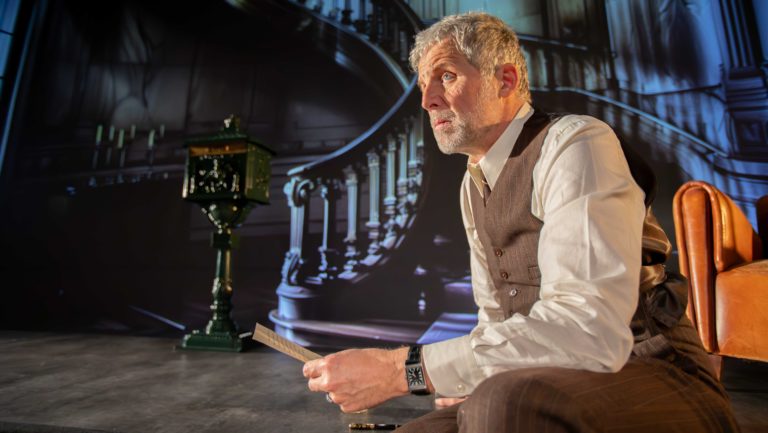
In terms of set design, a large area on stage—divided into several sections and composed of curtains—serves as a backdrop for the various set projections; the curtains themselves act as projection surfaces for the sets. This ingenious system allows the director to create multiple locations and switch between them quickly. Thus, whether through the sliding of a curtain or a new projection, the audience is transported from a building to be burglarized to Dortmunder’s apartment, passing through Jimmy’s psychologist’s office along the way. It’s worth noting that the actors take turns playing multiple characters, as there are numerous supporting roles ranging from the bartender to FBI agents, not to mention federal police officers.
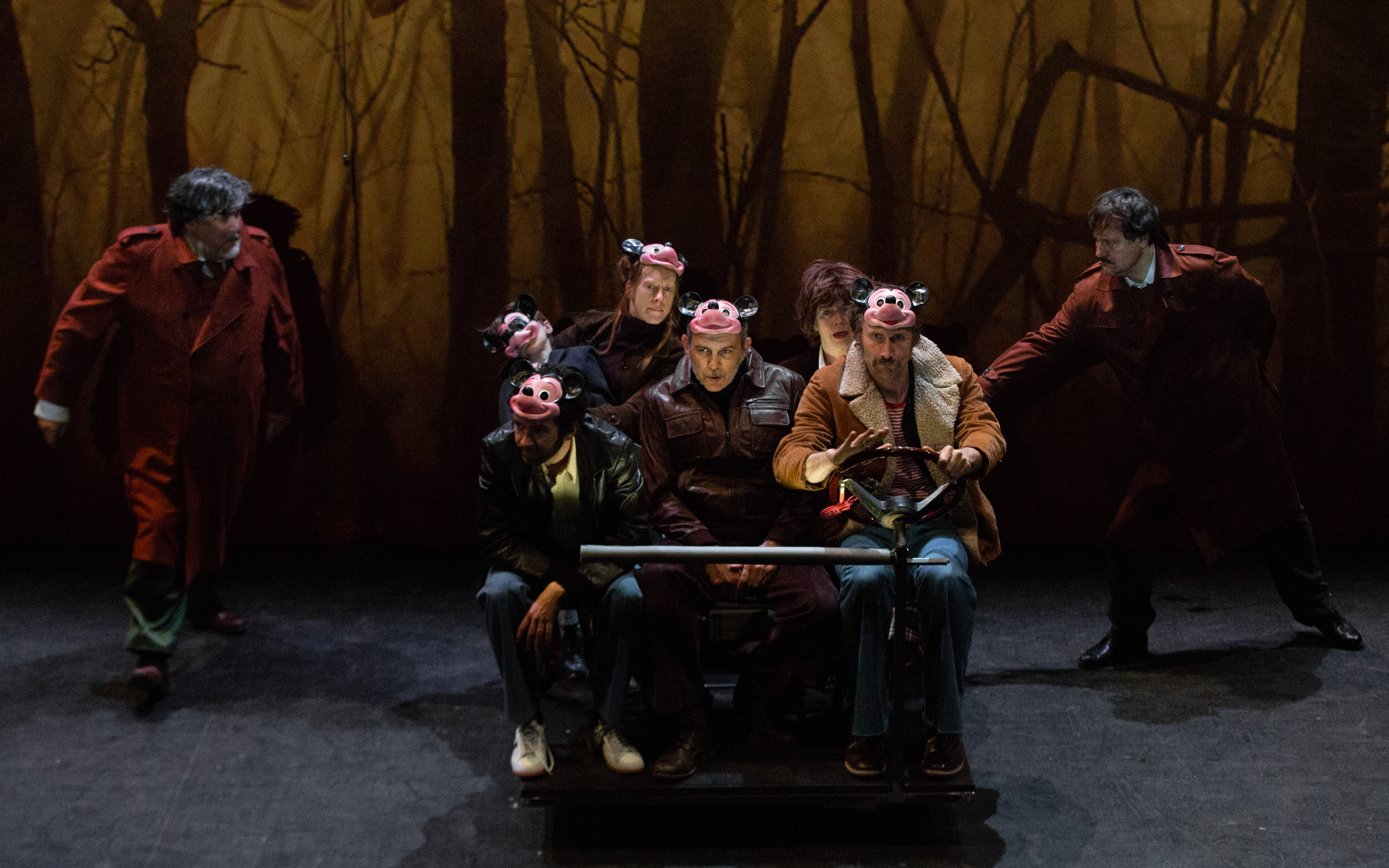
Often, narrators—dressed in long beige coats reminiscent of Inspector Gadget—handle the transitions between the various scenes that make up the story and explain what’s happening. Most of the time, the main narrator is someone who occasionally swaps his narrator’s coat to become Rollo, the bartender at the bar where Dortmunder’s gang gathers. To facilitate the characters’ physical transitions between locations, the director decided to put cars in the spotlight. A sort of cart on wheels with headlights serves as a means of transportation for the various characters—a clever nod to an era when the car was indispensable: the early 1970s, with the emergence of the consumer society.
American Icons
In fact, in addition to the cars, the director succeeds in grounding his production in this American spirit with a few references brought onto the stage during the performance. We’ll note in particular the prominence given to music in the play; the various songs the audience hears all seem to come from the American music industry of the late 1960s, alternating between rock ’n’ roll and jazz. Most of the time, the music helps facilitate the transitions between the different scenes, as if to ensure that the audience follows a common thread so as not to get lost in this whirlwind of movement.
Another amusing detail appears in the scene from the kidnapping Jimmy's. As he rides in the car with his driver, he watches his captors—wearing masks bearing the likeness of Mickey Mouse, the star of Walt Disney Studios—slowly approach. The scene, in slow motion, shows Dortmunder’s gang using pantomime to make their way to Jimmy, and suddenly, when they finally reach the child, the pace picks up and the story returns to its normal course. The kidnappers, inspired by a fictional novel whose title is said to be Child Abduction, take a rather loose approach to it in order to carry out their plan. However, sometimes reality surpasses fiction… Like when the third member of the gang, Stan Murch, hippie A car enthusiast misjudges the size of the truck that's supposed to make the Cadillac—in which Jimmy is sitting—disappear.
The entire performance is based on this dialogue between an underlying intertext—the famous novel—and the plot of the play itself—Dortmunder’s gang, which wants to kidnap a child—as they try, as best they can, to ensure that the plan outlined in the novel is a success for Dortmunder’s gang. Moreover, at the end of the show, the fictional author of Child Abduction – Donald Westlake himself – appears on set and tries to convince his lawyer to sue Jimmy for plagiarism. Jimmy, who dreams of becoming a film director, manages, by the end of the play, to make his dream come true and has directed a film about his kidnapping that bears the same title as Westlake’s book.
The tables have turned
The most intriguing character in the play is still little Jimmy. A gifted twelve-year-old who is somewhat neglected by his family, he maintains a relationship only with his psychologist, whose German accent and attire obviously bring to mind a certain Sigmund Freud… It is notably during a therapy session that the psychologist pinpoints Jimmy’s weakness; the audience learns that he has a dream: to become a director and make films. It’s an ambition he struggles to realize due to his intellectual limitations and his rather strict family background. So the young man sees his kidnappers—who, it must be said, aren’t very bright—as an opportunity to have fun and break free from his background.
After his kidnapping, the child, locked up in a house in the countryside with his kidnappers, tries to escape but ends up returning—for lack of means—and interrupts a movie screening. And for good reason: while Dort’s gang is watching a movie on TV, young Jimmy convinces them to let him watch too, and, as a film buff, he comments on clips from Frankenstein's Bride by James Whale, which are also projected onto the screen so the audience can see what the protagonist is saying. The play plays on the theme of «hoist by his own petard»: while Dortmunder and his gang believe they’ve won and outsmarted the police, young Jimmy ends up outwitting them all and making off with the loot.
To stage a play that a priori Adapting a text not originally written for the stage is no easy task. Yet Eric Jeanmonod tackles this challenge successfully and manages to bring Westlake’s playful spirit to life on stage by incorporating various mediums and comical situations. Jimmy The Kid These are the kinds of pieces that people take great pleasure in admiring, whether alone or with their families.
Write to the author: [email protected]
Jimmy The Kid / Based on the text by Donald Westlake / Directed and adapted by Eric Jeanmonod / Set design by Eric Jeanmonod / Produced by Théâtre du Loup / May 17–June 5 at the Théâtre du Loup in Geneva

You'll also like



 French
  German
  English
Leave a comment