

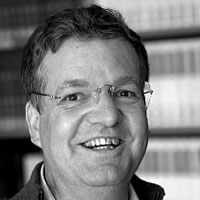
With a doctorate in theology from the University of Neuchâtel, Félix Moser was first a pastor and prison chaplain in France for four years, then a pastor in the canton of Neuchâtel for eleven years. After spending eight years at the Autonomous Faculty of Theology in Geneva, he returned to the University of Neuchâtel as a professor. Here, he shares his thoughts on Christmas.
Le Regard LibreWhat is the history and meaning of Christmas?
Félix Moser: In the beginning, historically, the first Christians gathered around what was the core of the Christian faith, namely the love and resurrection of Christ and the festive cycle of Easter. Christmas really came late, since it was celebrated in the 4th century.th century when it became widespread.
Theologically speaking, Christmas, which celebrates God's incarnation, is closely linked to Epiphany, the feast of the Magi. The theological significance of Christmas, then, is to show, on the one hand, the human Christ, and on the other, with Epiphany, the glorious Christ. Basically, Christmas was born with the first ecumenical councils, in 325 at Nicaea and in 381 at Constantinople. The idea is to show the nature of the God we believe in.
Christmas also has pagan origins, doesn't it?
Exactly. Christmas was actually grafted onto the cult of the Unconquered Sun (dies natalis solis invicti), a pagan festival established by Emperor Aurelian in 274. This is very interesting, as it shows that Christianity took over certain pagan feasts and gave them both religious and theological significance. Dies natalis solis invictiWe can see that this is a festival of light at a time when the days are at their shortest. It is therefore possible to make a Christian interpretation of the Sun cult, since Christ is called «Sun of Justice who carries the City in his rays» (Mt 4:2) and «Rising Sun who visited us from above» (Lk 1:78).
What about Christmas in the Bible?
Only two of the four Gospels tell the Christmas story as we're used to hearing it. The Gospel according to Matthew, with Bethlehem and the visit of the Magi, and the Gospel according to Luke, which also tells the story of Christ's birth, but this time with the visit of the shepherds. These traditions then merged.
I see you've also brought an apocrypha?
Yes, this is a text that is not found in the Scriptures. In the apocrypha, we have a text called the Protevangile of James. It recounts in great detail not only the Visitation, but also «the Edict of Augustus», «Jesus seeks a midwife», «childbirth», «Elizabeth and Zechariah», etc. In short, we have a text that is not found in the Scriptures. In short, we have a piece of writing that places much greater emphasis on the marvellous and the flowery. This text was not taken from the biblical texts, but was later taken up by the Gospel of Pseudo-Matthew. As a result, our Christmas traditions of the 20thth century (which are crumbling; basically, what's left is the family gathering and the gifts) emanate from the creation of a marvelous eclipsing Easter.
And the Christmas story isn't over yet.
No, because these historical elements have been grafted onto a whole series of other traditions, the origins of which are sometimes hard to pin down, and which are linked to culture. What's interesting is that a symbol like the Advent wreaths is given a Christian meaning: four candles are lit, symbolizing expectation and the Old Testament prophets who foretold the coming of Jesus. So there was a meeting of the minds between popular belief and Christmas celebrations.
Cult and culture are always intertwined, so sorting out what's in the Gospels and what isn't isn't really relevant. Basically, Christmas was an attempt to respond to Christianity's difficulties concerning Jesus' coming into the world by demonstrating that, for a believer, Jesus is more than just a man and that he was born, and not just at his baptism. We have therefore battled with popular beliefs to find a theological meaning.
Does Christmas 2015 have any special significance for you?
What's interesting is that we have a cyclical understanding of time. The year is structured on the one hand by the seasons and on the other by the liturgical year. In 2014, we read the Gospels, in 2015 we read them and in 2016 we'll read them again. So we're in a kind of spiral. For me, Christmas 2015 will have a very special meaning, because in 2015, I'm not experiencing the same thing as in 2014. This holiday will be both a repetition of the same, with family traditions, and at the same time we'll be going through these stories in a different way. In the same way, you've probably read Madame Bovary in high school, and maybe you'll read it again in your Master's degree: that'll be a completely different reading! So it is with liturgy. The task of pastors is to give new life through rereading.
How would you sum up the past year?
What struck me in general was that we're facing some major upheavals, which we're struggling to grasp. On the one hand, these are geopolitical upheavals, with, for example, the idea of the «Arab Spring» having come to an end in two years; on the other, they are temporal upheavals: I have the impression that we are experiencing an acceleration of time in the way we perceive it. This is linked to new technologies. We're in the decade of the acceleration of time. It's all the more important to have these landmarks, these ritual moments, because they allow me to anchor myself in a certain rhythm. Ritual enables rhythm. In The Little Prince, The fox asks, «What is the rite?» and the Prince replies, «It's what makes a day different from other days, and an hour different from other hours. Basically, time is made up of contrasts; Christmas is just such a contrast.
Unfortunately, some people don't have the chance to experience this contrast with their families. Many people are lonely, sometimes even depressed or worse.
It's very sad indeed. I think there are many fine initiatives, undertaken by believers and non-believers alike. I'm thinking in particular of «Noël Autrement», an association based in Neuchâtel. Above all, we need to engage in exchanges. As a teacher, I've noticed that many students from abroad can't afford to go home, so this is the time of year when they feel loneliest. There are also things being done with asylum seekers. We must continue in this vein.
How important is family to you?
I find that the concept of family has been instrumentalized a lot. Firstly, I support the family, because it's the first nucleus that enables individuals to take their first steps in society. Secondly, it has to be said that the traditional family model, which is a relatively late model (we owe it to the bourgeoisie of the eighteenth century), has not been able to survive.th century), was exalted with a Church syncretism that associated this family model with that of Jesus, Mary and Joseph.
Today, the family is very much marked by recomposition, with all the questions this raises, particularly at the social level. It's all a big question of negotiation and loyalty. At the same time, if you do a survey, you'll see that what people hold most sacred is the family. So there's quite a bit of tension between the dream of the family (and I'm all for the family, it's important) and sociological reality. When it comes to living it out, it's always very difficult.
You recently took part in a café philo in the town of Neuchâtel, where you argued for the separation of church and state. What kind of secularism speaks to you as a theologian?
It's extremely important to have a State that fulfills its function. The State is the guarantor of individual freedoms: freedom of belief, freedom of expression, but also freedom of association. Secondly - and this is less of a problem in Switzerland - the State cannot accept communitarianism, i.e. groups of people who adopt rules that are more important than the rules of secularism, than those laid down by the Federal Constitution. In this sense, I advocate a secular state, but one in which religious information is available. I believe that if we don't provide this information, it's the most vulnerable and weakest who fall into communitarianism. This is exactly what is happening. We don't see many university students going over to the jihad.
Even as we speak, the media are reporting that collaboration between schools and Christian churches has been stepped up in Valais, in order to fill a «spiritual void» that could lead to fanaticism, drugs and so on. What do you think of such measures?
We need to be very careful about what type of religion is taught at school. We need to distinguish between denominational teaching and religious teaching that presents the different forms of religion, even if this means visits to synagogues, mosques and so on. This is the kind of teaching that should be given at school. What's more, I find it incredible that the Valais school law of 1962 stipulates that schools must train good Christians! In the same «anti-secular» wave, the Valais parliament recently decided that judges belonging to the Freemasonry must declare themselves. Freedom of association is under attack.
More generally, what is your vision of the state and politics?
I'm a former radical from the canton of Vaud, so to speak. I think everyone should play their part. The state and the churches must be separate. In fact, I have a very noble vision of the State. When you're here discussing in this university, you realize the important role that the republican state has to play. Universities, hospitals, defense - all these can only function with a strong State. All the rules that governed until the 2000s were rules that still functioned in a globalized world. So the challenge facing you, the young people, is this: how do we think about and establish rules that take globalization into account?
Why should these rules no longer work with globalization?
One of the main explanations is the detachment of finance from the economy. This has led to deregulation, which requires the full attention of politicians. We're seeing this in France: people are crying and wanting to go back to the old rules. Of course, this doesn't work. You can't re-establish borders when you can send an e-mail across the Atlantic in a second.
It seems to me that in religious matters, it's extremely important to realize that the situation has changed. We live in a multi-cultural and multi-religious society, which raises major questions, because communitarianism goes a long way. When I was a prison chaplain, the question arose of serving «halal» meals to inmates. But if you do that, do you have to give fish to Christians on Fridays, and so on? We never stop. It's the same with religious symbols. That's why it's so important for the State to be truly secular. However, we must be careful not to fall into a secular religion as in France, where republican baptisms are now taking place.
How do you see Switzerland in 2016?
The year 2016 will resemble our decade, with major challenges playing out at the political level. I've been following very closely what's been happening in the Federal Council. We'll still have to keep a close eye on things, now that we have two SVP in power, with a whole series of important decisions that the Council will have to make. At local level, my priorities will be to maintain a good level of education. Fortunately, the budget has been maintained, but we're increasingly seeing the emergence of a new type of society. pragmaticIt's all about efficiency, it's all about performance. Economism is taking over. Let's maintain space for culture and debate.
 French
  German
  English