




How is Switzerland doing? Couchepin and Blocher cross swords
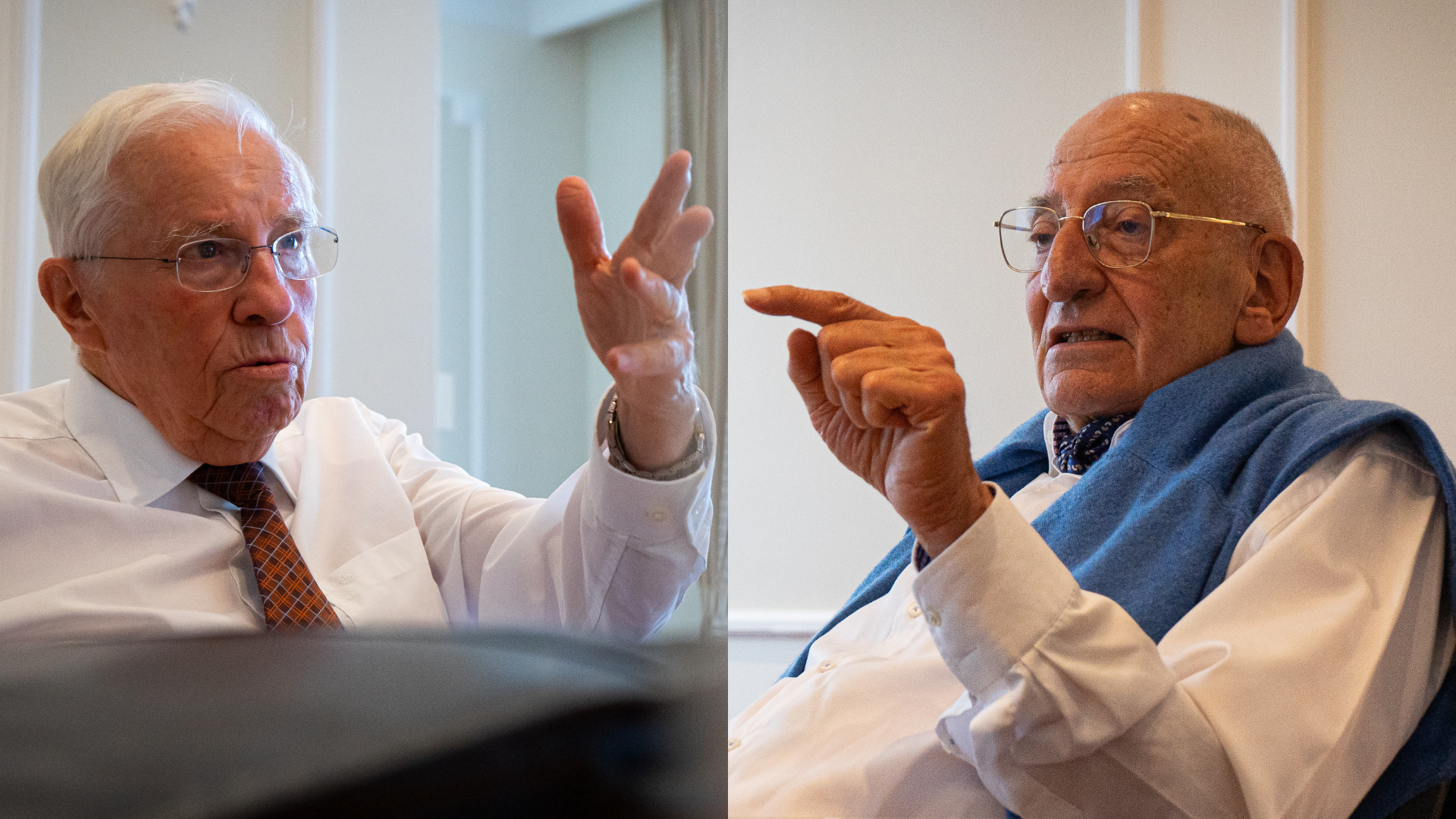
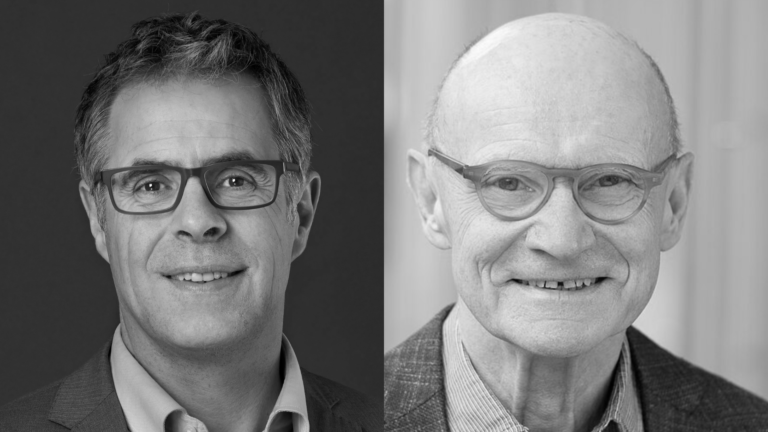
SVP Christoph Blocher and FDP Pascal Couchepin, colleagues in the Federal Council from 2004 to 2007, had not debated together since. Daniel Wittmer for Le Regard Libre
Immigration, Europe, the economy, the media... Former federal councillors Christoph Blocher and Pascal Couchepin met in Bern at the invitation of the Regard Libre to compare their views on Switzerland's current situation and the challenges it faces.
An interview by Jonas Follonier and Nicolas Jutzet
They hadn't debated together since Christoph Blocher's non-re-election to the Federal Council in 2007. Now, sixteen years later, they are meeting in a friendly atmosphere in the lounge of the Bellevue Palace, a stone's throw from the Federal Palace, to discuss their shared passion: the destiny of their country. The two former members of the government arrived well in advance for this Bern appointment. However, the interview will start twenty minutes late, as the former colleagues and eternal adversaries have so many anecdotes to share and questions to ask each other.
The little barbs are already flying. One has twelve grandchildren, the other eleven. Couchepin denies Blocher the status of Liberal-Conservative, preferring the label Conservative-Democrat. Blocher maliciously accuses Couchepin of having played a part in his ousting in 2007 - Couchepin denies it, adding that although he never contributed to his non-re-election, he was nonetheless delighted by it. And so the debate begins. The Valais PLR hands over the first word to the Zurich UDC: «The eldest has the floor.»
Le Regard LibreHow Switzerland is doing?
Christoph Blocher (C. B.): Compared with other countries, Switzerland is doing very well! The Swiss have the impression of living in a paradise. But this impression is pernicious. As we emerge from a long period of prosperity, our situation is set to deteriorate: Switzerland can only continue to do well if it has the courage to remain independent and decide its own destiny.
Pascal Couchepin (P. C.): I share the view that, in international comparison, Switzerland is doing very well. I also agree that the future will be less rosy. It's the story of the man who falls from a skyscraper: on the twenty-fifth floor, he says to himself that so far, so good, but there are still twenty-five floors to fall. The important thing is not the fall, but the landing. We may be united on the facts, but we're certainly not united on solutions for the future. To face up to this challenge, we need to be open to the world, and in particular to our partners, the European Union (EU) in particular. We need to reach an agreement with the EU, not least for the sake of Swiss research, which must remain competitive. Indeed, research is like glaciers: when they disappear, there's a problem of irrigation for rivers and dams. I'm also in favor of an independent Switzerland, but we need to be a little realistic. A country with 9 million inhabitants must be prepared to lose a little freedom in order to participate in bodies like the World Trade Organization (WTO). We also need a certain amount of immigration to meet the demographic challenge of financing our social institutions at a time when our birth rate is low.
C. B.: When you ask people what they think of Switzerland, they say it's great. When you ask politicians the same question, they mainly criticize the model that has made us so successful. They regret that Switzerland is not more integrated into international institutions. Personally, I think it's better for Switzerland to please its people than its politicians. I was an industrialist for a long time, active all over the world. The economy is an important part of human life, but there's more to it than that. We talk a lot about the demographic challenge, but today the challenge is more one of migration, given that Switzerland is the country that welcomes the most foreigners. Over the last twenty years, Germany, which is nine times the size of Switzerland, has welcomed 1.1 million immigrants, and Switzerland 1.5 million. All our problems stem from this excessive immigration. Switzerland has all the necessary legal bases to remedy this situation and implement the will of the people, who voted yes to the SVP initiative in 2014, aimed at controlling these flows. But politicians are not taking this responsibility.
P. C.: The Swiss have always been able to integrate people. Obviously, with more people to welcome, it's more difficult. But Switzerland is at the center of Europe, so we shouldn't be under any illusions that we can drastically reduce immigration. On the other hand, I'm delighted to hear that our fellow citizens - and even you today - are happy with the current situation, because to hear your party tell it, we'd be in chaos! The SVP gives the impression that all its opponents are incapable of solving the problems we face.
During the current campaign for the federal elections on October 22, the SVP is claiming: «Far too many foreigners are coming to Switzerland, and they're the wrong kind! Is it possible to define a tolerable immigration threshold??
P. C.: There is no limit that can be defined a priori. It all depends on the international situation. In terms of asylum, it's normal to welcome people fleeing war. We need to find balanced solutions on a case-by-case basis, drawing on our strengths such as the Red Cross and working with neighboring countries. As far as economic migration is concerned, we need skilled personnel, particularly in the IT sector.
C. B.: The problem isn't with this type of profile, but with those who come under the free movement of persons and don't work! And there are too many of them. Add to this the fact that many of those seeking asylum are economic migrants. Not to mention illegal immigration...


P. C.: Immigration poses certain problems, but you can't solve them by making them an emotional issue before every election, as your party does.
C. B.: The other parties don't like it when we talk about this issue. But it's a strength of our system that the SVP is able to push a subject onto the political agenda. And not just before the vote, either.
P. C.: The SVP has done very little over the last thirty years, apart from protest.
C. B.: In addition to our popular initiative of 2014, the people also accepted the one calling for the expulsion of criminal foreigners in 2010. That's a bit more than just protest!
In 1992, Switzerland refused 50.3% to join the European Economic Area (EEA). It was a victory for you, Christoph Blocher. Pascal Couchepin, you were in favor of Switzerland joining the EEA, and the EU in the longer term. Where do you stand today?
P. C.: I'm still of the opinion that our country would benefit from participating in European decision-making in the long term. In the 90s, I estimated that Switzerland would join the EU in the 2020s. Today, I think Switzerland will join a united Europe in 2050. There has never been a majority in French-speaking Switzerland to say that Switzerland should join the EU right away. But it must remain an option for the long term.
C. B.: Switzerland must not join the EU, either today or tomorrow. We must not reduce Switzerland's strength just because politicians want the country to be part of this great whole. If Brussels were to take over, we would lose part of our legal sovereignty. It would be a form of colonialism.
P. C.: What propaganda! If we freely sign a contract with the EU, it's like signing a lease: we lose part of our sovereignty, of course, but voluntarily, in order to gain other advantages - notably economic - and participate in another form of sovereignty.
Who has the greatest influence on the course of ideas in Switzerland today?
C. B.: It's impossible to give you a clear answer, and that's a good thing! But politically speaking, the administration has enormous power. What's more, there are no opposition parties in our country, because that role is played by the people. Otherwise, in the economy, the umbrella organizations have more power than the entrepreneurs, and they tend to be dominated by the big international companies. Yet these multinationals are run by managers obsessed with the short term, rather than by entrepreneurs who have to think over several generations.
P. C.: The economy doesn't have much influence on the rest of society when times are good. We hear a little more from business when things are bad. The problem is that many company directors have less of a political culture than they did twenty years ago. They often come from abroad with ready-made, American-style ideas, and have a poor understanding of the Swiss system and the values we respect. Another problem, of a civilizational nature, threatens us: the idea that if you have an opinion, it must be true. The love of debate is fading.
The Confederation is taking on more and more tasks. Is this a problem?
P. C.: The problem is not that the Confederation is taking on more and more powers, but that the cantons are no longer fighting to keep them. They're afraid of responsibility and tend to blame Berne when difficulties arise. It's the weakness of the cantons that's at stake, not the strength of the Confederation.
C. B.: I agree with this diagnosis. Too often, cantons prefer to delegate, to avoid having to foot the bill. It's nice not to have to decide for yourself. Federalism is an abstract concept. We need to better explain to people on a case-by-case basis why centralization leads to absurd decisions, with concrete examples. That's what I'm trying to do.
The «200 francs, ça suffit! initiative, which calls for a reduction in the radio and TV licence fee to this amount (currently 335 francs), raises the question of the role of public service broadcasting and its financing. Do you support this initiative?
P. C.: It will make for an interesting and necessary discussion. Even if I'm not sure it's the right way to go about it, I share the idea that we have a problem with the current media offering. This problem goes beyond the SRG: there isn't enough pluralism, including in the private media in French-speaking Switzerland! We need to discuss this, bearing in mind that a country like ours must ensure quality information for all linguistic regions.
C. B.: I'm going to support this initiative. There are several things that bother me about the current configuration. It doesn't make sense for someone who never watches public service TV to have to pay the licence fee, or for someone to have to pay the licence fee privately and then again through their company. This must be remedied. In recent years, the SRG's monopoly position has been strengthened. In my opinion, monopolies of opinion are even more dangerous than economic monopolies. The current situation is unhealthy.
Write to the authors:
jonas.follonier@leregardlibre.com
nicolas.jutzet@leregardlibre.com
You have just read a debate published in our paper edition (Le Regard Libre N°100), exceptionally freely available on our website. Subscribe to support us and get access to all our content!
Clarification for the reader: Pascal Couchepin is one of four columnists on the Regard Libre since September 2019, alongside writer Quentin Mouron, reporter Sophie Woeldgen and youtuber Ralph Müller. Every four months, the former Federal Councillor comments on in his column an essay - or another work - that particularly interested him. The contrasting opinions of these four columnists in no way reflect any «editorial opinion».
-
 Le Regard Libre N°100Price range: CHF5.00 through CHF10.00
-
 Youth passFrom: CHF2.50 / month
 -
Digital subscriptionFrom: CHF5.00 / month with a 30-day free trial and a CHF2.50 sign-up fee
-
 Standard subscriptionFrom: CHF10.00 / month with a 30-day free trial and a CHF2.50 sign-up fee

You'll also like

 French
  German
  English
Leave a comment