




Looking back on 2010: is the glass half-full or half-empty?
As the 2010 decade draws to a close, many of us are tempted to draw up a list of the major events of the past decade. This list, obviously non-exhaustive, will probably include some of the following: the Arab Spring, the Syrian civil war, the refugee crisis, the Paris attacks, the Fukushima nuclear disaster, Russia's annexation of Crimea, the Ebola epidemic, the eurozone crisis, the success of populist movements in India, Brazil, the Philippines and the USA, Brexit, record fires in the Amazon rainforest, and strikes for the climate.
Why, out of the hundreds of thousands of pieces of information we take in over the course of a decade, do we choose to remember the most dramatic ones above all others? According to the author of Factfulness, According to the Swedish physician and lecturer Hans Rosling (1948–2017), this is not a choice but an instinct: our brains are conditioned to remember dramatic information. Any news that conveys fear is automatically filtered by our brains as important information, because it is perceived as a sign of immediate danger. If you reread my list of the decade’s most memorable events, you’ll see that I am, of course, no exception to the rule.
However, instead of letting ourselves be guided by the instinct of fear, generalization, or even gap instinct, Rosling encourages us to develop a critical mindset so we can evaluate any information we receive with a sense of perspective. His message is not to ignore our instincts and view all the evils afflicting our world with cold detachment. Atrocities are committed every day, and we should never become indifferent to the suffering of others. Rosling’s message is quite different. To be able to maintain faith in our humanity, we must be able to make the following mental observation: the situation is bad, but it is improving.
Des millions d’avions arrivés sans encombre
Trapped by our instinct for fear, we are unable to recognize the quiet progress humanity has made over the past few decades. Access to electricity and clean water, vaccinations, and education are all areas that are constantly improving, yet they receive little media coverage. No journalist would write an article about the millions of airplanes that have arrived safely at their destinations. Plane crashes, on the other hand, receive a lot of media attention because such stories sell better.
Thus, despite the ongoing wars in Syria, Yemen, and Ukraine, as well as fires, earthquakes, and floods—all tragedies whose severity should never be doubted—the proportion of the population affected by war or natural disasters has never been lower in human history. Despite global challenges such as the persistence of extreme poverty in certain regions of the world, the increasing scarcity of natural resources, and rising inequality, human life expectancy has never been higher. The state of the world is obviously cause for concern, but progress is being made.
Another cause for pessimism stems from the use of concepts and generalizations that are now outdated. The idea of the «Third World» is undoubtedly one of the most persistent of these. This concept, coined in the 1950s and still widely used in 2019, encompasses most countries in Africa, Asia, and South America. These nations are supposedly destined to remain forever at a considerable economic and social disadvantage compared to industrialized countries.
However, the concept of the «Third World» no longer reflects today’s reality. To illustrate this, let’s consider two indicators of poverty: infant mortality, which reflects the availability and quality of health care systems, and the number of children per woman, an indicator of a country’s level of development—it is universally observed that the birth rate declines as a country industrializes. Let’s compare these two indicators between 1970 and 2018, since data for 2019 is not available. We have also added a third dimension: the population of each country, indicated by the size of the colored bubbles, which gives us a better idea of where the majority of the population «lies» on the graph.
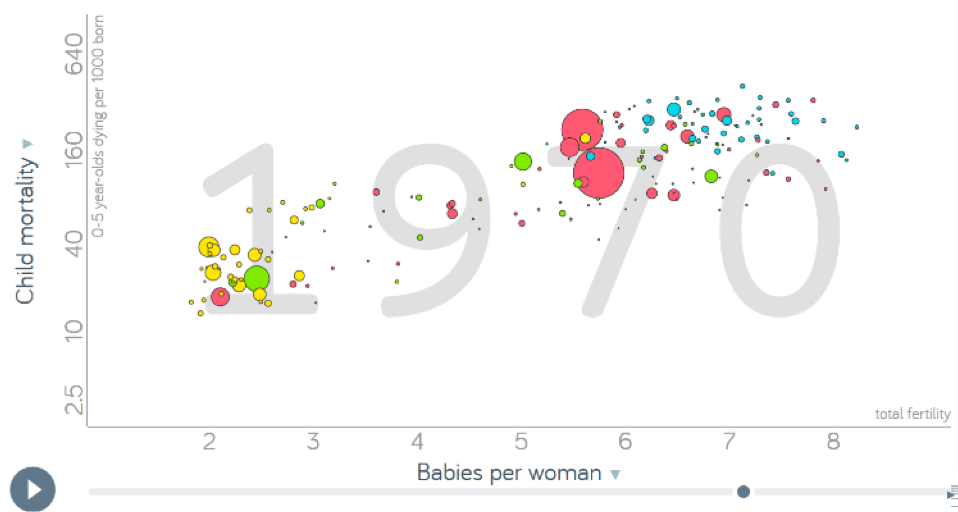

Is the «Third World» Coming to an End?
In 1970, there were clearly two distinct worlds. On one side was the industrialized world, where women had an average of two to three children and the infant mortality rate was very low. The majority of humanity lived in the «Third World,» characterized by high birth rates and high infant mortality. Today’s world is very different. The vast majority of humanity has reached a low birth rate, and infant mortality has decreased significantly, to the point where the «Third World» is now indistinguishable from the industrialized world.
Such progress, unprecedented in human history, should be celebrated more often. I can only advise curious or skeptical readers to visit gapminder.org and to compare other indicators. You will see just how wide the gap is between our perception of the world and reality.
A l’heure du numérique où le partage d’information est devenu instantané, nous sommes en permanence accablés de nouvelles dramatiques. Si nous ne nous retenons que celles-ci, notre perception de la situation sera erronée, sinon incomplète. C’est pourquoi, en ce moment de bilan de la décennie 2010, il est plus que jamais important de rester attentif aux progrès silencieux accomplis par l’humanité. Des milliers d’avions arrivés sans encombre à destination.
Write to the author: [email protected]

You'll also like

 French
  German
  English
Leave a comment