




The captain and the deputy prime minister
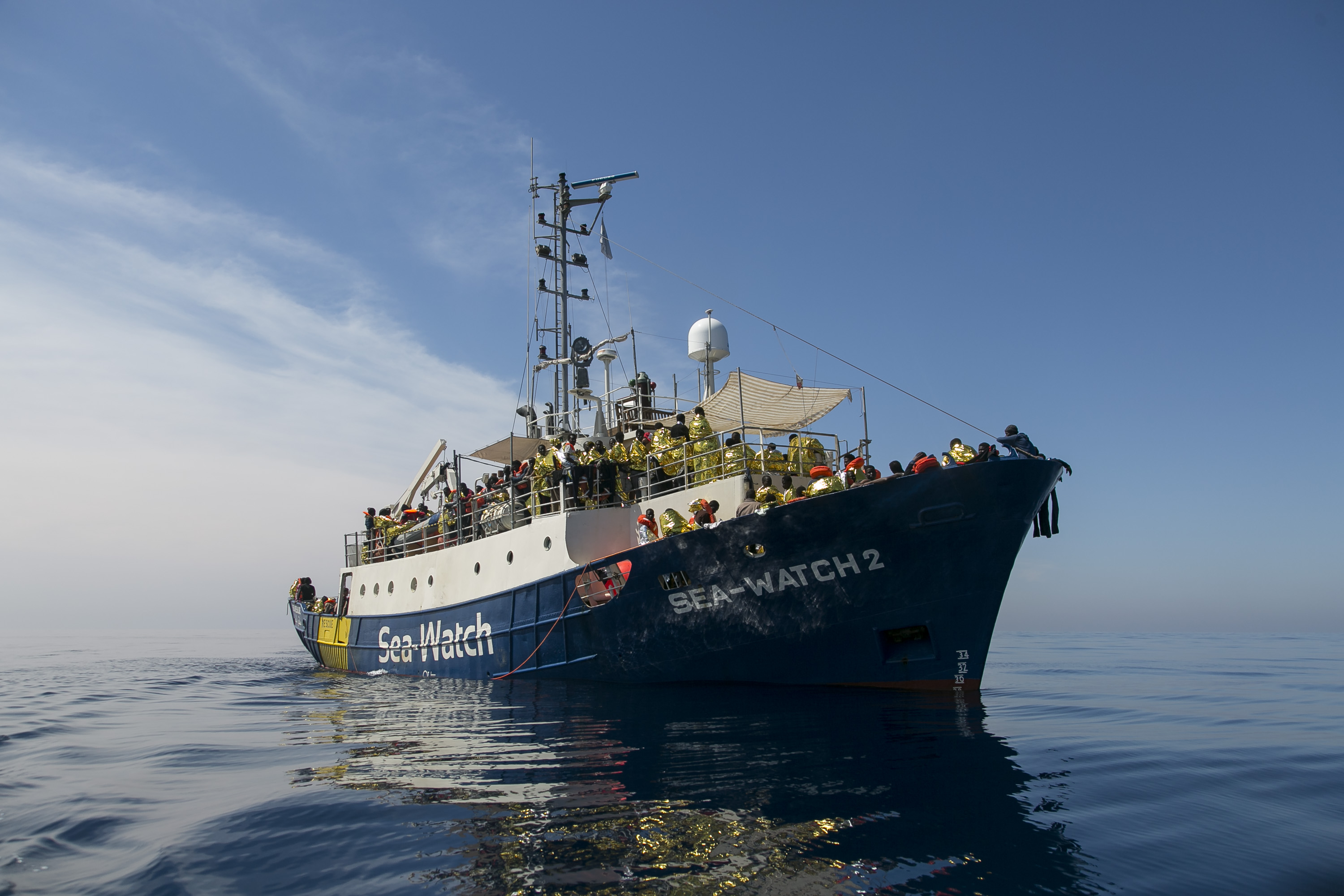
The rescue ship "Sea-Watch 2" has taken on board migrants who were evacuated from sinking rubber boats. With several hundred people on board, the ship is carrying several times its safe capacity.
Les lundis de l’actualité – Clément Guntern
It's like something out of a Disney movie: the young princess, a little rebellious and loose-haired, following only her dreams, becomes a heroine as she takes on a violent, selfish villain. She goes beyond her little student destiny and fights for a cause that is somewhat forgotten, but eminently just. The princess is not afraid to take on the villain's henchmen to achieve «what she believes in».
In recent days in the Mediterranean, the migrant issue has taken on an unexpected human face. On the one hand, Italian Deputy Prime Minister Matteo Salvini has become a leading figure in Italian politics with his outspoken views, anti-immigration stance, and determination to enforce order; on the other, a complete unknown, Carola Rackete—a volunteer with the NGO Sea Watch and a marine biologist—has in recent days come to symbolize the cause of migrants in the Mediterranean.
There’s no need to point out here that she has repeatedly forced her way through Italian naval blockades to disembark migrants from Libya who had been rescued in the waters south of Italy. Once again, personification has done its work, bringing with it caricatured visions of this debate—admittedly less prominent at present—on migration flows. She is the epitome of the modern heroine: an unknown woman who, one day, embraces her extraordinary destiny for a just cause. He represents hope for a people who feel helpless: he offers order to his country.
Read also: Personne n’a le monopole du populisme
These are also two laws that weigh against each other and clash: on one side, the law of men and the community—Salvini’s law, which advocates putting a stop to migration; on the other, a universal and sacred law—Rackete’s law, which calls for the unconditional welcome of migrants. The German captain is prepared to go to prison for her higher law because she believes that the law of men is unjust. She believes that, as a humanitarian ship, her duty is to sail into the waters between Libya and Italy to rescue migrants, in defiance of Italian laws and the Italian military. But is Italian law so unjust that it deserves to be knowingly and repeatedly circumvented?
Some of you may have felt the same way: this whole story is reminiscent of that of Antigone, who, in defiance of the king’s orders, decided nonetheless to bury her brother, who was considered a traitor. Is what Rackete stands for truly universal and sacred? Some would say that her rebellion against the established order is commendable and desirable. But aren’t there other interests at stake? To follow her law is to denigrate the responsibilities that weigh on those in power; as in Anouilh’s *Antigone*, Salvini plays the villain, and he knows it. He must enforce his country’s law, even if he comes across as obnoxious and vulgar at times.
What remains is the tragedy of the situation and the human lives at stake. However, one might legitimately ask whether there are other ways to save these people and whether this approach is not counterproductive. Whether it’s Rackete, with her open-door policy, or Salvini, with his call for a complete shutdown, their positions are far from what is desirable or effective. Nevertheless, it is essential not to raise too much hope among populations likely to migrate while still applying criteria for admitting them. The “middle ground”—so often touted but almost never applied—is nothing more than a cry in the wilderness.
Write to the author: [email protected]
-
 Standard subscription (Switzerland)CHF100.00 / year
 -
Support subscriptionCHF200.00 / year
You'll also like






 French
  German
  English
Leave a comment