



Simone Weil and national sentiment
Le Regard Libre N° 29 - Jonas Follonier
On the eve of August and the celebration of our beautiful Switzerland, let's take a look at a great woman of the 20th century.th Simone Weil, with a W, not to be confused with the politician who has just passed away. Simone Weil, with a W, not to be confused with the politician who has just left us.
Born into an Alsatian-Jewish family, Simone Adolphine Weil was exposed to the reality of the First World War from an early age. As her father was a military surgeon, she was confronted with human misery, to which she quickly showed herself to be sensitive. Throughout her life, her struggle would focus on the plight of the weakest, the oppressed and the uprooted.
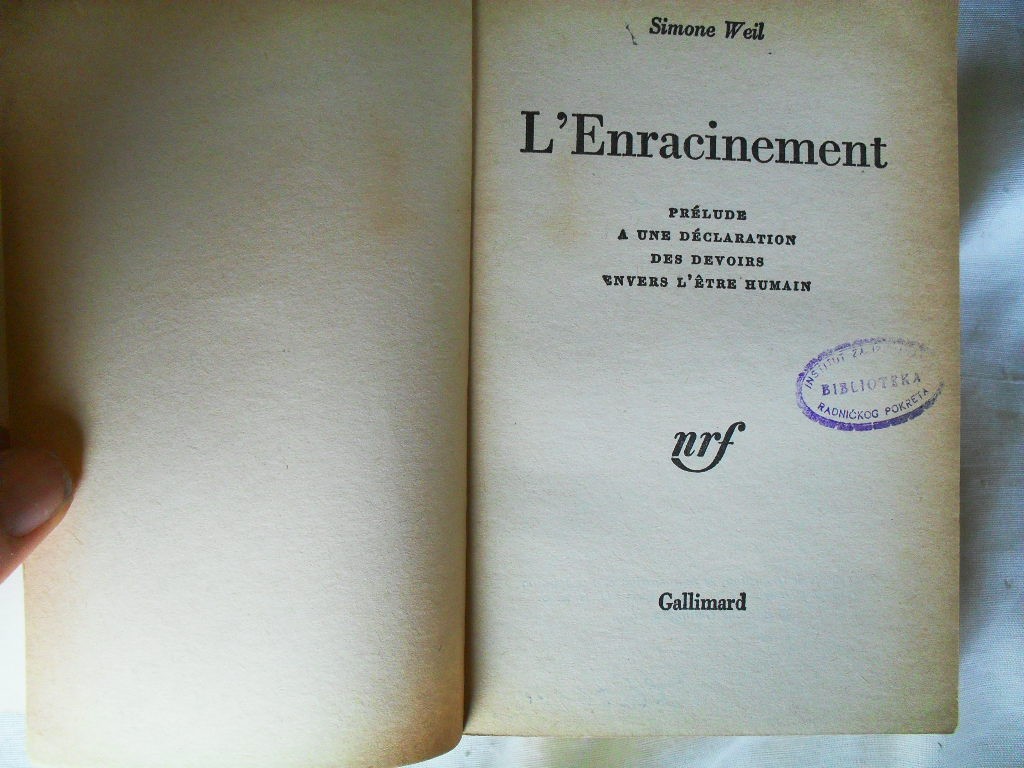
Uprootedness: one of the great themes, if not the most central, of Weil's thought. Convinced that this was the main cause of the tragedies of her time, with Nazism at the forefront, the young French philosopher devoted an astoundingly lucid and authoritative work to this question, which was unfortunately also her last: Taking root.
This «prelude to a declaration of duties towards the human being» (the book's subtitle) envisages a total overhaul of civilization, based not on rights, but on obligations. We are all responsible for providing for the body and soul of the human being. What does this have to do with rootedness? For Weil, it is «perhaps [the] most important and most ignored need of the human soul. [...] A human being has a root through his real, active and natural participation in the existence of a community that keeps alive certain treasures of the past and certain presentiments of the future.»
This community can be called a village, a canton, a region, or even a nation. The need to put down roots is not without a certain national emotion, which Simone Weil defines in these now famous terms: «The feeling of poignant tenderness for something beautiful, precious, fragile and perishable, is otherwise warm than that of national greatness. The energy with which it is charged is perfectly pure. It is very intense. Is a man not easily capable of heroism to protect his children, or his old parents, to whom no prestige of greatness yet attaches?»
Following in the footsteps of Simone Weil, who died at the age of thirty-four in the London Resistance of 1943, let's choose to praise not the greatness of Switzerland, which in any case does not exist, but its fragile and precious character, which is in danger of no longer existing.
«It seems to me impossible to imagine a renaissance for Europe that does not take into account the requirements Simone Weil defined in Taking root.» Albert Camus
Write to the author: jonas.follonier@leregardlibre.com
Photo credit: © kupindo.com
Jonas Follonier was Anne Laure Gannac's guest on her program «Philo In Vivo» on RTS La 1 radio.era to talk about Simone Weil and the concept of rootedness, on the 1er August 2017, alongside writer and patron Metin Arditi: link to listen to the show

Vous aimerez aussi

 French
  German
  English
Laisser un commentaire