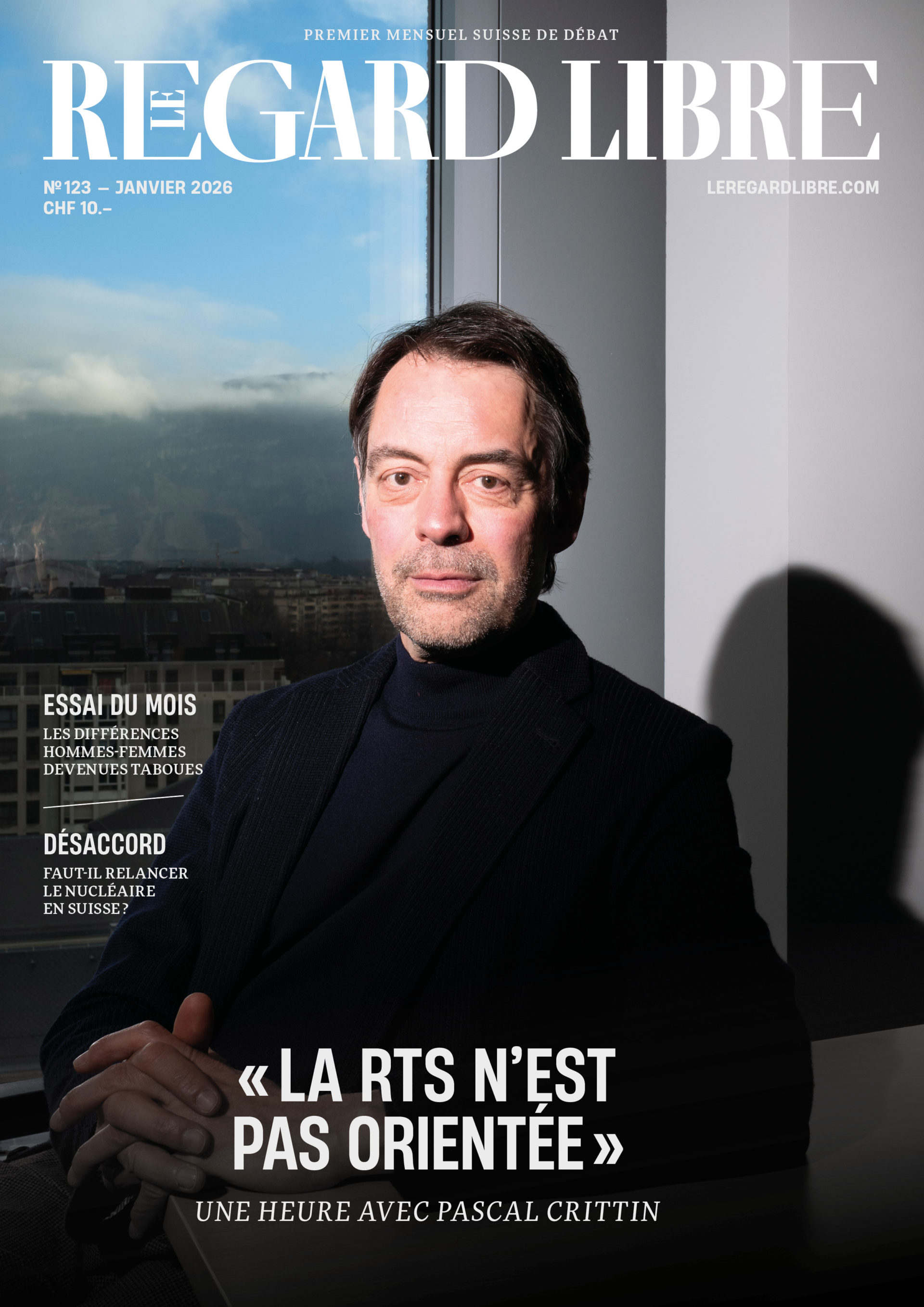




«Dominique de Buman, a Swiss»

Le Regard Libre N° 50 - Jérémie Bongiovanni
Professor Gilbert Casasus publishes a mixture in honor of Dominique de Buman with Editions Slatkine. Contributions from various authors who shared a moment in the National Councillor's political life. Above all, it is an eulogy of the man and of the Christian Democrat politician from Fribourg. Short essays also deal with subjects dear to Monsieur de Buman's heart in Swiss politics.
On the one hand, texts by friends of Dominique de Buman who evoke shared experiences, recount the character and, above all, compliment their friend with little restraint. On the other hand, some of the authors focus on a specific subject, trying to live up to the tough task they have set themselves: contributing to Swiss political thought.
An atypical profile
Dominique de Buman is a professional politician, which is rare enough in Switzerland. And that's what characterizes him: his ceaseless work in the service of the community. At the heart of this book is little description of his positions on specific issues - he is simply described as the left wing of the PDC - but rather of his values and origins. For a man who still lives in the center of Fribourg, tradition is extremely important. We discover a man closely linked to his city - he belongs to an old Fribourg patrician family - but also to his faith.
A Catholic, he speaks of his religious convictions and values rooted in the Bible - an atypical profile in parliament, to be sure. It has to be said, today it seems to be, if not taboo, at least difficult to defend values based on the Christian faith. This is often dismissed out of hand. The National Councillor manages to do just that, openly addressing the place and role of the Catholic Church in society: a rare and interesting occurrence! This relationship with religion is further developed in a number of essays, which we'll discuss later.
I'll say the hollow words
A recurring theme in this book is humanism. We are told how Dominique de Buman is first and foremost a humanist. An unfortunately vague adjective that has lost its force through overuse, with everyone now calling themselves a humanist. The Académie française defines humanism as «a philosophical attitude that takes man as its end and supreme value, aiming at the fulfillment of the human person and respect for his dignity». Every politician should therefore be defined as a humanist! This adjective is characteristic of the way Dominique de Buman is described throughout the book. It's a case of using only abstract, positive-sounding terms that anyone could relate to, which unfortunately detracts from the interest of the text.
In the register of vague qualifiers, he is also said to defend the common good. This abstract, indeterminate notion - given that everyone claims to defend the common good - is also emblematic of the ideas presented in this book. Dominique de Buman would defend the common good, i.e. «the general interest must always take precedence over particular interests». The only value in such an assertion lies in the argumentation, not in the assertion itself. We would like to understand why Monsieur de Buman defends the general interest better than others.
Unfortunately, the argument boils down to a superficial conception that liberalism is harmful and neglects the common good. It is claimed that liberalism advocates «all against all», but we don't know who is saying this, or why. Better still, it's called «neoliberalism», or even ’ultraliberalism«, terms that are purely political and have no legitimacy in the philosophy of ideas. As far as socialism is concerned, we simply state that everyone should not earn the same, as some people claim, but without further argument. So much for depth of thought and perhaps a contribution to political thought, a regrettable flaw in a book of this length.
The preface immediately tries to cut short any skepticism on the part of the reader who, on reading the title and subtitle, anticipates a tedious string of praises for the book's main protagonist. We are promised, however, that «there is no need for a panegyric». Nevertheless, many of the excerpts devoted to Dominique de Buman fall into unavoidable and unbearable shortcomings. We are treated to what we had been promised to avoid: a litany of eulogies. The list goes on: «Dominique, he's a good man», «Dominique de Buman can't be blamed for ignoring the past or not caring about the future. Moreover, the man is firmly rooted in the present» or «Dominique de Buman: the humanist». Only rarely is there an argument based on concrete facts as to why this or that label is used. This often proves disappointing and uninteresting for the reader, even though the approach is surely sincere.
Exciting passages
However, some of the essays are of real interest. The history of the Catholic Church's positions on the new social suffering caused by industrialization is fascinating. The turnaround initiated by Pope Leo XIII at the end of the XIXth century evolves through the XXth century and still influences Pope Francis today. Since Leo XIII, we have moved «from a social doctrine that the Church wants to impose on the world to a way of thinking that is certainly inspired by the Gospel, but which inspires action at the heart of the history that is being made».
The text by a former French ambassador to Switzerland is remarkably concise and precise on the Swiss system. In it, he observes democracy at its simplest - the Landsgemeinde - in Glarus, national unity despite four languages and just as many cultures, and federalism. His almost naïve wonder will convince those who still doubt. The former ambassador examines the relationship between Switzerland and Europe, and comes to the clear conclusion that «the respective DNAs of Switzerland and Europe are too far apart for outright membership to be an option».
The analysis of the Christian Democratic Party's place on the Swiss political scene is also interesting. Dominique de Buman observes the decline of his party in recent years, but remains convinced of the importance of its role as a buffer between the extremes. We note that what many describe as the polarization of political life coincides in part with a CVP in decline, unable to define itself and position itself clearly for the population. The center definitely has an important role to play. Could the CVP be replaced, or will it manage to survive if it undergoes its moult early enough? Nothing is less certain.
Although the book's contribution to Swiss political thought is small, the tribute to Dominique de Buman is certainly a success. It is clear from this book that the National Councillor has dedicated his life to serving his country. Last year, he presided over the National Council, the pinnacle of his political career. A humble and upright man, he embodies the idea of a servant of the nation.
Write to the author: jeremie.bongiovanni@leregardlibre.com
Gilbert Casasus
Dominique de Buman a Swiss
Editions Slatkine
2019
288 pages
-
 Le Regard Libre - N° 50CHF10.00
 -
 Standard subscription (Switzerland)CHF100.00 / year
 -
Support subscriptionCHF200.00 / year
Vous aimerez aussi


 French
  German
  English
Laisser un commentaire