




Does the brain have a sex? Ramus versus Vidal
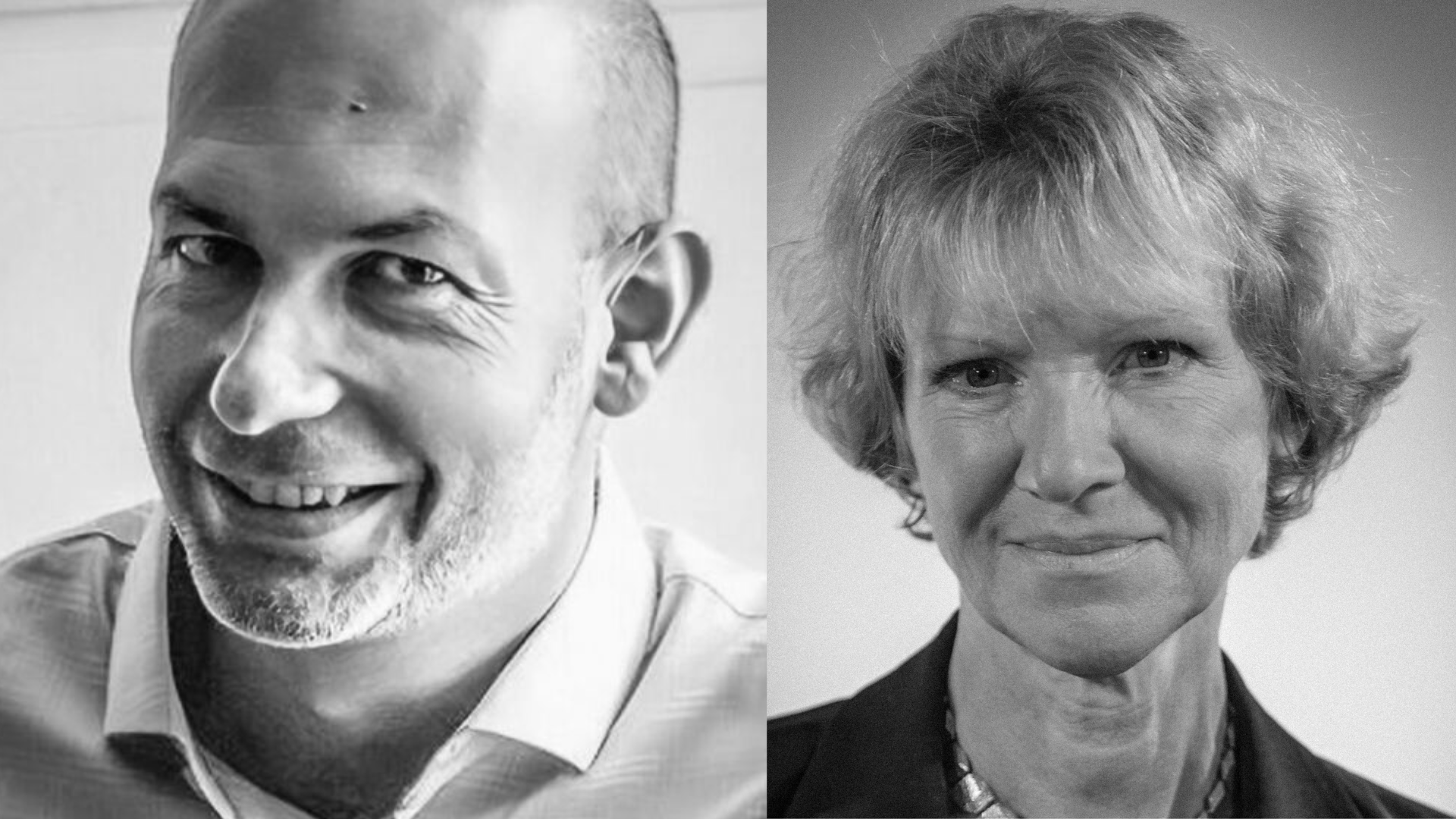
Catherine Vidal and Franck Ramus. Photo: DR
In 2014, France was the scene of a scientific controversy involving two renowned researchers: Catherine Vidal and Franck Ramus. At the heart of the debate: the differences between male and female brains. A decade later, what remains?
Act 1. Catherine Vidal and brain plasticity
In 2011, neurobiologist Catherine Vidal hit the nail on the head at a TED conference entitled «Does the brain have a sex?». She defended a radical thesis: men and women express no significant cognitive differences throughout their lives. Vidal immediately denounces the sexist excesses of 19th-century science.th century (notably by Paul Broca), then deconstructs, one by one, four tenacious prejudices:
- Women are thought to be less intelligent than men, their brains being 10 to 15% smaller.
- They are said to multitask thanks to a thicker corpus callosum.
- They have a better memory for words and greater verbal fluency.
- Differences in mental ability between the sexes are thought to be biologically based.
Vidal methodically refutes these four assertions, asserting that identity and behavioral differences between the sexes are constructed through socialization, i.e. the internalization of gender stereotypes inculcated from childhood. The brain's plasticity is extraordinarily flexible. She is thus fully in line with the socioconstructivist paradigm.
Act 2. Franck Ramus: a synthesis of plasticity and predisposition
Three years later, neuroscientist Franck Ramus took part in a TED conference on the same theme, responding to Vidal's theses. While he shares Vidal's criticism of 19th-century sexist prejudicesth, He takes a more nuanced stance, relying on experimental data that Vidal overlooks:
- Stereotypes influence thinking and behavior, but their scope remains limited and measurable. They are not enough to explain all the differences observed between the sexes, such as the worldwide over-representation of men in prison (between 85% and 98% versus 2% to 15% for women, depending on the country).
- General intelligence is equivalent between the sexes, but differences appear for certain specific skills: men are on average more successful at tasks involving the mental rotation of 3D objects, while women generally achieve better results in verbal memory.
- Slight differences are perceptible from birth, before any socialization: on average, boys show more interest in objects, girls in faces.
In addition to the research he and his team have carried out, Ramus draws on a solid body of international literature confirming the existence of micro-differences between the sexes.
Act 3. Locked in a monologue
Ramus invites Vidal to a public debate, but to no avail. Each remained locked in his own monologue. Vidal continued to spread his constructivist theses at conferences, while Ramus published an ironic article with Nicolas Gauvrit entitled «La méthode Vidal», denouncing his refusal to consider contradictory studies.
In 2016, Franck Ramus co-signed an article with eight other researchers in Le Monde entitled «En sciences, les différences hommes-femmes méritent mieux que des caricatures» («In science, gender differences deserve better than caricatures»). This intervention denounces the rejection of the international scientific literature on the subject of cognitive micro-differences between the sexes, targeting in particular Catherine Vidal and the proponents of the "myth of indifferentiation".
In the media and among university humanities faculties, Vidal has clearly won the day. In neuroscience laboratories and journals, on the other hand, the scientific community is leaning towards Ramus' position.
Three paradigms in debate, not two
In France, the debate on gender differences unfortunately boils down to a simplistic face-off: innate versus acquired. On the one hand, the human sciences and progressive sensibilities are massively aligned with the Vidalian position. Cognitive differences between the sexes are said to be purely acquired. On the other hand, the hard sciences and more conservative sensibilities tend to identify with the Ramusian camp. These differences are partly due to innate.
This scientific divide, correlated with an ideological divide, locks everyone into their own camp. Yet this opposition masks an essential aspect. In reality, there are not two, but three distinct paradigms:
- Visit constructivist paradigm (Vidal) postulates that behaviors and cognitive capacities are acquired, with the innate playing no role other than sexual reproduction - a perspective widely adopted by the gender studies.
- Visit interactionist paradigm (Ramus) considers that nature and nurture interact in a complex way - an approach now dominant in neuroscience. This vision recognizes that genes and environment combine to modulate brain plasticity and epigenetic mechanisms.
- Visit innate paradigm, now in the minority, maintains that the main cognitive differences are determined from birth.
Viewed from this tripartite angle, the positions of Ramus and Vidal appear in a new light: moderate for Ramus and relatively radical for Vidal.
Vidal: an ideologically appealing but scientifically fragile conclusion
In his impassioned defense of brain plasticity, Vidal makes two major errors that weaken the scientific significance of his theses.
On the one hand, it presents its positions as definitive and consensual, without taking into account the research and debates taking place in the scientific community. Prisoners of a strong confirmation bias, she selects the rare studies that support her convictions, while neglecting the bulk of scientific research, particularly Anglo-Saxon.
On the other hand, it tends to blur the boundary between facts and value judgments, confusing inequality with injustice and sliding insensitively from a descriptive analysis to a normative stance. For fear of being accused of sexism or conservatism, it adopts a principled egalitarianism, without respecting the essential distinctions between science, morality and politics.
Ramus: a more balanced and scientific path
In contrast, Ramus takes a more nuanced and rigorous approach. He points out that hundreds of recent studies confirm the existence of morphological, functional and developmental micro-differences between male and female brains.
He also stresses the need to always distinguish between different types of judgment: descriptive (what is), normative (what is right or wrong) and prescriptive (what should be done). Thus, the existence of inequalities de facto «does not legitimize (possible) inequalities in right». As David Hume put it in the 18th centuryth century, only «from what is, one cannot derive what must be».».
A Franco-French intellectual blockage
Why is France so reluctant to embrace a debate on nature versus nurture? A number of deep-rooted cultural heritages may provide the explanation:
- Cartesian dualism, which separates body and soul.
- Egalitarianism developed from the Revolution onwards, This can lead to confusion between de jure equality and de facto equality.
- Existentialism (Marcel, Sartre, Beauvoir), which places individual freedom above all biological determination and thus defends the «blank page» paradigm.
- Neo-Marxism,which transposes the dominant-dominated schema to that of man-woman.
These four legacies continue to weigh heavily on the reception of advances in biology, holding back research and debate in France. In contrast, the Anglo-Saxon world, faithful to its empirical tradition, is more open to exploring the complex interactions between nature and culture.
These philosophical legacies are compounded by a linguistic bias: in French, the terms difference and inequality now tend to evoke injustice directly. Thus, acknowledging a difference often arouses embarrassment or guilt, as if the mere fact of stating it were tantamount to legitimizing it. Yet acknowledging that men commit suicide more often than women, or that they occupy positions of power more often, in no way implies that they are superior or inferior in value.
The influence of Vidal's ideas
Catherine Vidal's vision is now widely accepted in the French humanities, where her theses are often repeated without any real critical distance. Hundreds of French-language works on the question of gender are based directly on Vidal's positions, to the point of reproducing a pattern that has become repetitive:
1) The introduction opens with the assertion that «the social alone explains the social», relegating the notion of sex to the biological domain, deemed insignificant and useless, the better to consecrate the notion of gender as the sole category of analysis;
2) The first chapter summarizes Vidal's arguments in just a few pages, lending scientific credence to the whole and anticipating any possible objections;
3) Since brain plasticity is total and gender differences are merely the product of stereotypes, the following chapters roll out the red carpet for constructivism. It's all about tracking down «structural and systemic» stereotypes, always to the detriment of boys and men, then meticulously deconstructing them.
This intellectual framework nevertheless raises two major objections. Firstly, while the interactionist approach prevails in neuroscience circles, this perspective remains curiously absent from works dedicated to gender. Secondly, the notion of stereotype, used in this way, becomes unfalsifiable: any questioning of the dogma is immediately interpreted as further proof of the omnipresence of stereotypes, thus locking in the debate with a self-fulfilling prophecy: «I told you, stereotypes are everywhere!»
Let's hope that a fourth act will reopen this dialogue of the deaf and allow science to regain the upper hand over ideology.
Yan Greppin teaches geography and philosophy at the Lycée Denis-de-Rougemont, Neuchâtel.
You've just read an unpublished free-access analysis. Debates, analyses, cultural news: subscribe to support us and get access to all our content!

You'll also like





 French
  German
  English
Leave a comment