



David Brulhart: «Apart from the drawings, all the works have accidents».»
Neve is the eternal snow found at the top of our mountains. We imagine them to be beautiful and pristine, but in reality they are often grey, dirty and fragile. «Névé» is also the name of the group show curated by David Brülhart, a hyper-productive artist from Fribourg, and Elise Meyer, curator of the Musée de Charmey. Accompanied by artists Benoît Billiotte, Lorna Bornand, Cosey, Steve Fragnière: Sval'barde and Laure Gonthier, they invite us to question our ideal of the mountains and reality, all with a touch of poetry.
Amélie Wauthier: What was the starting point for this exhibition?
David Brulhart: Basically, it's a residency at the Spitzbergen, in 2016. I spent four weeks on a sailboat. The idea of these residencies was to document the poles before they disappeared, but to document them in a poetic way. I wondered how to add beauty to beauty and how to work on this theme without necessarily making a tourist brochure, to avoid making other people want to visit this territory. When you walk around, you always have this idea of a masterpiece in danger. I didn't want to do an artistic work of the first degree where I draw the icebergs on my easel, in front of the iceberg. I took two years to re-enchant my technique, to go beyond my etching - my medium of choice for the past ten years.
Can you tell us a bit more about your silver silkscreens, those famous tears?
This series was born before I left for Spitsbergen. I went with a biologist to photograph my tears in super-size. What interests me about working in the mountains is the relationship with scale. There's always this idea of having the very large in front of you, and on the maps it's small. I also wondered: what links us to the ocean - or in this case, the Barents Sea? For me, it's salt and water, and we're made of salt and water, like our tears. So this is a series about the tears we can shed over this disappearing land. I continued to work on salt with the helmet, with the chair, and also invited Benoit Billotte, who made this salt installation.
Why a helmet and a chair?
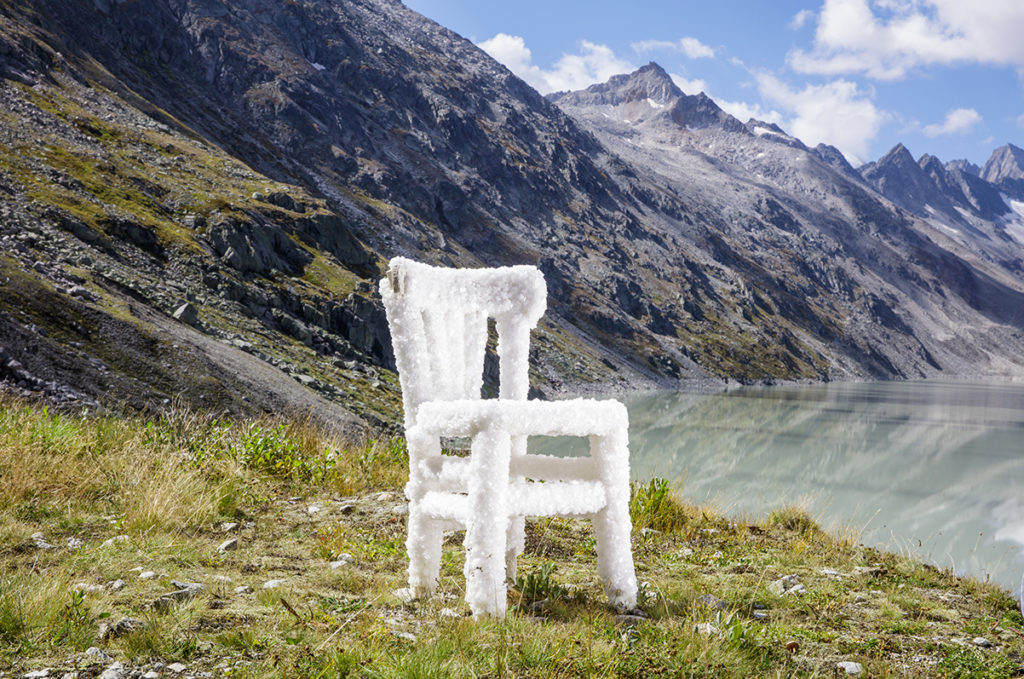
I had the idea for these two objects when I was in the Camargue. In the salt pans, large ropes covered with crystals crystals were coming out of the basin. It's very powerful, very strong, as if nature were nature was reclaiming its rights. I chose the chair model because in the the exhibition, there are several nods to Art History. The motif of the the chair has often been used by artists - Van Gogh's Van Gogh's chair, Ai Weiwei's chair... we also find the notion of comfort and the comfort and man's colonization of a territory. When you're a human being human being, you can't visit a territory without setting up a hut, planting a flag whether it's the moon, the North Pole or the jungle. We inevitably need to colonize. And at the same time, those salt crystals covering the chair give it a look that's not at all comfortable. Salt is an everyday medium in our home, it's very commonplace, but at the same time it's very abrasive, very destructive. And so, again, the idea of protecting nature, but if you put on that helmet, your face gets bloody. your face bleeds. I really wanted to combine these notions of danger and comfort in an object. I wanted to mix in an object.
Your exhibition also includes transfers of drawings on silk...
Someone in the exhibition told me it was a very sad exhibition, about death. I don't think so at all. It's a reflection on grief. Melancholy isn't necessarily all negative. Indeed, when you're in such a territory, you feel that it's disappearing. These silk transfers are like shrouds. I transferred my drawings onto a silk fabric, like the Turin shroud. The mark, the ghost and disappearance are all themes that live with me. As you go along, the artwork tells you what to do. And I really wanted to work on the ghost of the iceberg. The drapes are reminiscent of the tarpaulins we put on the Rhône glaciers, thinking «let's put a tarpaulin on it, it won't melt». But no. There's something to be done first! It's illusory and a bit pathetic, this kind of ecological solution, which is just cosmetic.
The exhibition also extends beyond the Musée de Charmey. Was it your wish to have satellite locations?
When Elise Meyer, the curator of the Musée de Charmey, suggested this exhibition to me, I immediately said I wanted an exhibition that encompassed the Charmey landscape. It's a great setting for this exhibition. I really wanted there to be satellite locations that would allow people to see the landscape through their eyes. I also wanted other artists to participate, to engage in dialogue with my work. Lorna Bornand, for example, with her work on hair, is a bit like the spirit of the mountains, the Yeti, or the fairies, these masks from the Lötschental, all this mythology. I also asked for Jacques Cesa's latest poem to appear on the windows of the Cerniat school, for its spiritual dimension. Benoit Billotte works on the cosmos and the notion of scale. Laure Gonthier also went to Spitzbergen, a year after me. Her ceramics take up this idea of territory where a trace is left. At the Cerniat school, I made mini-sculptures of icebergs that you can trample on, imitating the sound of snow. There's this thing about breaking to find out. Like the porcelain library, it's also about fragility and knowledge in a single object. For me, books are essential. It's an object of knowledge. And to know, scientists have to break a little. I was looking for an object that could bring together these notions of knowledge and fragility.
And these books are broken. Is that on purpose?
Porcelain as a medium as a medium. The first ones I did were all rotten, as if they were melting. like they were melting. I attach a lot of importance to the disguise of the material. It's an iceberg but it's on silk, it's draped but it looks like it's melting. like it's melting. There's always a kind of dialogue between the material and the object. the object. I found it interesting that the book melts, that it breaks. As a result, I kept all the proofs that hadn't come out properly. It adds a tension to the work.
It's like in engraving, where, generally speaking, it's the accidents that make the engraving unique?
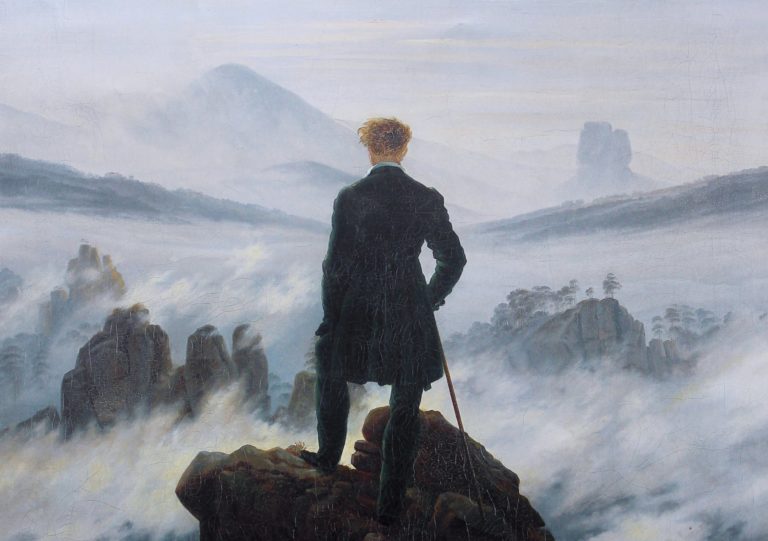
Apart from the drawings, all the works have accidents. You never know what you'll end up with. What really interests me about this theme is the notion of tipping over. You're in the mountains, skiing, like a mountain conqueror. Suddenly, the fog rolls in, it's whiteout day and everything becomes threatening. You're walking through the forest, it's all beautiful, and then night comes and you're lost. I love these situations where human beings are brought back to their humility. When you see a whale in Spitsbergen, for example, you're there on that tiny boat, and thank you for sharing your ocean with us. You sense the danger, you face up to your primordial fears, your survival instinct. I find this dialogue particularly beautiful, and it's something we're losing more and more in our ultra-connected, ultra-citadinous societies.
Write to the author: [email protected]
Photo credit: © David Brülhart / Musée de Charmey
-
 Le Regard Libre - N° 50CHF10.00
 -
 Standard subscription (Switzerland)CHF100.00 / year
 -
Support subscriptionCHF200.00 / year
You'll also like
 French
  German
  English
Leave a comment