




Rilke and Rodin, two geniuses
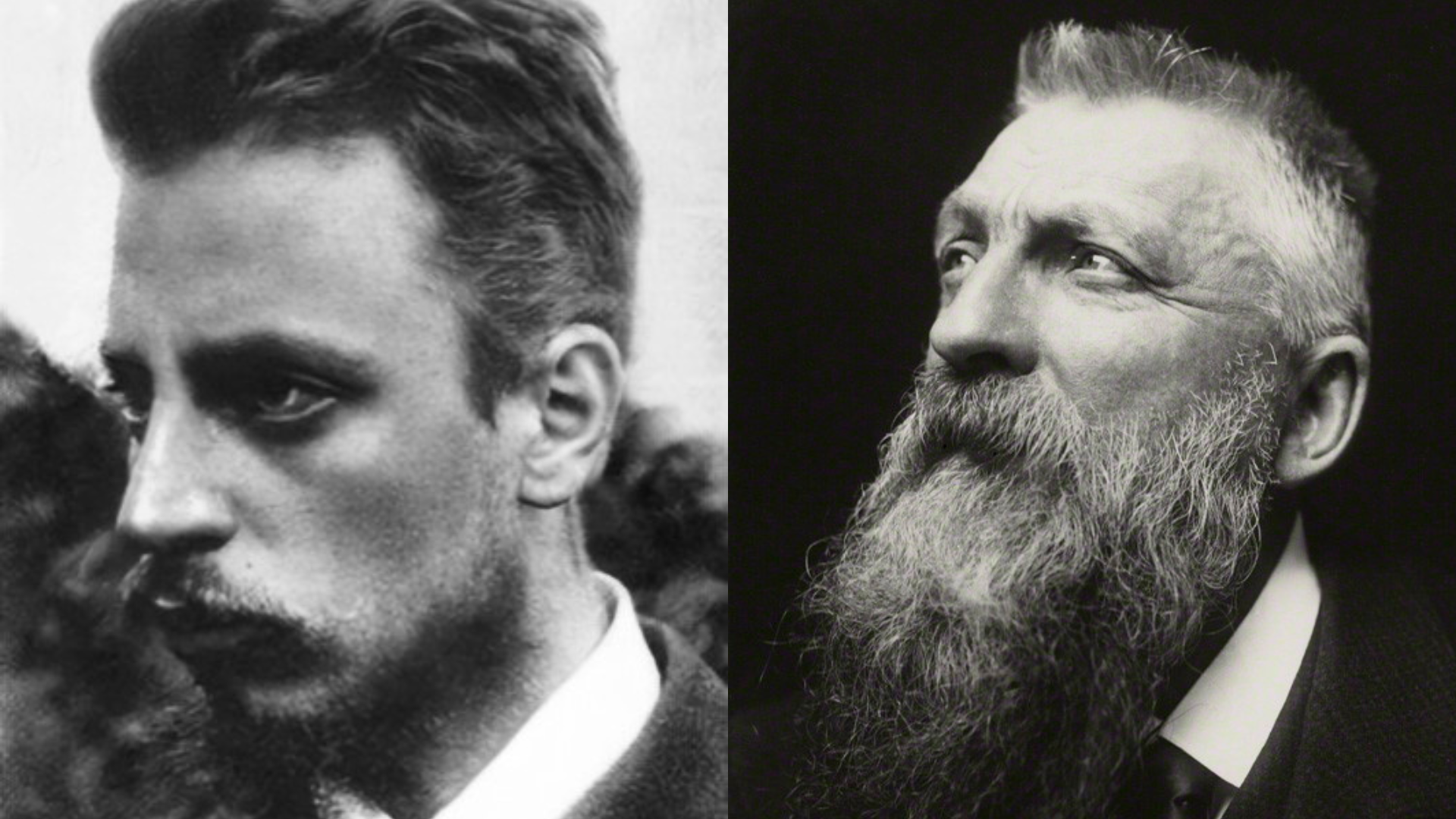
The poet Rilke and the sculptor Rodin. Photo: Wikimedia
A look back at poet Rainer Maria Rilke's decisive encounter with sculptor Auguste Rodin, as the Fondation Gianadda presents an exhibition devoted to these two major artists this summer, to mark the 100th anniversary of Rilke's death.
Rilke was 27 when he met Rodin (aged 62) in Paris; he was there to fulfill a commission from a German publisher for a monograph on the great sculptor. Rodin was well known, and his success in Europe and Germany was resounding. Rilke, who had been intending to become a writer for several years, was penniless; he already knew Rodin through his wife, who was herself a pupil of the sculptor; he wrote to him, unveiling his essay project in still clumsy French, and went to his home in Meudon. It was thus in September 1902 that these two representatives of artistic modernity met again. That year, Rilke painted the figure of the sculptor with unequalled finesse, composing a hymn to his work. Rilke, the poet of Angels, opened the door to Hell, and the two artists had a profound influence on each other.
Dans cet essai publié en langue allemande en 1903, le poète écrit: «L’artiste est celui à qui il revient, à partir de nombreuses choses, d’en faire une seule et, à partir de la moindre partie d’une seule chose, de faire un monde.» Si ce constat s’adresse à tout artiste, il s’adresse particulièrement à Rodin. On ne déambule pas longtemps au milieu de ses statues sans constater la manière dont les corps sont traités; il leur manque des bras, des têtes, des jambes, ou alors des mains sont isolées et semblent autonomes. En fait, il n’y manque rien de nécessaire, tant l’énergie et la vie de ce qu’on voit appellent ce qu’on devine. Car la force de Rodin est telle que le regard et la pensée du spectateur transpercent la face tumultueuse de la pierre ou du bronze pour scruter l’intérieur des corps, à telle enseigne qu’il n’a nul besoin de ces membres inexistants en surface. La rédemption provient du regard intérieur, de l’amplification de ces objets soudain devenus grands, et ce souffle, à partir d’une seule chose, comme l’écrit Rilke, refait un monde.
In Rodin's work, life emerges everywhere, in desire as in sorrow, with the impatience that awakens under the dowser's rod; life dances in bodies, between bodies too. The sculptor liberates it from matter, but it is thanks to this matter that liberation is possible, thanks to this substance and to the artist's genius. It is this body-to-body encounter that gives rise to beauty. Rilke speaks passionately of the work sessions he attended, and he understands Rodin's toil, but he also knows that the poet cannot write every day as the painter or sculptor does. There are long, arid, discouraging periods, and the writer must mount a constant assault against resistance. In Rodin's studio, however, he learned that ease is not enough for creation; it also requires hard work to bring out the essence of things and the meaning of life from the depths. Rilke had a great facility for writing: he wrote more poems in the first twenty-five years of his life than in the last twenty-five. And it was with Rodin that he understood how to combat this facility. In his work, then, there is a before and an after Rodin.
Rilke was to become the irascible statuary's private secretary, enabling him to reflect daily on the isolation of Rodin's statues from the surrounding world. It was an inhabited solitude, which he found again at Muzot (above Sierre) when he moved there in 1921. Rilke observes that Rodin does not work directly in front of the model, but essentially from the material he has stored in his memory. Shall we say that, in artistic matters, it's better to have seen than to have seen? Forgetting is a necessary condition for remembering. This is what Rilke wrote in Notebooks from Malta about poetry: «Verse is not made, as people think, with feelings (we get those all too soon) – it's made with lived experience. [...] And it's not enough to have memories. You have to be able to forget them, when there are a lot of them, and you have to be patient enough to let them come back. For memories are not yet enough. They must first merge with our blood, with our gaze, with our gesture; they must lose their names and no longer be discernible from ourselves.» The artistic material is not the preserved image, but the image brought back from oblivion by some mysterious process. The poet's unconscious, painful and uncontrolled return to the image does not take place in the happy mode he had imagined for Rodin: ugliness emerges, as do death and anguish, which come to claim their due, but which have to be sublimated by dint of hard work, often on the margins of joyful creation. This is undoubtedly his unpleasant experience of Paris. «Paris, this time, was exactly what I expected: difficult», he wrote to Lou Andreas-Salomé.
Rilke aura apporté à Auguste Rodin sa finesse d’observation, son élégance raffinée et sa plume pour défendre l’œuvre critiquée souvent, ainsi que des attaques contre Rodin lui-même qui jouissait pourtant d’une immense notoriété; par ses écrits laudatifs et son admiration, il écartait les bâtons dans les roues. Rodin dessinait et modelait. Comme d’autres sculpteurs, il confiait ensuite l’exécution sur marbre à des tiers qu’il dirigeait (Camille Claudel sculptait à sa place ainsi que bien d’autres assistants), car il estimait que l’art était avant tout une œuvre de l’esprit. Il réalise le plâtre que le praticien traduit dans le marbre, mais en se pliant à son style et à son caractère. Son atelier est en réalité une ruche avec plusieurs dizaines de praticiens qu’il dirige. Il produit abondamment et il répond à de multiples commandes des quatre coins du monde. Certains envieux l’ont violemment attaqué suggérant même qu’il était incapable de sculpter lui-même la pierre.
La correspondance, qui s’étend de 1902 à 1913 où s’entretissent deux voix, est révélatrice des caractères des deux hommes: la voix de Rilke, subtile, admirative et parfois obséquieuse, et c’est la voix du haut; celle de Rodin, plus rauque, concise, grave et c’est la voix du bas. Pour tous deux, c’est le plein vent de la création qui apporte l’espace.
A quarrel separated the two friends, then a reconciliation. Having reconciled, it was Rilke who brought the «Master» to the Hôtel de Biron in 1908, a superb building that would later become the Rodin Museum. Rilke's fascination with the visual arts owed much to his wife Clara. He met many painters, including Paul Klee. Later, at Muzot, he would pay close attention to Balthus and his budding talent. Rodin, for his part, gradually came to appreciate the importance of photography, whose artistic potential was not lost on him. It was not uncommon to see marble and photographs side by side in his major exhibitions. By the time of their deaths, in 1917 for Rodin and in 1926 for Rilke, post-war Europe had fully entered the reign of the image.
Il m’arrive, lorsque les ombres des deux créateurs s’allongent dans le soir, de songer au destin des deux femmes passionnées par l’art de sculpter: Clara Westhoff, l’épouse délaissée de Rilke, et Camille Claudel, la maîtresse volcanique de Rodin. Toutes deux voulaient mettre des ailes aux blocs de marbre, mais on trouvait inconvenant, à cette époque, qu’une femme travaillât à partir d’un modèle nu. Les deux hommes pensaient connaître les femmes, de fait ils en connurent de nombreuses, mais ils ne savaient rien du féminin. Et puis, la vie de famille ne convenait pas à un être aussi vagabond que Rilke, et Clara n’aura pas eu la reconnaissance qu’elle méritait en vertu du rôle important qu’elle a joué dans cette histoire. Elle fut l’éveilleuse auprès d’un mari peu versé au début dans le monde des arts plastiques. Clara Westhoff avait du talent. Quant à Camille Claudel, avec la force qui la caractérise, elle impressionna le Maître immédiatement. Une complicité artistique, une fusion des âmes, les unit et elle, surdouée, devint indispensable au travail en atelier. Rodin écrit: «Mademoiselle Claudel est devenue mon praticien le plus extraordinaire, je la consulte en toute chose.» C’est elle qui quitta Rodin après dix années de passion commune, elle voulait exister seule, mais la séparation troubla son esprit et elle ne parvint pas à trouver l’autonomie ; elle fut internée trente ans dans un asile psychiatrique. Camille Claudel avait du génie.
«Rodin selon Rilke», exposition à voir du 26 juin au 22 novembre 2026 à la Fondation Gianadda, à Martigny (VS).
Former President of Geneva's Grand Council, Jean Romain is a writer.
You've just read an unpublished free-access commentary. Debates, analyses, cultural news: subscribe to support us and access all our content.

You'll also like
 French
  German
  English
Leave a comment