




Poelvoorde in a totally absurd and brilliant «Au poste!
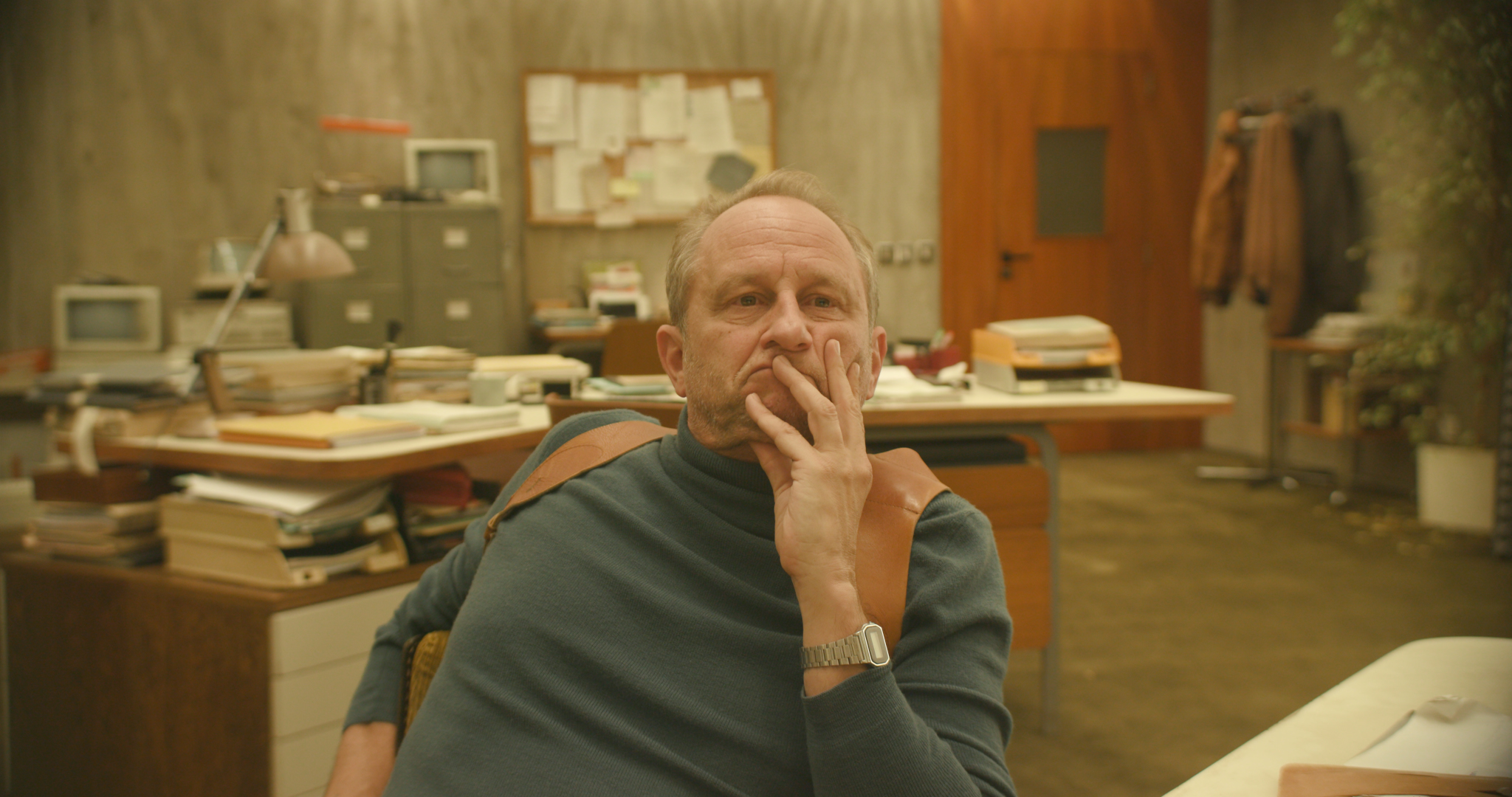
To the station!, Quentin Dupieux's new comedy is a huis clos in a police station, where viewers witness a tête-à-tête between a police officer, Fugain (Grégoire Ludig), and a superintendent, Buron (Benoît Poelvoorde). The former is innocent, but he's being interrogated because he called the police to report the presence of a corpse at the bottom of his building. As the first person to see the corpse, he's considered the prime suspect. That's why.
A comedy of the absurd
The opening scene sets the mood: an orchestra plays outside, conducted by a man in red briefs and a magnum moustache. This scene has no connection with the rest of the film, except that the conductor in question is identical to Fugain's character, and that the staging of this orchestra was only in Buron's imagination, as he listens to the piece in question - very beautiful, by the way - on the radio. This fictional mise en abyme sets the tone for the rest of the story, which we won't go into.
If the film is to be applauded, it is first and foremost for its unusual comic dimension. It takes a brave man to propose such humor to the public and the press, who are inevitably divided between fans of the absurd and those who don't subscribe to this kind of comedy. Despite this divide, I'm betting that everyone can be seduced, that this is a potential gateway to the world of the absurd for those whom playwright Eugène Ionesco failed to convince last century.
Read also | Ce qu’Eugène Ionesco nous dit aujourd’hui
Ionesco is everywhere in this work. In the dialogues, in the theatricality already present in the actors' acting style, but even more so than you might imagine, in the aged atmosphere or in the characters' isolation. In fact, in this film, we often see what one does through the other's writing, as evidenced by the oyster scene, which is sure to become a cult favorite. That's why we can speak of a situation à la Ionesco, since Ionesco's main aim in his theater was to show the incommunicability between individuals. There's no interaction, only solitary expression. Grandiose.
Photography and universality
This popular film, lasting just one hour and fourteen minutes, stands out not only for its comedic and intellectual power, but also for its meticulous photography, which serves the content well. The characters are illuminated - even though they're not lights - by a ceiling of light located in the room, bringing the guardhouse closer to an insane asylum. The whitish, yellowish and sepia-toned colors create a dated setting, a dimension that is even reflected in the film's poster.
Read also | The color yellow in the series Breaking Bad
The fact that the plot is set in an era a few decades distant - we don't know exactly how long - and in a singular atmosphere means that it speaks to everyone. It's through the particular that we reach universality. All administration, not just second-rate police, is ridiculed in To the station!, The furniture features typical Communist office chairs. As for the main character, he blends in with the spectator, totally baffled by the unrealism of this evening. His name testifies to this: Fugain is reminiscent of Michel Fugain, which refers to Michel, the French first name par excellence. Ionesco's Jean. Toi, moi. The redneck. The man.
Write to the author: [email protected]
Photo credit: © Praesens-Film

You'll also like

 French
  German
  English
1 comment
[...] Read also: Poelvoorde in a totally absurd and brilliant «Au poste!
Leave a comment