




Fifty shades of cross-border commuters: the canton of Ticino

Grenzkontrolle in Spluegen (Peter Klaunzer)
Le Regard Libre N° 31 - Nicolas Jutzet
Fifty shades of cross-border commuters (2/3)
While the issue is only vaguely on the agenda in the canton of Neuchâtel, it seems to be a permanent fixture in Ticino, where it occupies pride of place in the local media and in the mouths of local politicians.
Not content with having accepted the popular initiative of February 9, 2014 «Against mass immigration» by 68.2%, the canton recently distinguished itself once again following the acceptance by almost 60% of the «Ours First» initiative, which plans to «define the modalities for introducing articles requesting that, in the field of private or public employment, Swiss or foreign residents of the canton have priority over cross-border commuters. In addition, vacancies will have to be announced to the employment offices. Eventually, the phenomenon of wage dumping and unfair dismissals will have to come to an end». The public thus seems convinced that there is a problem in the labor market, and that the political world must take steps to remedy it. But what is the reality? Here's an overview.
Ticino in figures
Since the signing of the bilateral agreements in the early 2000s, there has been a marked increase in the number of people and jobs in Switzerland. Employment growth in Ticino has been strongly influenced by the tertiary sector. Unlike the rest of Switzerland, employment growth in Ticino has been influenced in particular by an influx of cross-border commuters.
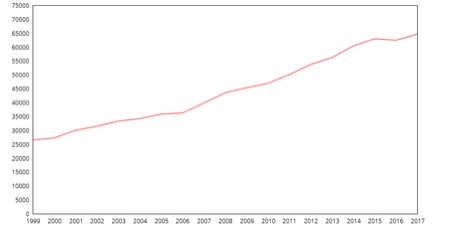
A breakdown by sector of activity shows that cross-border commuters are mainly active in the tertiary sector (approx. 40,000), followed by the secondary sector (approx. 24,000). Today, the proportion of cross-border workers (approx. 65,000) represents more than a quarter of the employed workforce. This percentage clearly shows that Ticino has the highest percentage of cross-border commuters in the country. This fact alone goes some way to explaining the negative perception that the local population has of this ’flow’ of cross-border commuters. This feeling, which is certainly not very rational, is further accentuated by the continuous evolution of the situation.
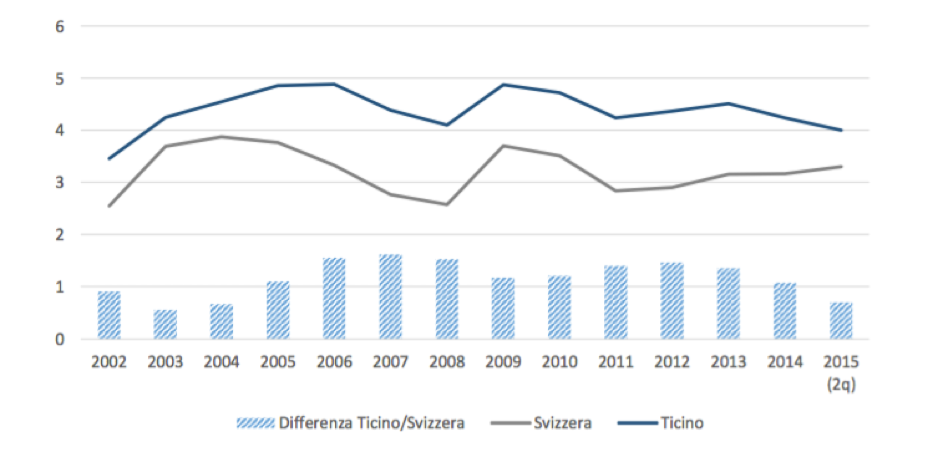
The graph below shows an evolution that follows the Swiss trend, even if the unemployment rate remains consistently above average. However, it is interesting to note that over the same period, the unemployment rate for locals has not soared. On the contrary, it is relatively stable. In fact, it would be somewhat hasty to link a massive influx of cross-border commuters with rising unemployment among locals.
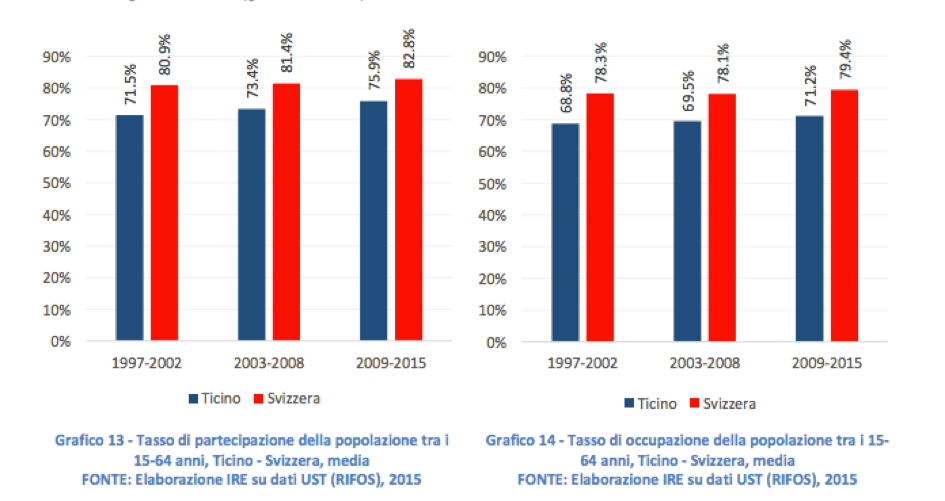
On the left, the participation rate of 15-64 year-olds, a measure of the ratio of working-age people to all people of working age. On the right, the occupancy rate of these working people. Subtracting the employment rate from the participation rate gives the unemployment rate. In general, therefore, the population of the canton of Ticino participates less in the labor market than the national average.
Pleasingly, however, this rate is narrowing. The absolute difference with the Swiss average has decreased slightly in recent years. This means that the canton's population is participating more and more in the job market (more applicants for open positions). And without unemployment rising. This already seems to call into question the idea that cross-border commuters are «stealing jobs».
It's more likely to be the usual Neuchâtel-style cake-sharing. A win-win situation. The creation of new jobs has therefore primarily benefited cross-border commuters, simply because skilled labor was not available locally, without prejudicing the fate of «our» people. Although it is always possible to find individual cases that contradict an overall dynamic.
Study sparks controversy
As in the first episode, where we reported on a study that analyzed the labor market in the canton of Neuchâtel, there is now a report that attempts to reveal the secrets of its Ticino counterpart. Unfortunately, it is far less ambitious, and focuses primarily on a possible substitution effect between local and cross-border labor. It therefore focuses on skills and the scarcity of the latter, without taking an in-depth look at the structure of wages, and thus possible wage dumping.
To say that the results of this study, the publication of which has been postponed several times, have triggered a tidal wave is an understatement, given how violent the shockwaves appear to have been. According to the authors of the study, the Institute for Economic Research (IRE) in Lugano, commissioned by the State Secretariat for Economic Affairs, it cannot be ruled out that local employees may be replaced by foreign workers from time to time, but there is no evidence of systematic substitution. In other words, the same result as in the canton of Neuchâtel. Discomfort. But all in all, this conclusion seems logical in view of the figures presented above.
The task now is to refine the research and determine the extent to which wage dumping exists, and what can be done to remedy the situation. It should be noted that the canton is already a good pupil in this respect: «already today, Ticino is the canton that carries out the highest number of checks among employers not subject to collective employment contracts: 24% in 2015, compared to a Swiss average of 5%».
In contrast to the canton of Neuchâtel, where the controversy has calmed down following the UDC's debacle, in Ticino the subject continues and will no doubt continue to occupy people's minds. A mixture of emotion and electoralism. On the other hand, a consensus is in place, with very little room for doubt, even though the figures seem to indicate that the situation is, after all, beneficial for the entire canton. The treatment given to the study in question is indicative of a climate that is hardly conducive to scientific truth.
Write to the author : nicolas.jutzet@leregardlibre.com
Photo credit: © AFD

You'll also like






 French
  German
  English
Leave a comment