



«Un divan à Tunis», a square circle?
Cinema Wednesdays - Jonas Follonier
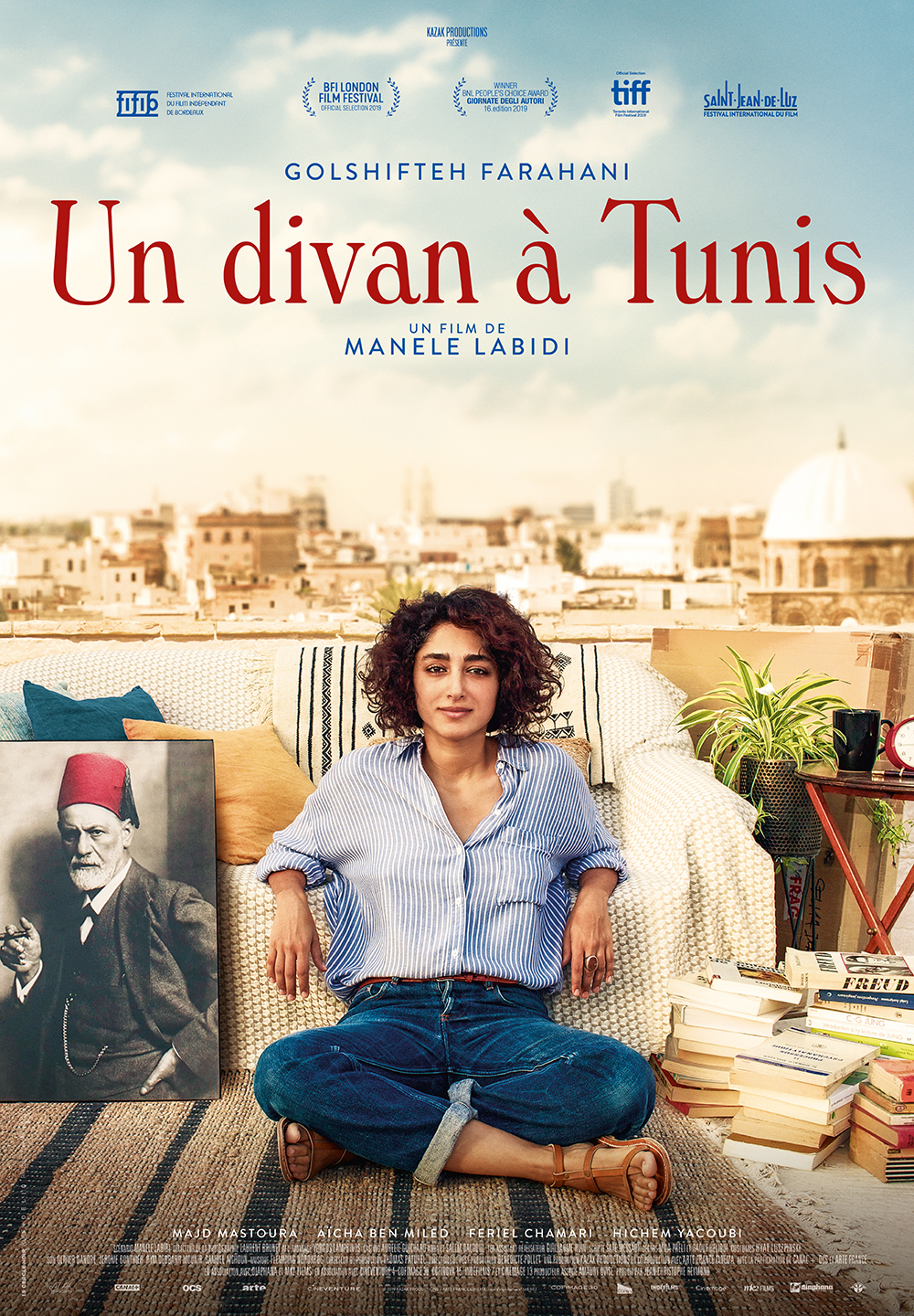
Selma (Golshifteh Farahani) is a Tunisian-born Parisian in her thirties. After switching her studies from medicine to psychoanalysis, she decides to return to Bled to open a practice. There, many people will want to talk. The schizophrenia of an entire people, torn between French and Arabic, between French and Arab, between Islam and pleasure, will serve as the backdrop to the entire film, like a (slightly too) spun metaphor. Like me, you'll no doubt come away from this film with the memory of a woman as moving as she is charming, with the memory of a stunning cinematographic style, but also with a few disappointments in terms of substance.

Form saves substance
First of all, to start right in the middle of things, the imam who doesn't like «bearded men» is a facile statement worthy of the most simplistic «no amalgam». It's as if the director, Manele Labidi, The psychoanalyst, who talks about the problematic aspects of Islam, showing the gap between its norms and the practices of Muslims, found it useful to show that «Islam can still be a religion of peace». Also, the psychoanalyst who quickly stumbles upon lunatics when no one but her would have believed it, is a bit thick. In short, it's the viewer who, in turn, no longer believes the story. Fortunately, the film is more to follow in its form than in its story.
And there's much to admire here. Quite simply, because the style is free and carries us along at several points in the film. I was particularly struck by a scene in which Selma breaks down on a long road in the Sahara desert with her complicated sister. They wait, and then a wealthy gentleman comes along, stops to look under the hood of the car to see if there's anything he can do, and seeing that it's no use, agrees to act as their cab. Electric guitar chords, a sun at the end of its run and the arid setting evoke for a moment the western genre. But why? Probably just because it's beautiful. And a little unreal. Sad, sublime sequences follow in the stranger's car, where Selma's sister seems to have disappeared.
Evocative objects
The shape of’A couch in Tunis also lies in the film's treatment of its objects. It was a good idea to center the film on a piece of furniture, in this case a sofa. The sofa is a direct reference to the shrink's office. But in cinema, everything is a symbol, everything is a type, not a particular. Or rather, the particular filmed becomes a type. Mind you, I'm talking about successful cinema. Go figure, maybe we can extend this reflection to art in general (I'm not afraid of generalizations, they help us think): after all, how can a work speak to us if it doesn't speak at least a little about us?
Read also | How to tell you Farewell?
Another gizmo is significant in this film: the Coke can, which in fact contains another liquid... The protagonist's neighbor uses it to drink on the sly, even - and above all - while driving. He drinks to drive, to go to work, to relax after work. He drinks to watch his wife and children. But alcoholism - even if it is an important social problem - is not the issue here: this Coke can filled with alcohol, this hideaway can, is a kind of tartufoA truffle as the embodiment of hypocrisy. A hypocrisy in which post-Independence North Africans have become entangled.
With these images, the film itself also has its rather dull side. In front of A couch in Tunis, We hope that the armchair you're sitting on isn't too comfortable, as you're liable to doze off. There are, however, those light, polished, artistic slumbers that take you away for an intoxicating moment and are not really serious: this is undoubtedly the dream into which actress Golshifteh Farahani is likely to take you. If possible with your eyes open, because it would be a shame not to follow the story of this Tunisian character; a simple story, but evocative; a simple character, but evocative.
Write to the author: [email protected]
Photo credit: © Praesens-Film

You'll also like

 French
  German
  English
Leave a comment