




How can I say goodbye?
Cinema Wednesdays - Loris S. Musumeci
«It's not cancer that kills, it's fear.»
How do you say goodbye to someone who's about to hit the road for a destination from which they'll never return? How do you say goodbye to a grandmother who has been diagnosed with terminal cancer, and yet believes herself to be in perfect health? Farewell (The Farewell) tells the story of an entire family's farewell to its matriache, between laughter and tears.
Billi was born in China, but has lived with her parents in the United States since childhood. Beautiful, free-spirited and rebellious, she doesn't share much with her father and mother, who are fully married. the american way of life since their immigration: they've become gentrified. She confides in Nai Nai, her grandmother. By telephone, of course, since Grandma lives in their native Changchun.
Lung cancer, stage four. «The doctors give him three months, or maybe less.» Shocking news for Billi and her parents. As is customary in China, Nai Nai is given results that have been faked by those closest to her, to prevent her dying of worry and sadness before the disease has even taken her. A family reunion is called for. To pronounce Farewell. The pretext is the wedding of Billi's cousin, who lives in Japan. From Japan and the United States, Nai Nai's sons travel with their respective families to leave it to their mother to organize a proper Chinese-style wedding for her grandson. With all the kitsch and tradition that goes with the occasion.
Made in China
Lulu Wang has made a complete film: through a particular case, her personal experience moreover, she tells universal facts. Love and the meaning of marriage, death and its «preparations». China, too, in all its nuances. Made in China equal kitsch, we agree. We also agree that the Middle Kingdom is the empire of traditions, ancestor worship and marriage codified to the millimeter. No need to be an expert in sino-je-ne-sais-quoi, You don't have to have written a thesis or lived there to know. Anyone who has seen the Disney cartoon Mulan know their stuff, up close and personal!
China is colossal mountain ranges and vast plateaus, megacities and rice paddies, icy and tropical climates, uniformity and diversity, social communism and economic liberalism, yuan and US dollars, Mao Tse-tung and Confucius, order and chaos. All these apparent opposites that make up the Chinese identity can be found in Farewell, through its shots, a lively family discussion and a day of preparation for the famous wedding.

A wedding in bling-bling
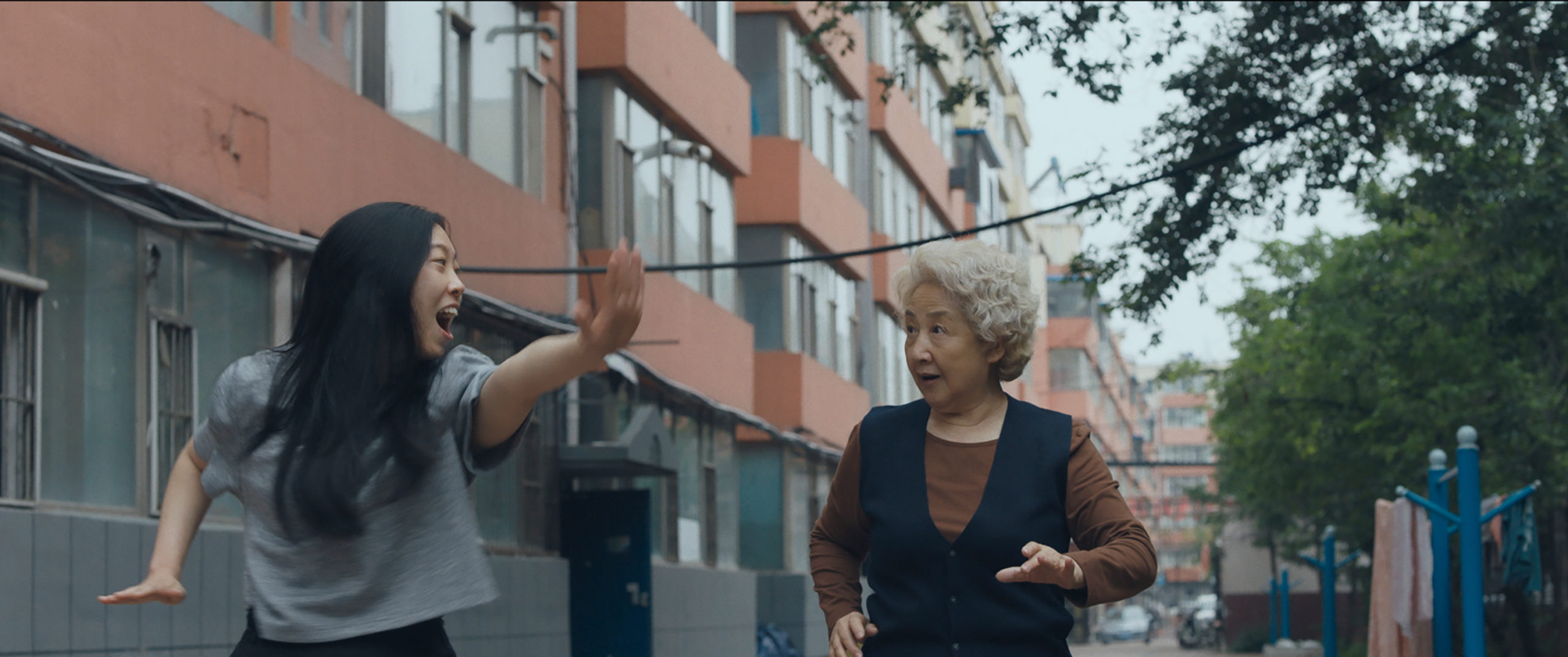
The scene in question is hilarious, and staged with real talent. As the bride and groom move from room to room in a specialized studio to have their so-called romantic photographs taken, Nai Nai and Billi, who accompany them, dissert on love, the meaning of the wedding feast, women and their independence, the destiny of a life. The dynamics of this scene are exceptional. The spectator is drawn in by the stealth of the grandmother who, despite her advanced age and illness, directs the young couple, who are decidedly ill at ease, stifled by the bling-bling, while joking and teaching her beloved granddaughter about life. The discussion between the two women is in the foreground, while the main subject of the scene is in the background.
Without overdoing it, the film's perspective, through that of a Billi who is actually discovering her native country, questions China's social question. On the one hand, two brief but powerful shots of prostitution in a hotel provide food for thought on the division between rich and poor, and on human nature in its desire for power and pleasure. On the other hand, the camera insists, during several scenes, on Changchun's urban landscape, staring at lines and lines of similar blocks. These shots fit in perfectly with Lulu Wang's aesthetic quest to use photography to speak about her subjects, above all through images.
Another important element of the photography is the side shots of the characters. They may go unnoticed, but their role is essential. They reveal the solitude needed for thought to take stock. Every decisive step taken by the characters appears in the form of a side shot. Indeed, when a camera films someone from the side, the viewer witnesses what he or she cannot see off-screen. They see what the person in question is thinking, looking away, lost, but determined to move forward. The film's cinematography is therefore highly mastered, if not too much so. The form, whose beauty is not in question, perhaps lacks discretion. One senses too much that the director is behind the viewfinder, imagining what she can express through the image.
A gastronomic experience
Still on the subject of form, the music accompanies the whole storyline with choral voices and violins. Melancholic, they create a balance between comedy and drama, serving as a counterweight to the burlesque side of the playful lines. Even if these melodies carry you along, you can't help but feel a slight excess that veers towards the tedious.
For once, two other senses cross the screen. Taste and smell. Food is very much present, from the most everyday dishes to the most festive tables, not forgetting alcohol and its joys. The food is filmed in such a way that you can really smell the strong, delicate aroma of Chinese cuisine, while the sweet-and-sour meats crisp up under your teeth. Farewell, It's also a gastronomic experience. This impression is undoubtedly due in part to my love of Asian cuisine. I felt the same appetite when I read’Winter in Sokcho a Elisa Shua Dusapin detailing the consistency and emanations of Korean cuisine.

Reach for the sky
In Farewell all the experiences and questions offer a pleasant moment to spend in theatres, learning, discovering, enjoying and being moved. Even if the film remains a little limited, dragging some scenes out unnecessarily and trying to draw tears sometimes clumsily, it allows the kind of explorations that constitute the value of the seventh art, in its rather light, accessible and entertaining form.
It's a journey that finally brings us back to the main question: how do you say goodbye to a loved one who's about to die? Above all, how do you te say goodbye? How can I, in each person's own, real existence, can he or she welcome a you, just as real? A painful question that reason cannot answer. It's up to the heart to speak up and reach for the sky, to surrender to that which is beyond us, so that the other can continue to see us. In the distance.
Write to the author: [email protected]
Photo credit: © Ascot Elite Entertainment
You'll also like





 French
  German
  English
Leave a comment