



Algeria's hirak and us: the end of innocence
The scandal caused by the France 5 documentary «Algérie, mon amour» has revealed a societal flaw in the popular opposition movement to the Algerian regime. Until now, progressive Europe has presented this unprecedented peaceful mobilization in an ideal light. It was mistaken. Things are both banal and complex.
What could have been a harmless moment - two individuals talking about sexuality - turned into a powerful revelation. A brief reminder of the facts: on Tuesday May 26, the France 5 television channel aired a documentary entitled «Algérie, mon amour», directed by the Franco-Algerian and journalist with the daily newspaper Le Monde Mustapha Kessous, in which five Algerian men and women under the age of thirty who took part in the hirak, the peaceful anti-regime uprising, give their rather negative impressions of their country. It's not the negative tone, as such, that will set social networks abuzz. Rather, it's the crude words spoken by a minority of the witnesses interviewed, all of whom are nonetheless deemed «unrepresentative» of this popular movement born on February 22, 2019 in opposition to a fifth term for the physically diminished President Abdelaziz Bouteflika, in power since 1999.
Puritanical indignation on the part of Hirakist twitters, followed by the Algerian government recalling its ambassador to Paris to join the chorus of patriotic disapproval of what is being described as French interference. But «back home» in Europe, particularly in French-speaking countries that care about Algerians, how does this digital vindictiveness for moral deviationism change our perception of protest, where unity is the watchword? This question is addressed primarily to print and broadcast media with the financial means to send reporters to Algeria, subject to the issuance of visas - a hassle that disappears when the special envoy has an Algerian passport.
Trauma
The only image we have of the Hirak is that of the people standing up to those in power, demanding their departure. A power described as «predatory» and made up of «clans». The people intend to take back the thread of the glorious history of independence, to trace it back to its source, which a «privileged caste» from the FLN, the former single party born of the war against France, now a political-military apparatus modelled on the Soviet model, has arrogated to itself. Such is the historical hook of this peaceful movement, which is determined to remain so. For its part, the regime does not abuse physical repression, limiting its public interventions for the time being to targeted arrests, notably of journalists.
This non-violence is probably partly due to tactical considerations, but probably even more so to the Hirakists« desire to represent the nation in all its dignity. There's an obvious pride in appearing irreproachable in their own eyes and in the eyes of the world, far from the image of immaturity sometimes attributed to »Arabs". The non-violence of this unprecedented mobilization, interrupted by the coronavirus, can also be explained - some would say above all else - by the trauma of the civil war of the 1990s. This trauma may have delayed the takeover of the streets, which had already occurred in neighbouring Tunisia at the end of 2010.
Blind
With the framework of the hirak's historical legitimacy more or less established, let's return to what the major French-language press, particularly the French press, most concerned with the Algerian popular uprising, understands and portrays. On the whole, it gives an idealistic, romantic, one-dimensional vision. Certainly, all the «components» of society are present, from Islamists to liberals, libertarian youth and soccer fans, but they are there, one for all and all for one, generations mixed, pulling at the same rope. As if no conflict stirred the belly of this immense monomony.
We should perhaps ask ourselves whether the persistence of the hirak, its continuation for more than a year, beyond the fall of Bouteflika in April 2019, after two months of revolt, is not partly due to the need to maintain the appearance of unity at all costs. Conversely, an endgame following the start of negotiations by one or other fringe of the hirak with the authorities would reveal the divergences. A residue of Third Worldism and the desire not to stigmatize blind us to what we see and read between the lines, even when we are several hundred kilometers away from the events.
So we create icons, holy images that are supposed to symbolize what's going on. These representations are carefully considered, if implicit, choices. From Algeria's civil war, we'll keep in mind the heart-rending photo of this grief-stricken woman, remembered as the «Madonna of Bentalha», named after the Mitidja locality that was the target of a horrific massacre in September 1997.
The ballerina of Algiers
From the peaceful uprising of Algeria, the antithesis of the black decade, we seem to have chosen a shot of a beautiful young woman, long smooth hair, pink slippers, black jeans and perfecto over a purple bodysuit, performing a dance step on a street in Algiers, with an Algerian flag in the background. After the Madonna of Bentalha, the ballerina of Algiers, after tragedy, rebirth.

Men? No men. Well, not here. It's that we choose, but never say so. A soccer fan wrapped in an Algerian flag? - Yeah, don't you think that's a bit redneck, a bit nationalistic? Even at Libé, This is something that the person in charge needs to think about when making his or her choice. Especially at Libé, a daily newspaper with a libertarian tradition. But Libé is neither racist nor neo-colonialist, nor is it anti-hirak - no media outlet has any reason to be. Nevertheless, there's a hirak he likes and a hirak he likes less. A photo will tell you which he prefers.
We quote from the newspaper Release, But it's our entire social-liberal, progressive press that thinks like this: the future of the Arab world is the young, free woman - not veiled, of course. We don't proclaim it, but we think it. In doing so, we're not necessarily doing the boys any favors: they're jealous of the attention girls get, and tend to close in on themselves, in their macho preoccupations. This can be seen in the French suburbs, with the encouragement of the Parti des Indigènes de la Républiques, the scapegoat of «individual freedom», that false emancipation proposed by the former colonist to blacks and Arabs - what whisky is to North American Indians in the albums of Lucky Luke...
The trick
Let's stay with the photo. To muddy the waters, to avoid being accused of neo-colonialist appropriation, we accompany the illustration finally chosen, that of the graceful dancer, with a commentary that makes Western readers feel guilty, incidentally putting them at fault. For example: «This image contrasts with the clichés one might have of these young people...». Of course... We're sufficiently educated to know that Algeria is sociologically diverse, that it's made up of tradition and modernity, as the saying goes. So much so that this comment rings hollow, as the writer knows.
He or she is not unaware that the balance of power, the tension, the struggle for emancipation, in this case, lies in Algeria, not in Europe. This habit of putting the blame on the ’Westerner« also applies in France, for example when referring to a work conceived by a descendant of North African or sub-Saharan immigrants living or having grown up in the suburbs. We'll say, we'll read: »Contrary to the clichés we may have about working-class neighborhoods...«, whereas the emancipation observed, particularly in the artistic field, is more often the result of distancing oneself from the traditional framework linked to one's country of origin, of a determination to go beyond the »qu'en dira-t-on« of one's buddies. It is also sometimes the result of overcoming an inferiority complex, a feeling of illegitimacy vis-à-vis the »French«, which the latter, clumsy or ill-intentioned, are not always quick to dispel.
In the Algeria of the hirak, it is in spite of the country's tradition and not in spite of the Western gaze, it is in rupture with the milieu and not to fight external clichés, that this ballerina with beautiful black hair performs this dance step, which «has gone around the world». When the photo, taken during a Hirakist demonstration, was published in March 2019, the scathing remarks came from Algeria and the Algerian diaspora in France and England. They concern the young woman's lack of «modesty», who «puts people to shame by wanting to do as Westerners do». But it was in Algeria itself, as well as in the diaspora, that she was supported by another section of Algerian youth, who identified with her, proud to see her «embody the Algerian woman of tomorrow».
Where is Walesa?
Today's outraged reactions to the documentary «Algérie, mon amour» highlight a societal fracture within the hirak. The issue of morality may be considered less essential and less of a priority than work, justice, health and democracy, but it cannot be dismissed or even suppressed. It is the source of tensions that we knew existed. These tensions came to the fore with the release of Mustapha Kessous's film, putting an end to the movement's innocence and our naivety.
This societal point acts as a moment of truth in what was perhaps becoming a live myth, that of unity achieved, forever having to overcome divisions that give rise to fears, among those over twenty years and two decades after the civil concord law validating amnesty, widely approved by referendum on the initiative of Bouteflika, then adulated as the providential man, of a resurgence of the dark years. But let's be optimistic, if we can be optimistic in Europe as the «unconcerned», to use the rather silly expression of neo-militancy. The pitfall of the hirak, however, would be to turn itself into a single party, a FLN bis, which rose up against this and which is preferred to the Polish Solidarnosc. It's up to Algerian society, with its Muslim tradition, just as Walesa's Poland was Catholic, to allow all its members to live free, fully. Perhaps a Walesa is missing.
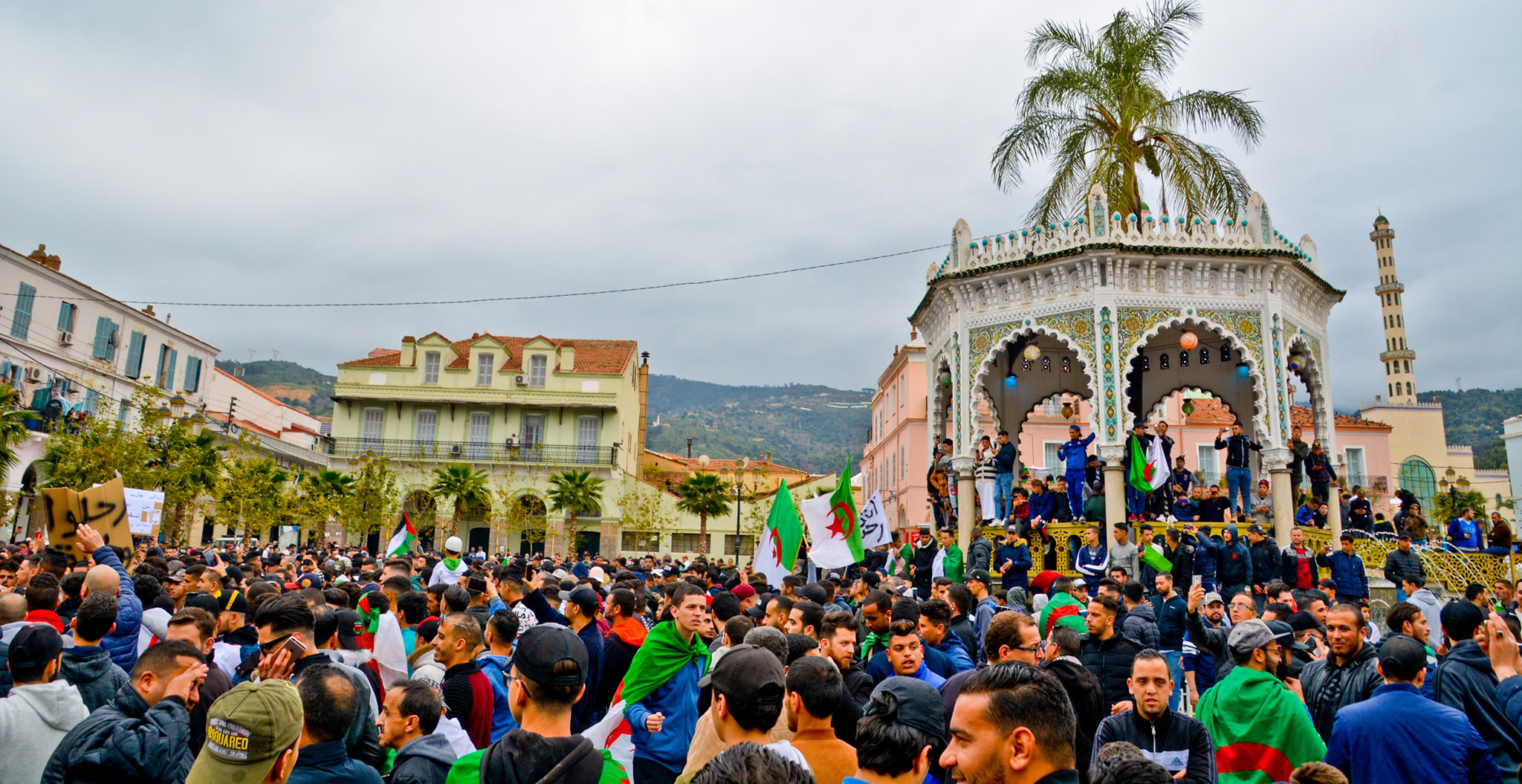
Header image: Protest against Abdelatif Bouteflika’s fifth term. Source: Wikimedia CC 4.0
Antoine Menusier is a journalist. Editor-in-chief of Bondy Blog from 2009 to 2011 and a former senior reporter at Time and L'Hebdo, he is the author of Livre des indésirés - A history of Arabs in France (Editions du Cerf, 2019). Today, he writes for the Swiss media outlet Watson and contributes to the French magazines Marianne and L'Express.

You'll also like


 French
  German
  English
 .jpg)
3 comments
https://bonpourlatete.com/analyses/algerie-mon-amour-haro-sur-le-docu Thanks for your comment. You're right, there's quite a lot implicit in this article, which is a step further than the recension of the facts of the departures related in the link above. Best regards.
Hello, thank you for your appreciation and you're right, there's quite a bit implicit in the article, which was a step further than recounting the facts of departures. Which appear here in this article https://bonpourlatete.com/analyses/algerie-mon-amour-haro-sur-le-docu
Very interesting article. But also very frustrating. The controversy that apparently followed the French TV report and the comments made by young Algerians about their sexuality is presented as revealing the lack of unity in the Hirakist movement. But in the end, for those who haven't read any of the young people's interviews and the ensuing controversy, we learn next to nothing.
What were these young people saying? What were they accused of, apparently vehemently? Where did these attacks come from? That's what I was hoping to find out. Unfortunately, I didn't find out, even if the article is superbly written.
Leave a comment