




«Shantaram», a philosophical epic in Indian lands

Tuesday books - Lauriane Pipoz
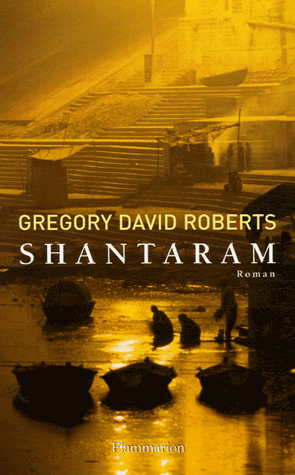
The first few pages of Shantaram will speak to you… Or not. This pseudo-autobiographical epic novel, published in 2003, is certainly full of character. It recounts the epic journey of Gregory David Roberts, a man sentenced to nineteen years in prison for a series of thefts after falling into heroin addiction. He flees to India. Blending travel, exile, and philosophy, the author describes Mumbai—its landscapes, its smells, its people—with magnificent prose. But there’s also the risk of getting lost amid too many adventures.
«It took me a long time—and nearly a trip around the world—to learn what I know about love and fate, and the choices we make, but the heart of it all was revealed to me in an instant, while I was chained to a wall and being tortured. I realized, in a way, amid the screams in my mind, that despite my vulnerability, my wounds, and my chains, I was free: free to hate the people who were torturing me, or to forgive them. It doesn’t seem like much, I know. But when the chain tightens and cuts into your flesh, when that’s all you have, that freedom is a whole universe of possibilities. And the choice you make between hate and forgiveness can become the story of your life.»
It’s hard to say what makes this book so addictive. Is it the storytelling? The descriptions of the landscapes? The pseudo-autobiographical nature of the story? Indeed, Gregory David Roberts escaped from an Australian prison and fled to Mumbai, where he lived for ten years. The descriptions of Indian landscapes and life in a slum undeniably feel like they’re drawn from personal experience. After being recaptured by the authorities and imprisoned once again, legend has it that he wrote his book in a German prison. We are said to be holding the second version, rewritten after the first was destroyed by prison guards. Even though the author has clearly described his work as fiction, the autobiographical aspect remains fascinating. What is reality, and what is invention?
Once this question has been addressed, the reader realizes that this is, above all, a philosophical tale. Each setting serves as a stepping stone that brings Lindsay Ford, the book’s protagonist, closer to redemption. He discovers friendship and love, hits rock bottom, resolves to do good, and sometimes repeats the same mistakes. Faced with the constant threat of being caught up by his past, the narrator seeks to escape in an attempt to find himself. His reflections punctuate the book and are surprisingly gut-wrenching. Probably because, more than anything else, they are profound enough for us to recognize their sincerity.
Perhaps the protagonist needed to travel around the world to learn the lessons he needed to learn. The reader might have done without certain adventures, which took him a little too far. The author of this article, for her part, found herself lost in the Afghan mountains while reading this book. But never mind. This epic is well worth reading, without reservation. Lose yourself in the reflections, in the landscapes, and above all, rest assured that you’ll be moved. As for Gregory David Roberts, he has written a sequel to Shantaram in 2017, The Shadow of the Mountain. Maybe this is a chance to get together?
Write to the author: [email protected]
Photo credit: © Lauriane Pipoz for Le Regard Libre
Translated by Pierre Guglielmina
Flammarion
871 pages
2007 (2003)
You'll also like






 French
  German
  English
Leave a comment