




Cancel the debt to break free from the markets
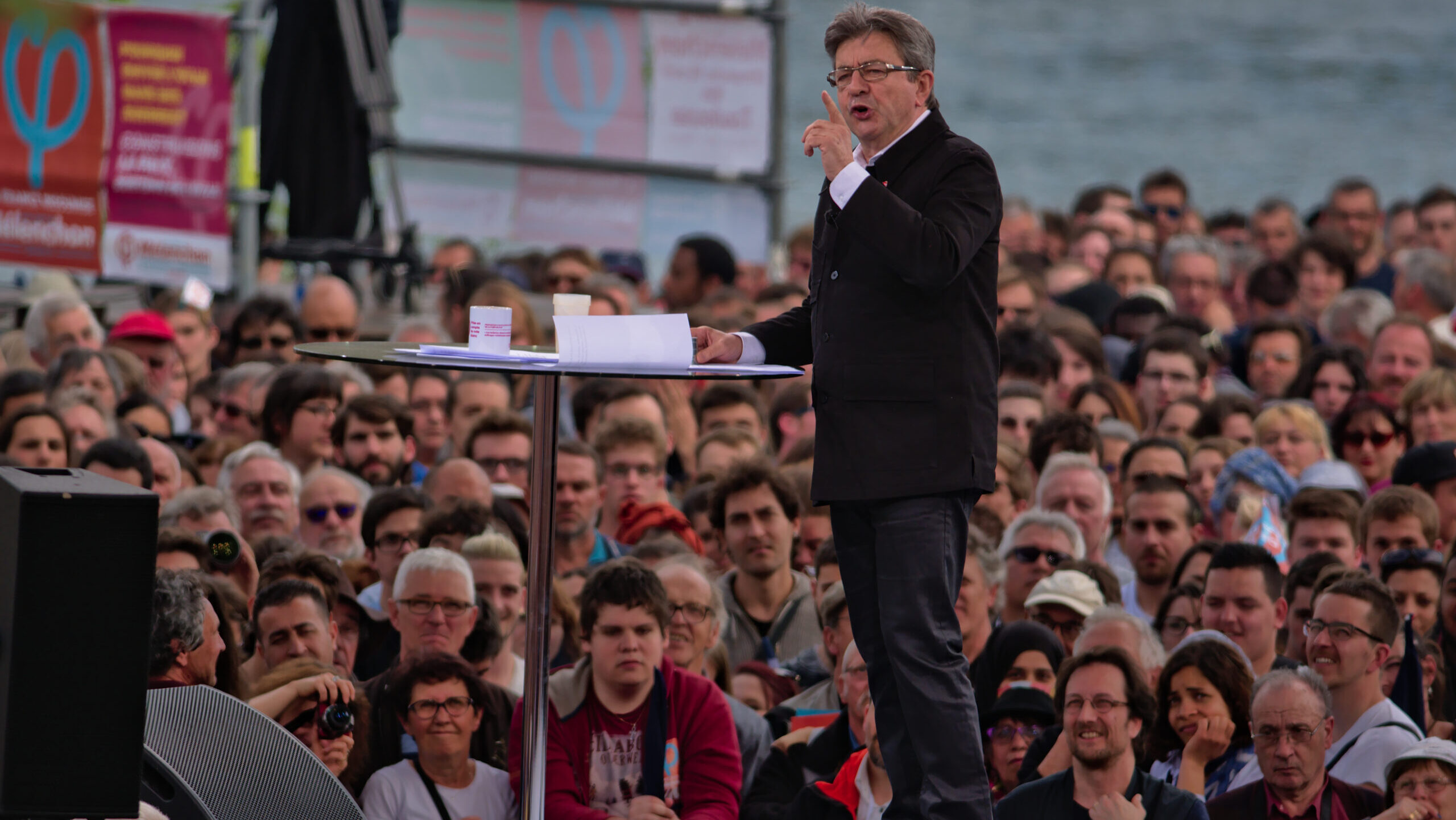
Jean-Luc Mélenchon's political rally at the Prairie des Filtres in Toulouse on April 16, 2017. Photo: MathieuMD (via Wikimedia Commons, under CC BY-SA 4.0)
Contrary to the liberal ideas of the Regard Libre, Alexandre Darbellay calls for serious consideration of writing off part of France’s debt. This proposal by Jean-Luc Mélenchon raises profound questions about government financing.
As the new political season begins in France, public debt is the talk of the town. However, while most presidential candidates are promising greater fiscal discipline, Jean-Luc Mélenchon is taking a different approach to the problem and proposing the outright cancellation of part of the debt.
However, the leader of La France insoumise is not targeting debt securities held by households or investment funds. He is focusing exclusively on the debt that the European Central Bank (ECB) has accumulated through various programs aimed at stimulating inflation.
A debt the government owes to itself
After purchasing these debt securities on the financial markets, the ECB transferred them to the balance sheets of the central banks of each member country in order to limit the pooling of risks. As a result, this portion of France’s debt now appears on the balance sheet of the Banque de France, of which the French government is the sole shareholder.
But what is the difference between repaying a debt one owes to oneself and simply canceling that same debt? The proposal by the “Insoumis” candidate therefore appears perfectly neutral from an accounting standpoint, although it raises questions about the credibility and independence of monetary policy. Its true radicalism thus lies less in its macroeconomic consequences than in its challenge to the institutional framework that currently governs the functioning of the eurozone.
The Challenge to the Markets
According to Jean-Luc Mélenchon, this cancellation would improve the perception of French public debt in the financial markets, reducing its level from 1,17% of GDP to approximately 98%. This reduction of some 600 billion euros could then lead to a drop in sovereign interest rates. This would be a welcome development since, in France, nearly one out of every two euros in income tax revenue is used to pay interest on the debt. It would also help stave off, at least temporarily, the prospect of an austerity policy that the presidential candidate considers particularly dangerous.
But beyond the short-term benefits he expects to gain from it, Jean-Luc Mélenchon’s proposal could, above all, lay the groundwork for a more far-reaching initiative: challenging the dependence of public funding on the markets.
Another Model for Government Funding
The current system for financing France’s public debt involves asking the financial markets to continually assess the credibility of the country’s economic program. Every week, France rolls over a portion of its debt on the markets, which determine the interest rate at which they are willing to lend to the country. But this has not always been the case.
Before the financialization of French public debt, during the Trente Glorieuses, the government relied on a system that was largely administered by the government and supplemented by advances from the Banque de France. This system enabled the government to finance major projects with full sovereignty, without being entirely dependent on private creditors.
If he were able to demonstrate that debt purchased and then canceled by the central bank results in only a very limited level of inflation, Jean-Luc Mélenchon could once again pave the way for a radically different approach to financing public spending, by restoring the monetary institution’s leading role. At a time when profitability requirements are struggling to align with environmental imperatives, such an approach deserves serious consideration.
Alexandre Darbellay is a high school economics and law teacher and co-founder of the Fribourg chapter of Rethinking Economics, an organization that promotes pluralism in economics.
You have just read content published in our print edition (Le Regard Libre No. 130)

You'll also like





 French
  German
  English
Leave a comment