



«Nocturne», an unusual prophecy
Saturday movie platforms - Eugène Praz
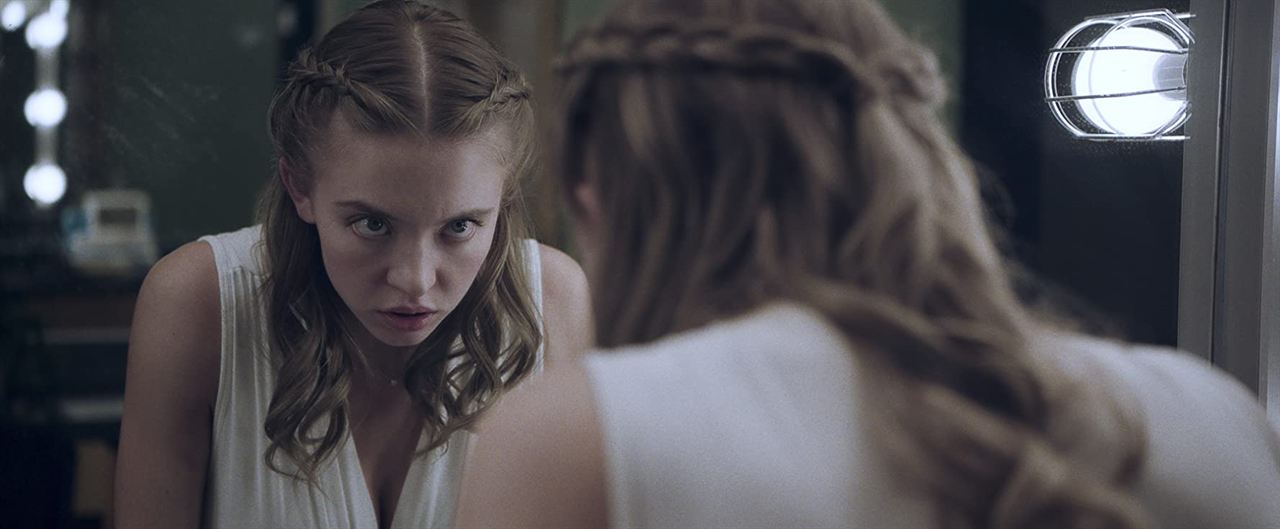
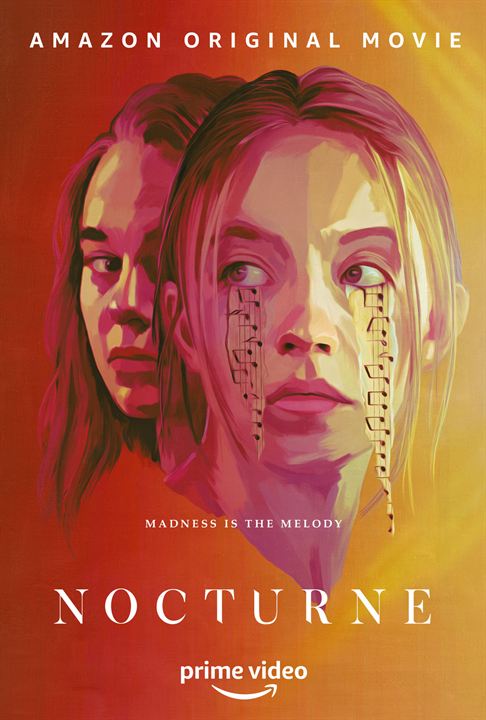
The American horror fantasy Nocturne (2020), written and directed by Zu Quirke and released by Amazon Studios, tells the dark and tragic story of twin sisters pianists studying at the same arts academy. One of them, a brilliant pianist, is admitted to Juilliard for the following year, but finds herself surpassed by her sister, who is wrongly considered less talented. The recent death of a violinist student will change the destiny of the fragile rising piano star, who has surpassed her sister, even in evil.
We're thinking of Black Swan Darren Aronofsky's Nocturne, While recognizing the superiority of the former, which is to dance what the latter is to piano: a horrific homage in which the main character gradually loses his mind, while perfecting his art. Nocturne, is the story of two sisterly enemies. In her fourth and final year at Lindberg Academy, Juliet Lowe (Sydney Sweeney) is blackly jealous of her sister Vivian (Madison Iseman), also a senior, because Vivian has a boyfriend and the best tutor in the academy. But the full extent of this jealousy is only revealed after promising violinist Moira commits suicide. The auditions for the end-of-year solo for the senior music students, the academy's most important event, resume. One day, someone collecting Moira's belongings from her locker drops a notebook of scores that belonged to the deceased, which Juliet recovers. Drawings reminiscent of a tarot deck and mysterious inscriptions cover some of the pages; Juliet discovers that they describe exactly what she is going through.
Vivian's grace, sensitivity and intimate mastery of Saint-Saëns' piano concerto n°2 are her strengths. Juliet was supposed to present a work by Mozart, but the crazy idea of presenting the same score as her sister at the audition never left her. Although Juliet has managed to become better than Vivian at Saint-Saëns, Vivian is nevertheless chosen, because Juliet is missing something, and she can't explain exactly what it is. The ruthless world of classical music is well represented in Nocturne, and the practices of Mr. Cask (Ivan Shaw) speak volumes about the condescending coldness of certain pedagogues in this milieu. The way Juliet's character is filmed during her audition shows us a young woman haunted by the extreme beauty of the music she performs, that of Camille Saint-Saëns, and her fingers lead her to a vision where Moira's world is revealed to her: she crosses the same corridor as at the beginning of the film where we witness the violinist's suicide on Giuseppe Tartini's sonata known as «The Devil's Trills». The vision finally leads us to the balcony of a theater - premonition? - where she sees herself at the end of a concert, acclaimed by an enlightened audience, and an inexplicable anxiety shows on her face. These scenes, in which we enter the night zones of the psyche, give meaning to the title, in addition to the musical form that John Field almost invented and that Chopin illustrated in an unsurpassable way.
Towards sacrifice
Juliet sleeps with the book of scores containing the strange drawings of Moira, who used to write in the specular style of Leonardo da Vinci. She has the impression that these pages are trying to deliver a message to her, that they are guiding her on her pianistic and existential quest. The film's staging contributes to this, with Juliet's point of view almost constantly in evidence, and the notebook could be seen as the main character instead of Juliet, as if it contained Moira Wilson's tormented soul.
At an underground student party similar to that of the Circle of Missing Poets, Juliet's rapid distancing and isolation from the group shows that she can't stand the hustle and bustle of a party for too long. Whether the reason is her memories mixed with anti-anxiety medication, or a message from beyond the grave sent by Moira, the enigmatic drawings left by the latter in her notebook are punctually shaded in shifting shades of red, yellow or brown, or covered with black zones, a strange modulation that colors Juliet's gaze. This effective procedure encourages us to understand that something, either in Juliet or in the notebook, is dissonant. The indecision about the reality or unreality of a paranormal connection between Moira and Juliet, which could be no more than a chilling coincidence, plunges us into the heart of the fantastic, as defined by Tzvetan Todorov.
Sometimes, during important events, a mysterious light appears to Juliet, as if to warn, guide or speak to her. Such is the case a few seconds before Vivian falls from a height that will prevent her from taking part in the final Lindberg Academy competition. When she is still unconscious, her position from above resembles that of one of Moira Wilson's drawings. This is undoubtedly the film's most impressive element: that strange, omnipresent sun, fascinating and terrible, remains the best aesthetic find in Nocturne.
Ambivalent music
After her sister's accident, Juliet, in a hallucinatory shot, runs towards the screen, in which her size does not vary, an effect achieved by a fairly simple procedure: the camera zooming in on her is placed at a great distance, and behind her rises the disquieting piece of yellow sun from her nightmares. In Nocturne, one is left to wonder whether Juliet's increasingly strange behavior stems from incipient madness, or from transcendent knowledge or knowledge from another time, as, for example, James Cole's character in The Army of the Twelve Monkeys by Terry Gilliam. The absence of a definitive explanation allows these hypotheses. Juliet will eventually replace her sister in Saint-Saëns.
Almost all the film's action takes place within the academy. But this unity of place is broken twice, first at the sisters' parents' home, and then before the final scenes, on their birthdays, in a restaurant and at the home of tutor Henry Cask. This is when the theme of the devil resurfaces. During the evening, he delights in recounting the legend associated with Giuseppe Tartini's violin sonata in G minor, in which the Italian composer is said to have dreamt of the devil playing him sublime music that inspired the violinist.
At Cask's, Juliet burns an old prize that was the tutor's pride and joy, and is noisily chased out of his house as a result, another event foretold in the mysterious notebook. However, the last drawing had been torn out, and it is Juliet who, under the dictation of a spiritual power, completes the prophecy by automatic writing, eyes closed. Panic-stricken by the image she had just traced, which a mirror enabled her to read from left to right in the legend traced in specular writing, she burned the large notebook in her bedroom sink. The end-of-year concert takes place the next day, but something unexpected happens just as Juliet is about to start playing. In fact, she may be the only one to witness this event, in the very music of Saint-Saëns... From now on, she will let the piano lead her destiny.
Write to the author: [email protected]
You'll also like

 French
  German
  English
Leave a comment