




Racism got «Get Out», feminism got «Blink Twic».»

Naomi Ackie stars as Frida in director Zoë Kravitz's BLINK TWICE, an Amazon MGM Studios film. Photo credit: Carlos Somonte 2024 Amazon Content Services LLC. All Rights Reserved.
Zoe Kravitz's directorial debut, a psychological thriller, is a scathing denunciation of the «toxic masculinity» of billionaires. It's reminiscent of Jordan Peele's first opus, which used the genre to tackle racism.
An idyllic, isolated setting. A protagonist swept off his feet. And very quickly, the oppressive impression that something is amiss. That beauty hides ugliness. This summary applies equally well to Zoe Kravitz's first film, Blink Twice, than Jordan Peele's, Get Out (2017). In the latter, the African-American protagonist meets his girlfriend's wealthy white family in their country-style villa. And beneath the apparent tolerance and warm welcome extended to him by his in-laws, the hideous reality gradually dawns: black people trafficking, as in the worst days of the slave trade. Released in the same year as the advent of Trump and the supremacist riots in Charlottesville, the film struck a chord in an America still struggling with its demons.
Zoe Kravitz's film is almost exactly the same, but she's attacking sexism; she's replaced the black character with a woman, the white supremacists with toxic men, while keeping the same theme: the power that seizes women's bodies.
And as Get Out conjured up the spectres of the past, Blink Twice conjures up those of violence against women: Harvey Weinstein, Jeffrey Epstein's island and its pedocriminal traffic.
What the camera doesn't show
Enthralled by the aura of a tech billionaire (Slater King, played by Channing Tatum), and by the world of the ultra-rich in general, waitress Frida (Naomi Ackie) manages to slip in among them at a party, donning a cocktail dress at the end of her shift. Slater offers to follow him and his friends to his private island, his so-called spiritual retreat. The guru's finery, the perfect gentleman's appearance, the rustic but chic voluptuousness of his hacienda, the floods of champagne and drugs, other beautiful girls who seem to trust him - everything is done to numb Frida's senses. But she eventually discovers what's behind the scenes.
If the film recalls Get Out without being a pale copy of it, it's because it stands out formally. The beginning of the film consists almost exclusively of very close-up shots of faces, leaving the background in a blur. The camera focuses on the expressions of Channing Tatum and Naomi Ackie, demonstrating its hold on them. The viewer is blind, cut off from the context. Sets and costumes obey a color code of contrasts: the characters wear white, the hacienda's walls are blood-red - an exuberance that contrasts with the more sombre Get Out.
By filming this faunistic bacchanal, Kravitz denounces the framework imposed on women, the need to be seen and desired by men, the superficiality of luxury, female competition...
A not-so-trivial ailment
While the film is undeniably successful, it's a safe bet that it won't have the same impact as Get Out. The scandals of the #MeToo era are long gone, in this society where one buzz chases another. What's more, it doesn't allow for any deeper introspection. Where Get Out confronted the white middle class with its inclusive pretences, Blink Twice portrays absolute (male) evil: Epstein and Weinstein, the abuse of power and the impunity of the rich. It's not the ordinary violence against women, the kind that can be instilled in every cottage, every couple, every bed, as psychiatrist Philippe Brenot wrote, that the film shows; Blink Twice, In the end, it puts the point at arm's length: anyone can unequivocally condemn Slater King, and no-one will recognize themselves in him.
Write to the author: [email protected]
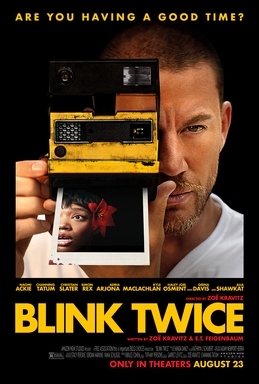
Zoé Kravitz
Blink Twice
With Naomi Ackie, Channing Tatum, Geena Davis, Christian Slater
August 2024
102 minutes
You'll also like






 French
  German
  English
Leave a comment